The Color TV-Game 6 was one of two systems with which Nintendo entered Japan’s home-console market in 1977. Rather than offering an expandable platform, it packed several Pong-inspired games into a single machine. Its historical interest lies both in that simplicity and in how Nintendo and Mitsubishi Electric turned integrated-circuit technology into a product for the living room.
A circuit and a commercial opportunity
The project grew out of a collaboration between Nintendo and Mitsubishi Electric. According to Infoconsolas, the bankruptcy of calculator company Systec left Mitsubishi with an LSI circuit developed to produce color images on a television. Nintendo engineer Masayuki Uemura proposed using the technology for a home console. Company president Hiroshi Yamauchi approved the idea with one condition: the price had to stay below 10,000 yen.
That requirement helps explain why Nintendo introduced two models at once. The Color TV-Game 6 cost 9,800 yen; the Color TV-Game 15, with more options and detachable controllers, sold for 15,000 yen. Infoconsolas interprets the cheaper model as a way to offer an attractive entry price and draw customers toward a range that also included a more fully featured version. That interpretation belongs to the source; on its own, it does not establish how individual customers responded or measure the strategy’s commercial effect.
Six options in a closed system
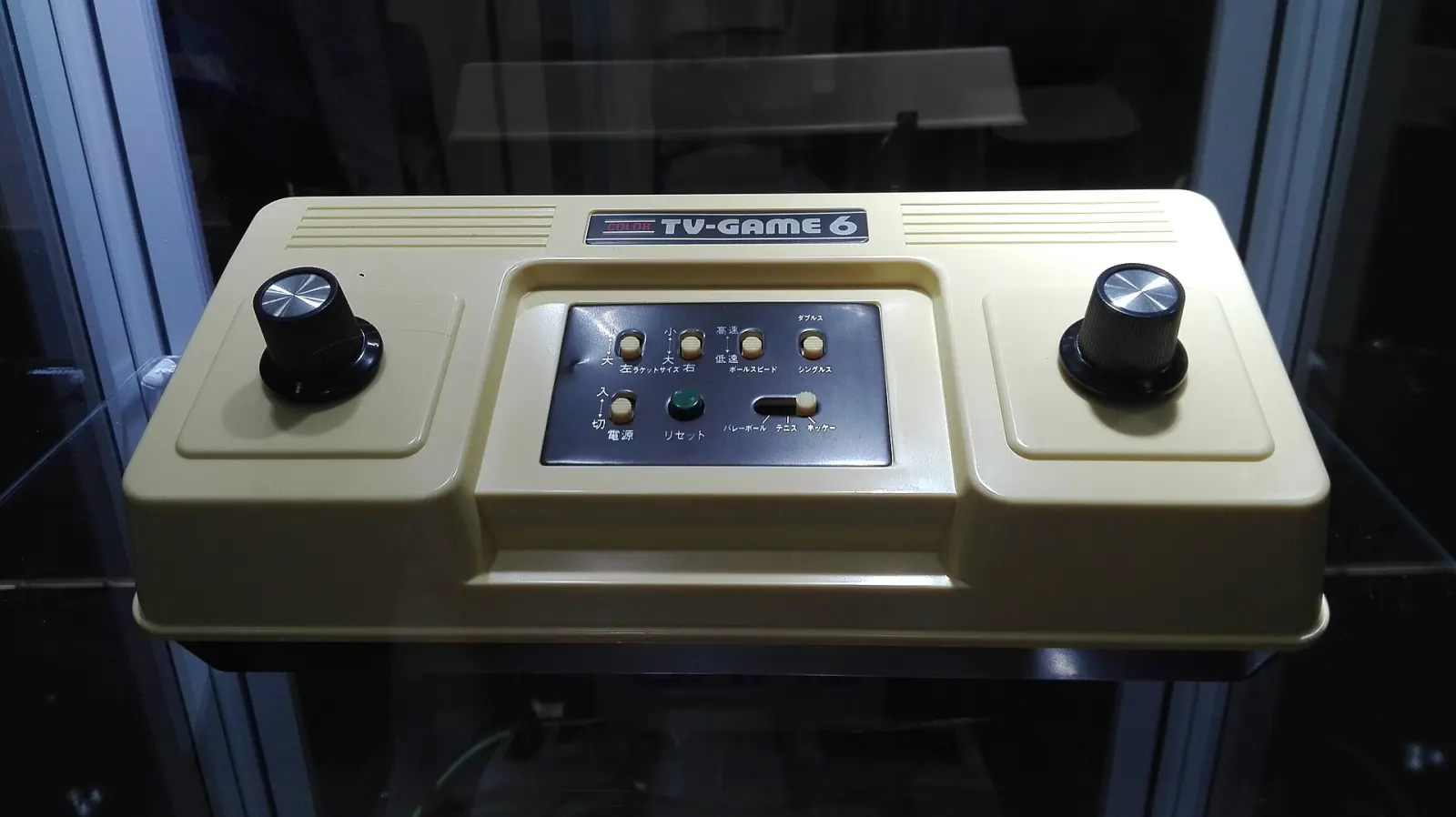
The Color TV-Game 6 offered tennis, hockey and volleyball variations for one or two players. Switches on the case let players adjust features such as paddle size and ball speed. There were no cartridges or expandable library: the games were part of the machine itself.
The controls were built into the design, too. Two dials on the console moved the paddles, unlike the separate, cable-connected units on the Color TV-Game 15. The result was a self-contained product: connect it to a television and its games were ready to play, without separate game controllers or a library to buy.
The phrase “six games” needs a little explanation. Infoconsolas describes three sports, each playable in singles or doubles, and says those combinations were marketed as six options. Adjusting ball speed and paddle size changed the play, but did not turn the console into a platform for adding distinct games.
One machine in a crowded market
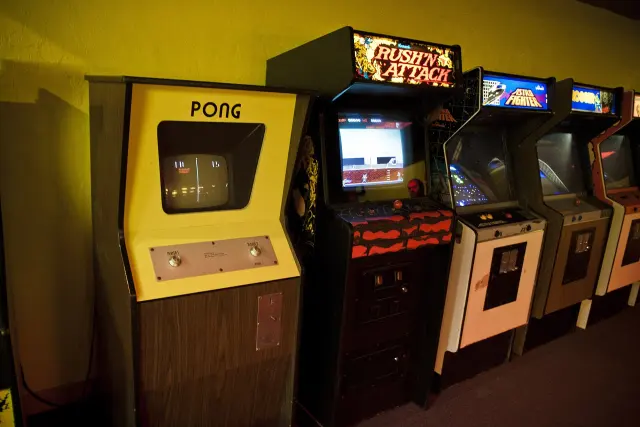
The Color TV-Game 6 arrived during a boom in dedicated Pong-style consoles. The 20th Century Video Games database lists numerous systems of this kind from 1977 and dates Nintendo’s model to that year. Its catalogue gives a sense of the market’s breadth, but does not, by itself, evaluate Nintendo’s sales, popularity or competitive position.
Infoconsolas estimates sales of 500,000 Color TV-Game 6 units and 900,000 Color TV-Game 15 units. These are figures attributed to that source, not verified accounting records. The same page links the development to Mitsubishi and describes manufacturing or distribution cooperation with Mitsubishi and Sharp on related products. Beyond those details, the console illustrates a specific product decision: pair a fixed selection of games with a lower entry price than its sibling model.
It is also important to distinguish the Color TV-Game 6’s chip from those used in other Pong consoles. The 20th Century Video Games database mentions the AY-3-8500 in various contemporary systems, but that reference does not confirm that Nintendo used the component in this machine. Infoconsolas identifies the Color TV-Game 6’s circuit as a Mitsubishi Electric LSI, initially developed in connection with Systec’s project.
Before the Famicom
The Color TV-Game 6 was not a miniature Famicom or a direct preview of every decision Nintendo would make later. Its importance is more specific: it placed the company in the home videogame market with a dedicated appliance, built-in games and integrated controls. Memoria del Juego includes it in its 1977 console timeline alongside other systems from that year. That entry establishes its place in the chronology, but does not prove direct technical influence on the Famicom.
The console represents a period when home videogames were sold as self-contained products, ready to connect to a television and play. Its fixed selection, controls built into the case and entry-level price explain its character better than a retrospective comparison with the cartridge consoles that followed. It was a limited, practical first step: Nintendo brought Pong into the home before building the platforms for which it would later become known.
- Decade
- 1970s
- Region
- Japan
- Level
- Enthusiast
- Entities
- Nintendo, Masayuki Uemura, Pong, Color TV-Game 15
Sources and references
- EL DERECHO COMERCIAL INTERNACIONAL:doi.org · 2026-11-01
- Color TV-Game 6 y Color TV-Game 15 | 100% RETROinfoconsolas.com · 2026-11-01
- Cronología - Memoria del juegogamedesignla.com · 2026-11-01
- Pongs:1103www.20thcenturyvideogames.com · 2026-11-01
- Programas Españoles de Radio/Podcast de Videojuegoswww.devuego.es · 2026-11-01