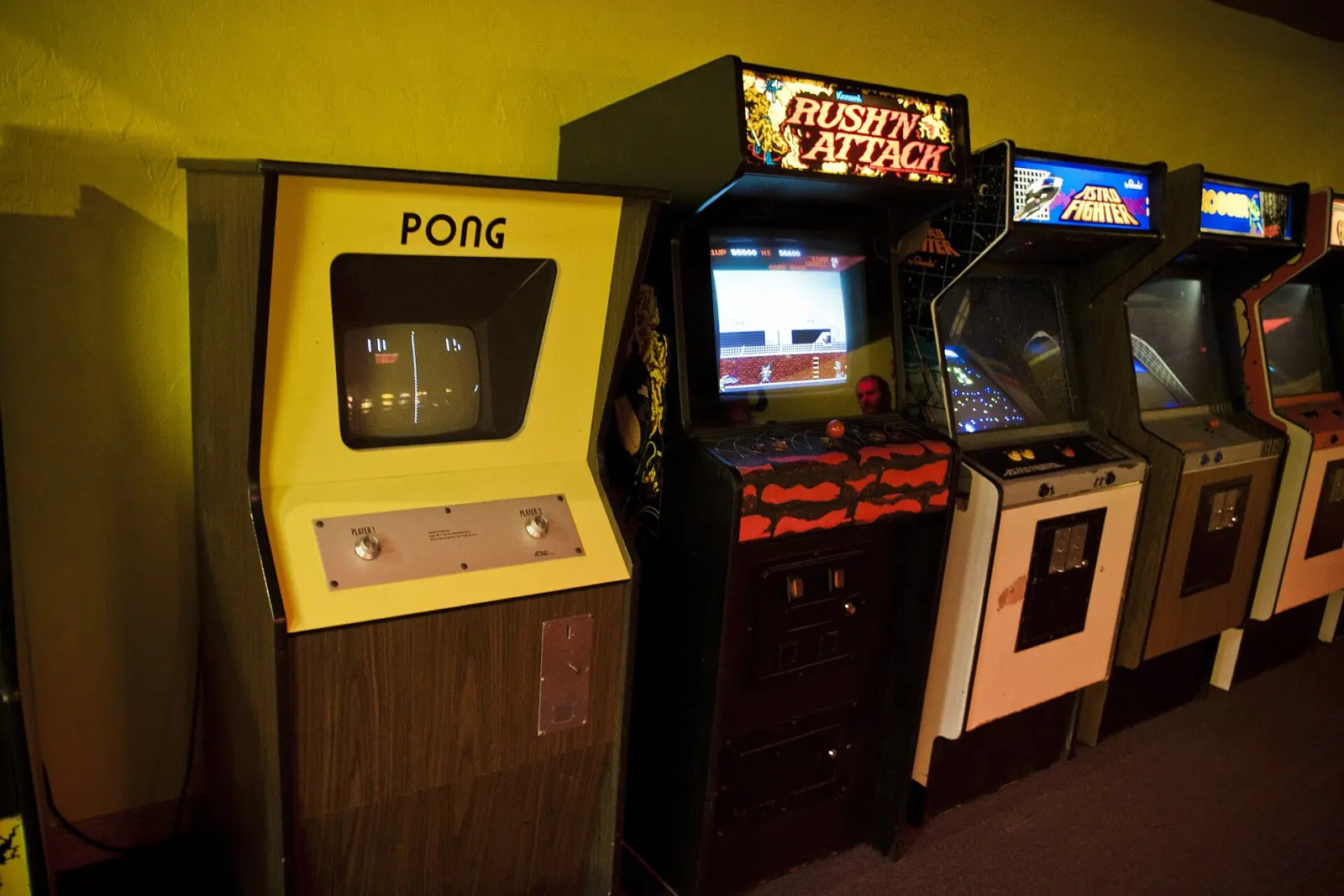
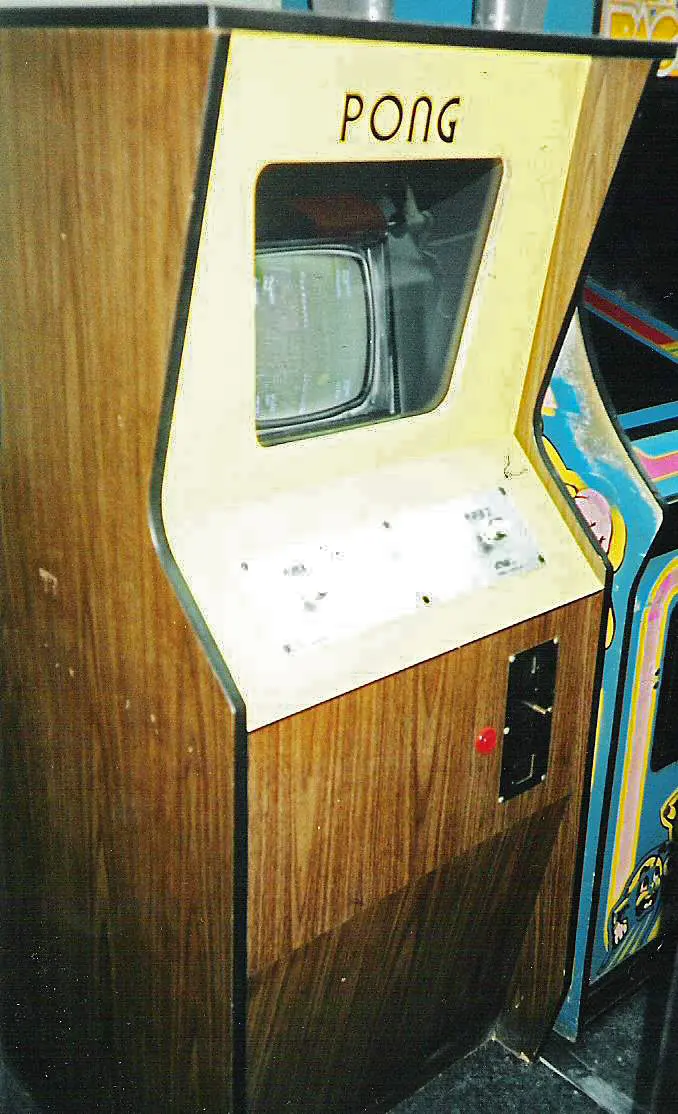
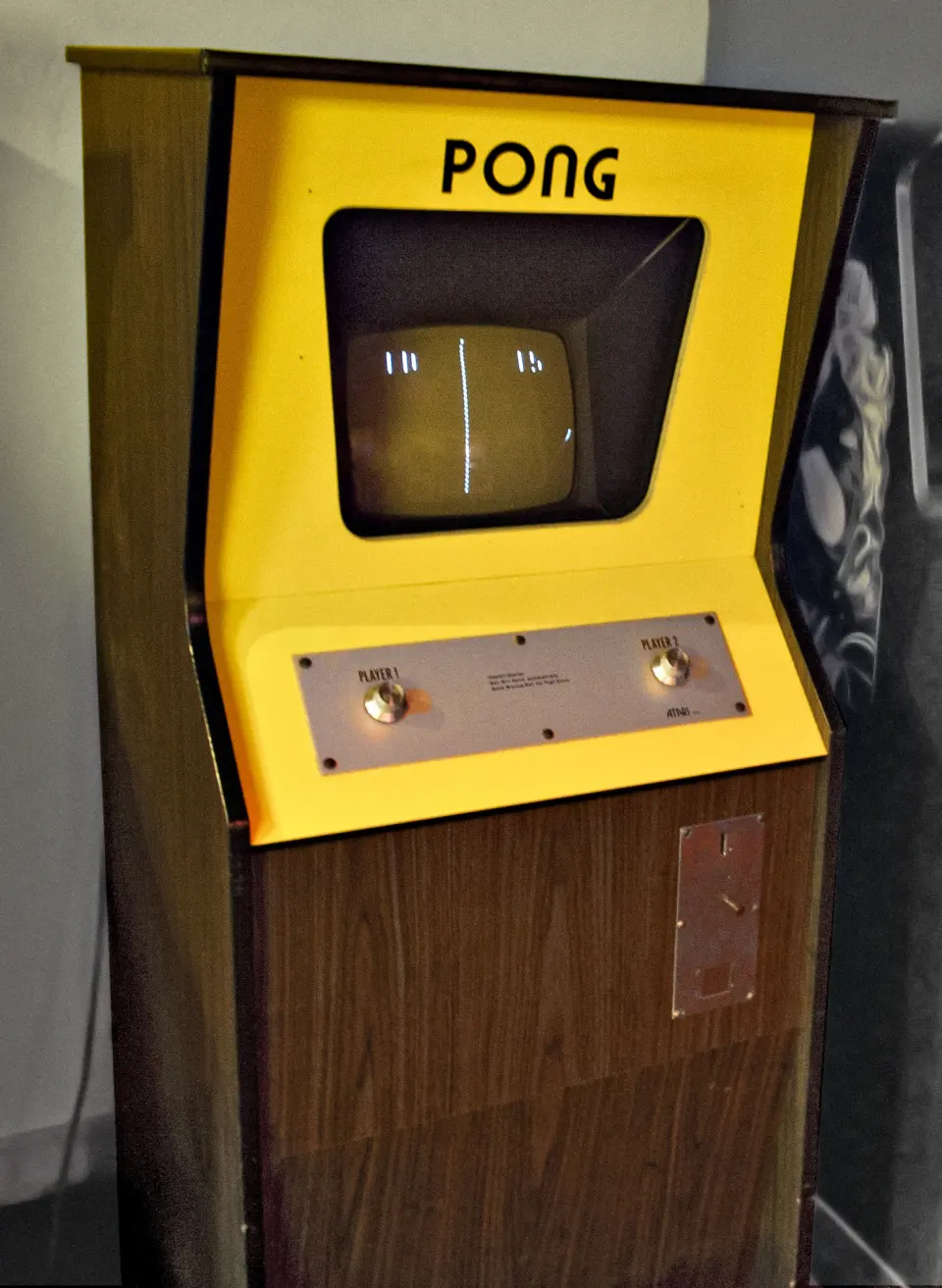
Pong fits into a very short description: two paddles, a ball and a screen. Yet its historical significance is not just a matter of how simple the game was. The sources consulted place it in two settings: as an arcade game and as a home experience. That shift offers a way to trace how video games began to circulate between public spaces and households, without making one release stand for the entire development of a complex industry.
Before the home console
Video games did not suddenly appear in family living rooms. Historical accounts place their precursors in earlier electronic and research projects associated with the growth of computers and the spread of television after the Second World War. The University of Seville’s exhibition outlines this development; Narratech also describes these factors as context and prehistory for video games.
That context matters because the idea of playing with a machine is not the same as a product being available to consumers. The early experiments mentioned by these sources do not automatically amount to a consumer industry. For this account, the useful question is not which was the first object that can be called a video game, but when and how particular games began reaching commercial and domestic spaces.
The arcade as a showcase
La Nación’s account identifies 1972 as the year video games made a leap into the consumer market with Atari’s Pong. It describes the game as a simple version of tennis for two players and says it was an immediate success. This is a journalistic account of its reception; the material available here does not allow us to measure its reach precisely or compare sales.
An arcade machine placed the game in a shared space: one person could play while others watched, waited or took turns. That describes a possibility offered by the format, not an identical experience in every venue. What the evidence supports is more limited: Pong became a reference point for arcade games, and other companies began exploring the market. Cultura Informática mentions the game alongside other titles associated with arcade machines, but its excerpt supplies neither figures nor a detailed chronology.
From cabinet to television
The most significant transition in this story was not a change in screen size, but the presentation of the game as something for the home. La Nación reports that Atari released Telegames Pong in 1975, a home console that allowed people to play Pong at home, and says the product was well received and attracted competitors. The source is not enough to reconstruct its price, distribution or differences among versions; those details cannot be verified from the evidence available here.
The home console moved the experience from an arcade cabinet to a device connected to a television. The game remained recognisable, but the place of play changed: playing no longer depended solely on finding a machine in a commercial venue. It is reasonable to interpret this move as a cultural change in everyday play, though without more documentation we cannot claim that it transformed every household in the same way.
Cartridges broaden the idea of a console
A machine dedicated to Pong and a console that accepts different games are not quite the same proposition. Cultura Informática credits Fairchild Channel F, introduced in 1976, with pioneering the use of cartridges to load new games. This marks a different step: a home device could be understood as a platform whose library did not have to end with a single built-in game.
The history of video games on the Universitat Politècnica de Catalunya website also describes the evolution of portable games and arcade conversions, although its excerpt mainly focuses on later periods. Taken together, these sources place Channel F within the development of home consoles, but they do not support a complete account here of competition among manufacturers or the reception of each model.
What we can—and cannot—conclude
It is tempting to tell this sequence as an inevitable progression: experiment, arcade, home console and cartridge library. The evidence collected here does not prove that change was linear or that all players experienced it in the same way. It does allow us to distinguish three facts often blended together: Pong was presented as an arcade success; Atari marketed a home version in 1975; and Channel F helped introduce interchangeable cartridges to home consoles, according to the source consulted.
Nor should general figures or enthusiastic language in a single source be turned into precise measures of the market. Reconstructing sales, distribution by country, prices or household habits would require company records, catalogues, advertisements and period journalism that are not part of this evidence set.
A change of setting, not a complete history
Pong lets us tell a specific story about where people played. It first appears linked to the arcade; later, the name also identifies a game that could be brought to the home television. Channel F helps mark the emergence of another possibility: adding games to a console through cartridges. These milestones are not enough to explain the medium’s entire development, but they show how playing in the 1970s became associated with more than one kind of machine or place.
The legacy of this transition is not that Pong single-handedly invented home video games. More cautiously, the sources place it in a recognisable sequence between the arcade and home entertainment. That account is less sweeping than an absolute-origin myth, and more useful for understanding how the experience of playing changed.
Documentary gallery
- Decade
- 1970s
- Region
- Global
- Level
- Introduction
- Entities
- Salón recreativo, Fairchild Channel F, Televisión, Arcade game, Pong, Atari
Sources and references
- Historia de los videojuegoswww.fib.upc.edu · 2026-09-28
- Historia del Videojuego – Narratechnarratech.com · 2026-09-28
- La historia de los videojuegos - LA NACIONwww.lanacion.com.ar · 2026-09-28
- Historia de los Videojuegos: Un viaje por la segunda mitad del siglo XX - culturainformatica.esculturainformatica.es · 2026-09-28
- Historia del videojuego - Expobus - Universidad de Sevillaexpobus.us.es · 2026-09-28