In June 1977, Nintendo entered Japan’s home-console market with two dedicated machines: the Color TV-Game 6 and Color TV-Game 15. They were not radically different systems. Both shared the same basic technology and offered variations on Pong-style paddle games, but they differed in price, the number of modes available, and their controls. Together, they gave Nintendo a relatively affordable entry point and a fuller model for buyers willing to pay more.
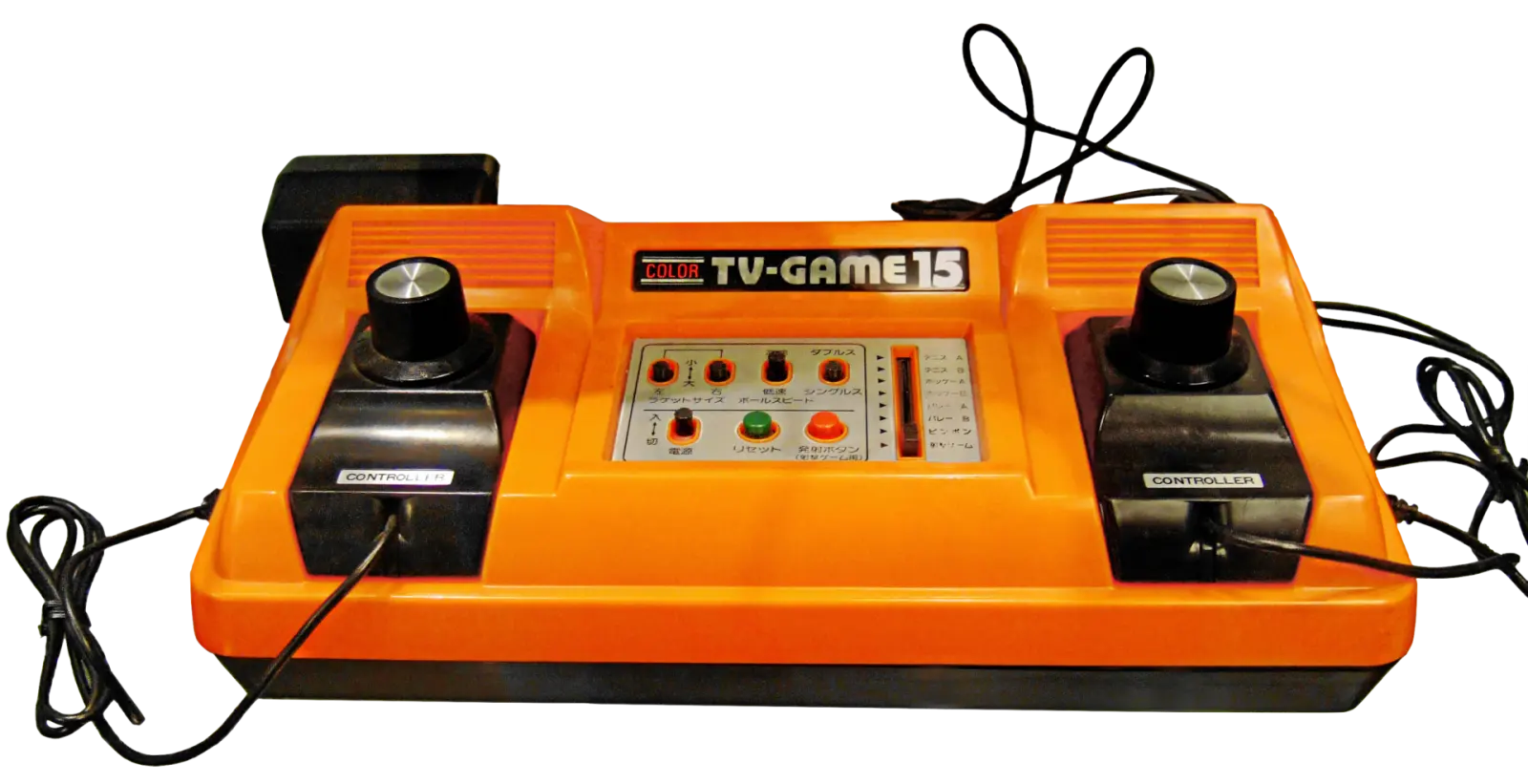
The Color TV-Game 6 went on sale on June 1 for ¥9,800; the TV-Game 15 followed a week later at ¥15,000. Nintendo was offering two product tiers in a market already familiar with dedicated electronic-tennis consoles. The 6 had control wheels built into its casing. The 15 came with wired controllers that could be detached and stored in a compartment. It also offered fifteen game variations, although both machines shared the same set of fifteen: on the cheaper version, only six were accessible without modification.
From an available chip to two products
The project grew out of a collaboration between Nintendo and Mitsubishi Electric. The electronics company had an LSI chip capable of generating color graphics and was looking for a partner to bring it to the home market. Accounts of the series’ development say Mitsubishi approached Nintendo after calculator company Systec went bankrupt in 1976, leaving the chip project without a commercial path. Masayuki Uemura, Nintendo’s engineering lead, saw potential in the proposal and presented it to president Hiroshi Yamauchi.
The available electronics did not, by themselves, solve the commercial challenge. Nintendo wanted a low launch price, but the development team considered a price near ¥15,000 necessary to reach break-even. The solution attributed to Uemura was to split the offer: a ¥9,800 machine with limited features, and a ¥15,000 model that made the full range available and added detachable controllers.
The basic model made the entry price visible; the higher-tier one made its extra features visible. That comparison may have encouraged some buyers to choose the TV-Game 15, but the decision should not be reduced to a marketing formula. The two machines also served customers with different budgets and expectations, and the cheaper option had its own appeal for people who wanted a handful of electronic-tennis variations without paying for the full set.
Variations on a theme, not fifteen wholly different games
The number in the name can suggest a modern notion of variety, but the fifteen modes were variations on paddle games: hockey, volleyball, tennis and ping-pong, among others, with options for one or two players and changes to the shape of the center line. The controls also allowed adjustments such as paddle size and ball speed. The TV-Game 6 offered a smaller selection; the 15 made the broader range accessible.
Like other first-generation dedicated consoles, neither machine used cartridges: the games were built into the hardware. Their appeal depended less on an expanding library than on the variations gathered into a single unit. The proposition was to bring electronic play to the home television in a simple, color setup, at a time when Pong and electronic-tennis consoles were multiplying in Japan.
Nintendo did not develop all the electronics alone. The first systems were produced with Mitsubishi Electric, and Sharp marketed its own versions of the models. Nintendo also obtained a Magnavox license for Pong-style games. That relationship places the consoles in a broader industrial history: the commercial success of paddle games created opportunities, but also rights disputes among manufacturers.
A commercial success, not an inevitable path to dominance
Sales figures for the two models are commonly put at around one million units apiece, though published accounts do not always agree on the details. The result made the Color TV-Game series an important commercial step for Nintendo. The company continued with other dedicated consoles, including Racing 112 and Block Kuzushi, before releasing the Family Computer in 1983.
That history was not a straight line from the TV-Game 15 to Nintendo’s later dominance. The 1977 consoles had no cartridges or expandable library; they belonged to a generation of simple products built around variations on familiar games. Their significance is more specific: they showed that Nintendo could design and sell home hardware in Japan, work with electronics manufacturers, and compete through pricing and product configuration.
Seen in that context, the Color TV-Game 15 was not simply a “better” version of the TV-Game 6. The two machines formed a tiered offer built on the same technical base. Combining a low entry price with a more complete model let Nintendo test the home market while responding to production constraints without giving up a higher-priced product.
- Decade
- 1970s
- Region
- Japan
- Level
- Enthusiast
- Entities
- Nintendo, Masayuki Uemura, Pong, Color TV-Game 15
Sources and references 5
- EL DERECHO COMERCIAL INTERNACIONAL:doi.org · 2026-11-14
- Read [Pdf]> The Game Boy Encyclopedia: Every Game Released for the Nintendo Game Boy and Game Boy Color by Chris Sculliondoi.org · 2026-11-14
- Read [pdf]> The Game Boy Encyclopedia: Every Game Released for the Nintendo Game Boy and Game Boy Color by Chris Sculliondoi.org · 2026-11-14
- Juego de TV a colortranslate.google.com · 2026-11-14
- Color TV-Game 6 y Color TV-Game 15 | 100% RETROinfoconsolas.com · 2026-11-14