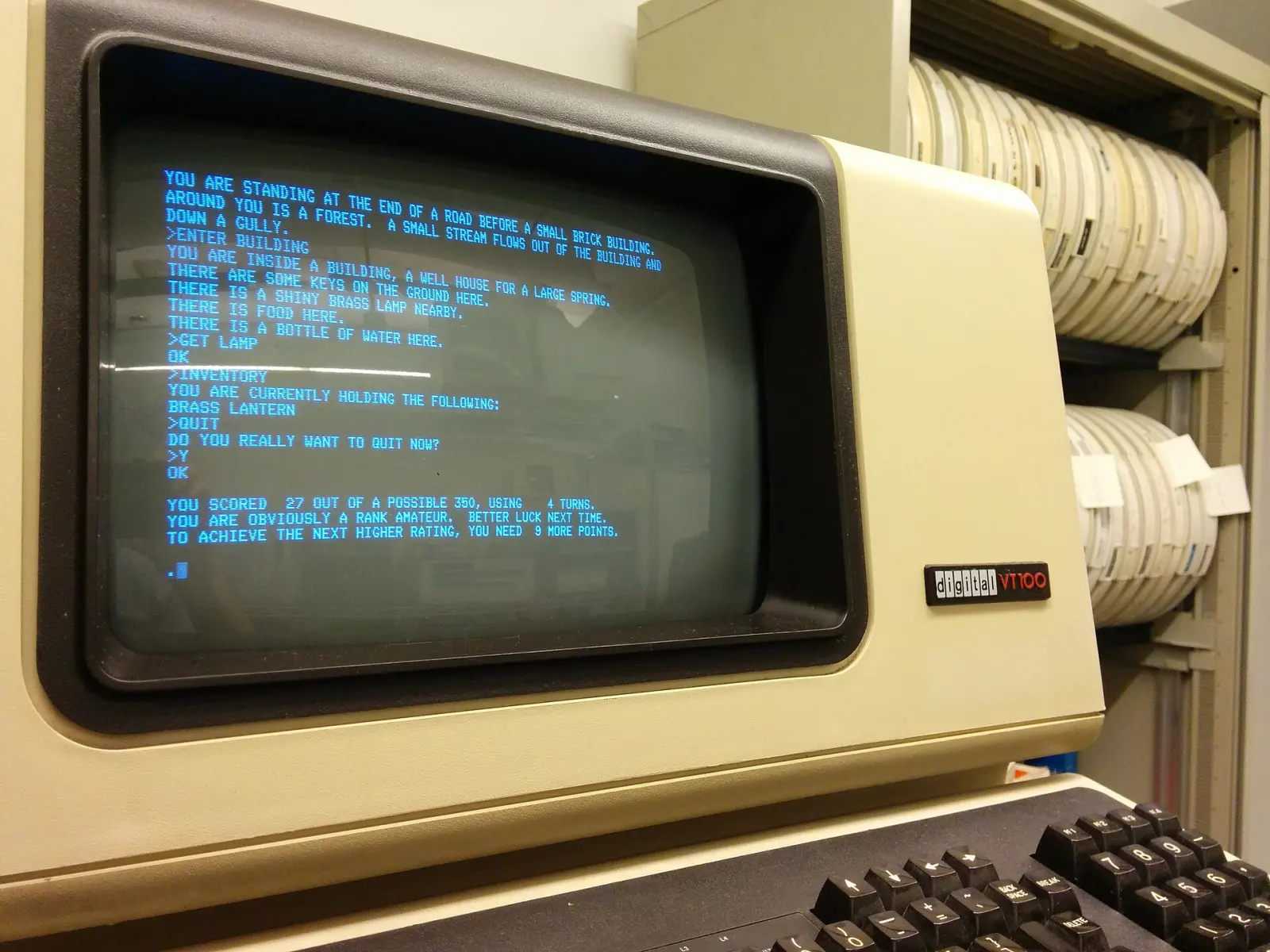
A cave that takes shape through reading
In Colossal Cave Adventure, the cave is not viewed from the outside or traversed behind a visible character. It takes shape as players read descriptions and type commands. The computer reports where they are, responds to what they try to do, and sometimes makes clear that it has not recognized an instruction. Exploration therefore involves two tasks at once: finding one’s way through an imagined space and learning to communicate with a system whose vocabulary is limited.
Language is not decorative narration layered over the action. It is the interface and, at the same time, the material through which the space becomes intelligible. Players must translate an intention into an instruction the program can recognize, then interpret the response to decide what to try next. The world emerges from the exchange between the system’s rules and the player’s imagination.
From caving to textual adventure
William Crowther created the original version in 1976. His experience in cave mapping provides a meaningful context for a game whose progress depends on remembering routes, recognizing locations, and building a mental picture of passages that are never shown all at once. Memoria del juego’s chronology places the work in 1976 and credits Don Woods with an expansion in 1977: two distinct moments that are often blurred in brief accounts of the game’s history.
The cave is revealed in pieces, through described movement and the player’s memory. This structure makes orientation an intellectual activity, not simply a matter of pressing the correct direction. In his 2026 reading, Mário Gomes connects cave mapping with programming and proposes that the underground space can also be understood as a metaphor for computer architecture and early networks such as ARPANET. This is a critical interpretation of the game, not a definitive explanation or the only way to read it.
A dialogue with limits
The exchange with the program can feel like a conversation. But the computer does not take part in an open-ended dialogue: it responds within a bounded set of commands and states. The impression that it “understands” depends both on the replies it provides and on the player’s work—filling in what the system leaves unsaid and learning its conventions through trial and error.
The replies serve more than one purpose. They indicate whether an action has had an effect, but they also sustain the fiction, describe locations, and guide the next decision. Each command turns an intention into something the program can process; each description gives the player material for imagining a space larger than the text currently on screen. The experience is built between the system’s limited capabilities and the interpretive work of the person navigating it.
A game within a culture of experimentation
Colossal Cave Adventure belongs to a broader history of academic computing, shared programming, and software circulation. The consulted history of hacker culture describes how code and knowledge moved through networks such as ARPANET, enabling collaboration among programmers, and places the emergence of text adventures beyond MIT within this technical culture. The game did not appear outside all tradition: it was part of an environment in which experimenting with computers also meant exploring new forms of interaction.
The connection to later works can be described without turning it into an overly simple genealogy. Memoria del juego’s chronology lists Zork in 1979 and identifies it as a text adventure based on Colossal Cave Adventure. This supports a claim of specific influence; it does not mean the two games are identical or that an entire genre has a single point of origin.
A map made of descriptions and memory
The text interface does not show a complete image of the cave. Players assemble names, descriptions, and memories of their movements into a mental map, while deciding which words might express the action they want to take. Reading and orientation become inseparable: making progress requires remembering where one has been as well as finding an instruction the system will accept.
The game’s lasting contribution lies in this combination of rules, language, and space. Colossal Cave Adventure does not merely tell an adventure in text; it proposes a particular way of producing an interactive world through commands and replies. Rather than offering a total view of its setting, it invites players to explore gradually, test instructions, learn from the results, and retain the map each description allows them to glimpse.
Documentary gallery
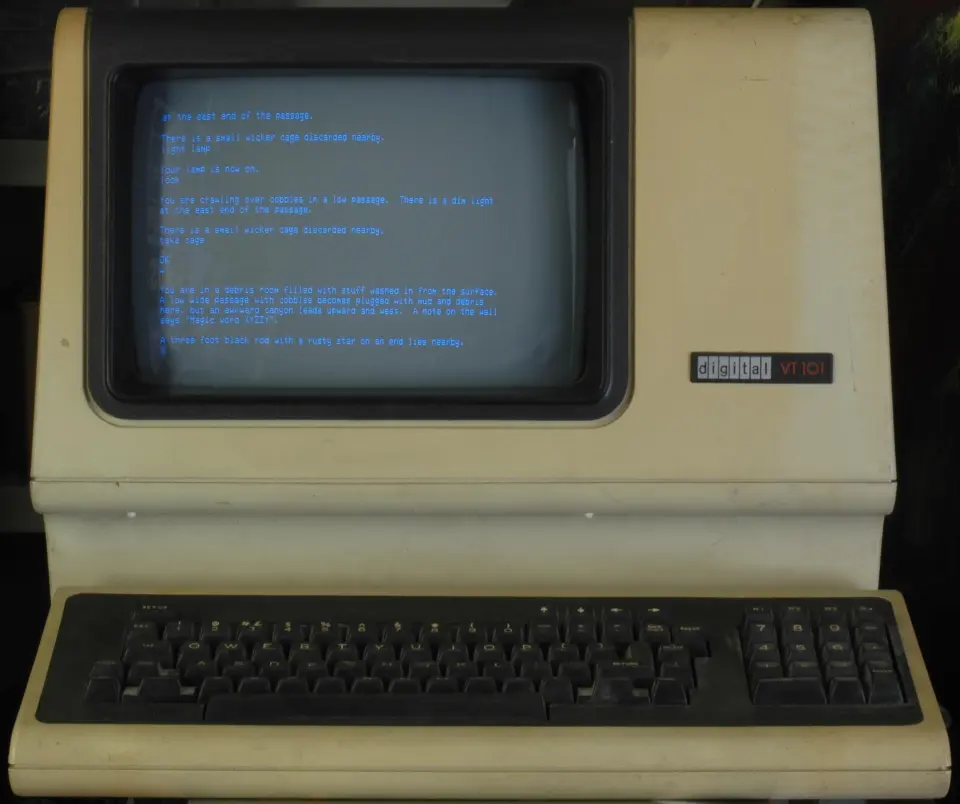
- Decade
- 1970s
- Region
- North America
- Level
- Enthusiast
- Entities
- ARPANET, Mappa, Colossal Cave Adventure
Sources and references 5
- Cave and Code: A Poetological Reading of "Colossal Cave Adventure"doi.org · 2026-11-13
- Cronología - Memoria del juegogamedesignla.com · 2026-11-13
- Videojuego de mazmorrases.wikipedia.org · 2026-11-13
- Género de videojuegoses.wikipedia.org · 2026-11-13
- Historia de la cultura hackeres.wikipedia.org · 2026-11-13