An uneven arrival
Television is often remembered as a domestic scene: a family gathered around a screen. In Mar del Plata, that image took time to become everyday reality. In the early years, watching television could mean going to a neighbour’s home, a club, or a community association. The arrival of a broadcast signal and the purchase of a set followed different timelines, and children and adults experienced the change differently.
Historian Inés Pérez reconstructed this process through interviews with 21 people who lived through the spread of television sets in the city between 1960 and 1970. Her study focuses less on programmes than on the television as an object of everyday life: who could buy one, where people watched, and how it changed domestic spaces and routines.
A signal did not mean a television at home
Television broadcasting in Argentina began in Buenos Aires in 1951. Mar del Plata got a local station, Canal 8, in 1960. But broadcasts did not mean every family could watch them at home: sets remained expensive, and buying one depended on a household’s means. Some families even bought a set before local broadcasts began, then waited months to use it regularly.
In those early years, people often watched in shared spaces. Children visited neighbours’ homes; clubs and community venues were also places to gather around a screen. In Pérez’s interviews, age is central to the experience: adults might see television as a modern novelty, a luxury, or something troubling, while children remember looking forward to programmes and knowing their schedules. Many interviewees place the moment when “TV came home” between 1966 and 1968, though there was no single date for every household.
In Mar del Plata, practices that had unfolded at different times in Buenos Aires therefore coexisted. Viewing outside the home continued as more families bought sets for domestic use. The boundary between public and private did not vanish at once: access first travelled through networks of kinship, neighbours, and community life.
A status object in everyday life
The television was more than a window onto programmes. Its price, brand, and country of origin could make it a visible sign of modernity and social standing. One family interviewed by Pérez remembered buying an expensive imported Philips as a decision to get “the best.” That symbolic value could endure even as prices fell and buying on credit became more common.
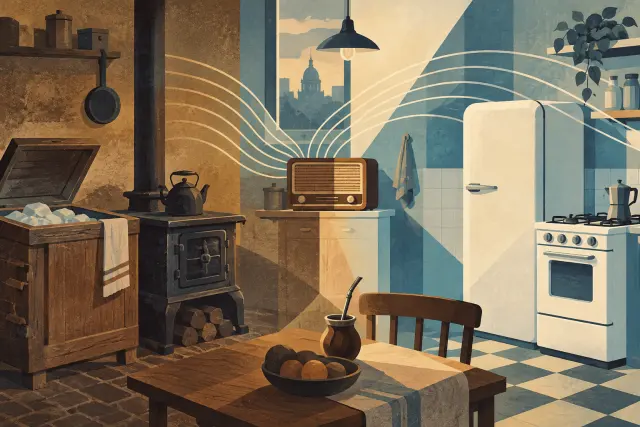
The set’s place in the home was not fixed either. Many first televisions went in the living or dining room—shared spaces where the device could also be seen by visitors. Others were installed in the kitchen. Pérez connects this placement to a broader change: the kitchen was becoming more integrated into family life, and a television there made it possible to follow programmes while doing household tasks. There was no universal arrangement; placement depended on each household’s circumstances and habits.
The relationship between television and domestic work was ambivalent. Some people described watching as a waste of time that should have been spent on chores, especially work done by women. At the same time, the importance of sound made it possible to follow a programme without keeping one’s eyes on the screen. The set did not automatically replace existing routines; it became part of them in different, negotiated ways.
Childhood memories and family life
People who first encountered television as children often remember the anticipation, programmes, and schedules. For some adults, by contrast, the most noticeable change was the time their children spent being entertained. This generational difference helps explain how the television could be a technological novelty, a family purchase, and a gathering point all at once.
The interviews also suggest that visiting someone else’s home had its own patterns. Children were the ones who most often went to neighbours’ houses to watch; such visits were less common for adults. Accounts from those who hosted groups of children do not always match the memories of those who came to watch. That gap points to the selective nature of oral memory and to the different positions from which people recount a shared experience.
The case of Mar del Plata makes it possible to see television not only through programmes or broadcasting history, but as a social practice connected to housing, consumption, and everyday relationships. The screen brought images of the outside world into the home, but the conditions of viewing depended on who owned the set, who could visit, and what other activities were happening around it. Television became domestic gradually, and not in the same way for everyone.
- Decade
- 1970s
- Region
- Latin America
- Level
- Enthusiast
- Entities
- Televisión, Buenos Aires, Argentina, Inés Pérez
Sources and references
- La televisión argentina: historia, composición y crítica de mediosdoi.org · 2026-11-11
- Historia de la televisióntranslate.google.com · 2026-11-11
- 9.1: La evolución de la televisiónespanol.libretexts.org · 2026-11-11
- USOS DEL TELEVISOR EN LA VIDA COTIDIANA. MAR ...www.scielo.org.co · 2026-11-11
- La domesticación de la “tele”: usos del televisor en la vida ...journals.openedition.org · 2026-11-11