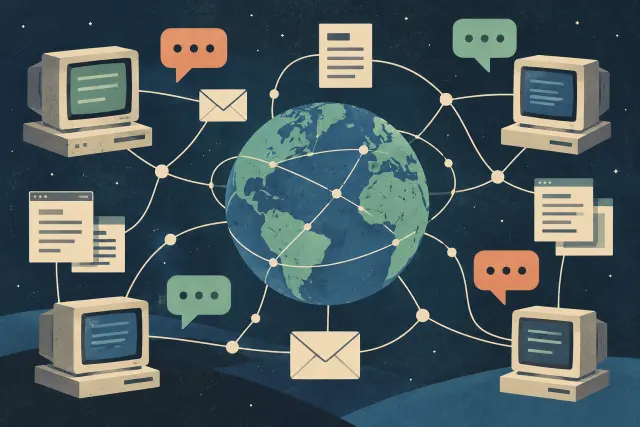
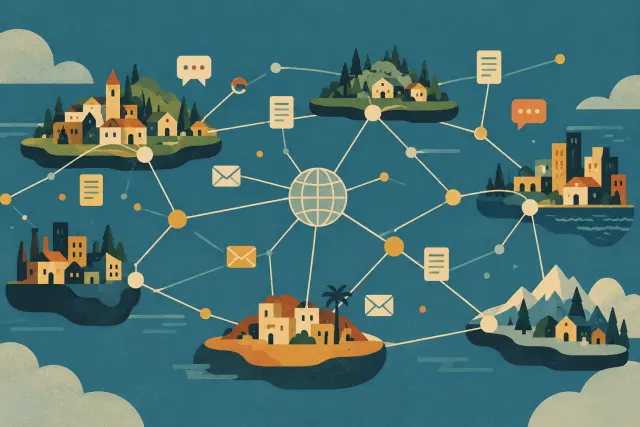
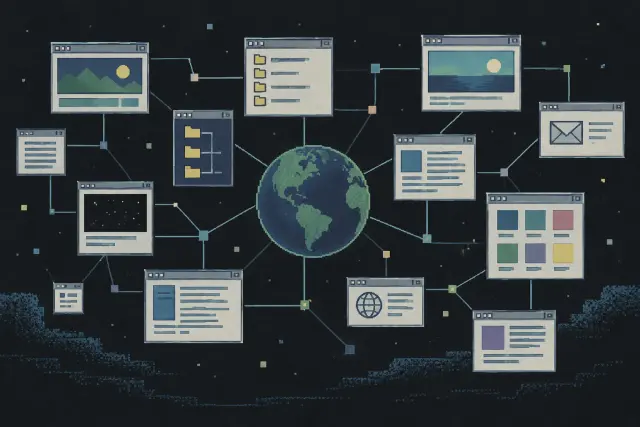
DBpedia describes the Internet as a global system of interconnected networks.
Selected excerpts from our archive offer more context on this subject. Each reading links to the original article and its sources.
Internet Before the Web: A Cautious Timeline of Networks, 1957–2009
Calling everything that happened between early research networks and later web culture “the Internet” is useful, but also misleading. The evidence assembled for this timeline describes a process: research into computer communication, interconnected networks, working programmes, protocols, services, and forms of use. It does not provide one uncontested origin date, nor does it allow the story to be reduced to a single inventor.
Telefónica places the seed of this history in 1957 and in the context of the Cold War. Other items in the supplied material likewise connect initial networking and computing projects with the 1950s, the space race, and that political setting. This is contextual starting ground, not proof that the Internet already existed then. The distinction matters: a rigorous timeline must separate the conditions that enabled a network from the services and standards that later made it recognisable.
The reference to 1957 explains why accounts of the Internet often begin before ARPANET. It helps locate research, institutions, and technical priorities, but it does not describe a user experience or a worldwide system. From a retro perspective, this period belongs more to institutional and technical prehistory than to everyday Internet use.
The available documentation does not support a linear tale in which every advance replaces the one before it. CCCB warns that Internet chronologies are built from familiar milestones while also revealing major gaps in study and reflection. That caution is especially valuable when looking back: clean diagrams can conceal collaborators, infrastructures, and uses absent from the most popular summary.
Before the Web: The Internet Built to Connect Computers
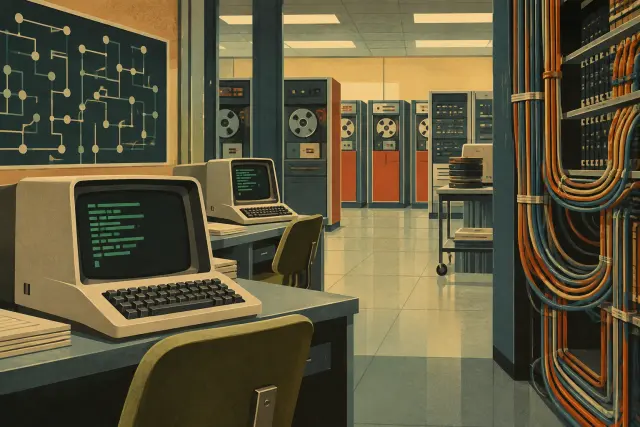
Speaking about the old Internet often triggers an overly simple image: slow connections, text screens and, later, elementary web pages. That image contains something familiar, yet it mistakes a later stage for the starting point. Before the World Wide Web became the most visible way of moving through the network, the Internet was already an environment for work and communication between computers. Its purpose was not “browsing” in today’s sense, but enabling machines and people in different places to exchange information and use remote resources.
Internet Society’s account places ARPANET at the centre of this process. As computers were added to the network, host-to-host protocols and network software were developed. In December 1970, the Network Working Group was working under the leadership of S. Crocker. Rather than being a mere founding anecdote, this detail shows that the network was a collective undertaking of technical groups, protocols and programs that had to work across different systems.
ARPANET’s defining feature was not a domestic consumer experience, but the connection of costly, separate machines. Internet Society explains a straightforward rationale: linking computers was far less expensive than duplicating those costly machines. The network could therefore turn local resources into resources reachable from elsewhere.
That function shaped the experience. Users did not arrive at a front page full of links; they accessed services. Communicating with a remote machine and moving files were core tasks. From today’s perspective the network may look austere, but that austerity was purposeful: every added capability addressed a concrete problem of coordination, computing or exchange.
KEY FACTS
- Type
- Service
References
- Internetdbpedia.org