A network, a service and a tool
The World Wide Web is not the Internet. The Internet is the infrastructure of interconnected networks that lets computers communicate; the Web is one service built on it, designed for publishing and consulting linked documents. Email and file transfer, for instance, were already network activities independent of the Web.
The Web is also not the same thing as a browser. The Web is a system of documents and conventions for accessing them; a browser is a client program that requests those documents and lets people move between them. This distinction clarifies the original idea: the Web did not create a network from scratch. It offered a way to link information held on different computers.
From proposal to a working system
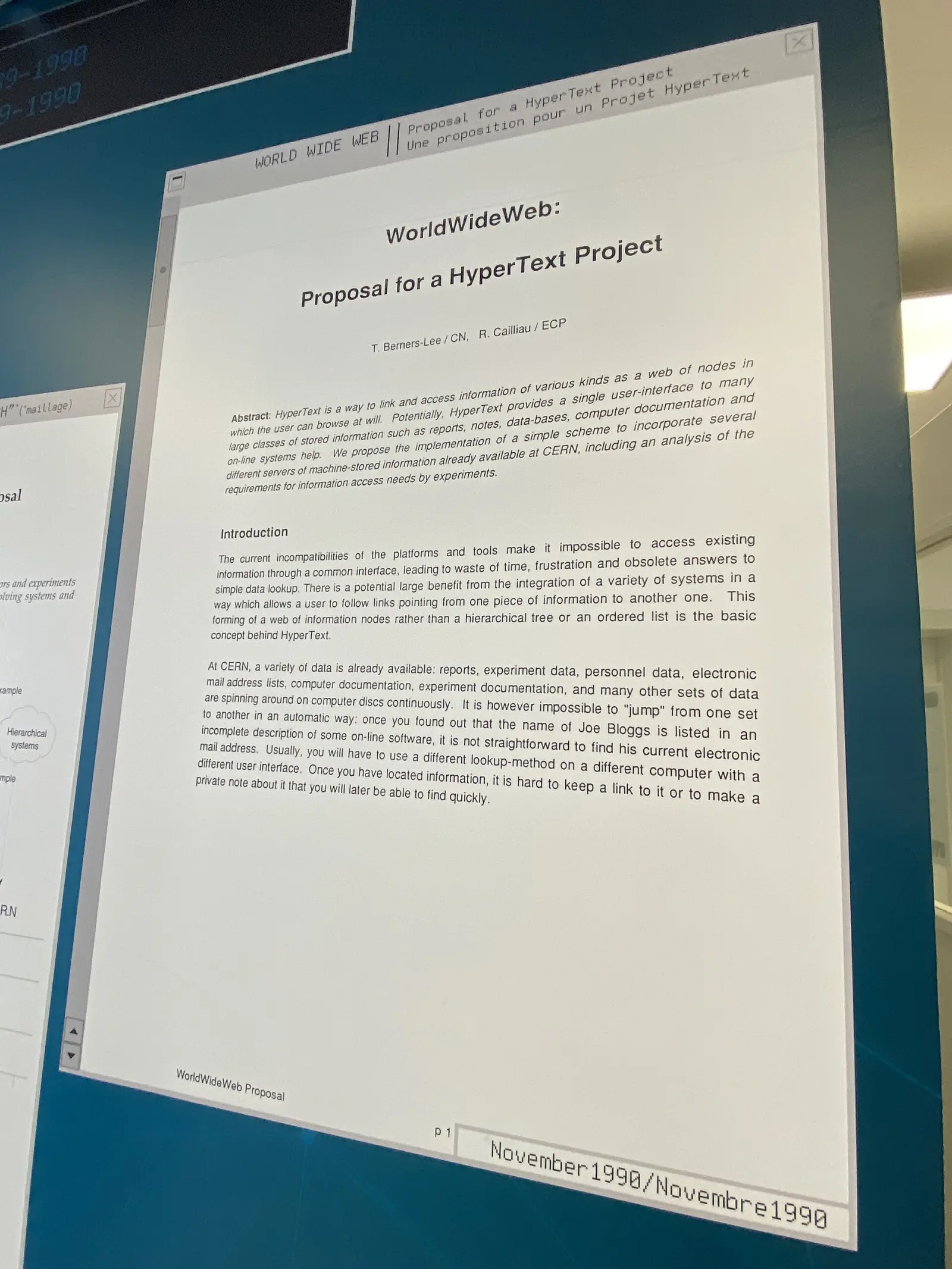
In March 1989, Tim Berners-Lee proposed at CERN a way to organise information through hypertext and make it accessible across networks. In November 1990, he and engineer Robert Cailliau formalised the project as a proposal for a hypertext system. It addressed a practical need at CERN: sharing information among researchers and institutions whose members worked in different places.
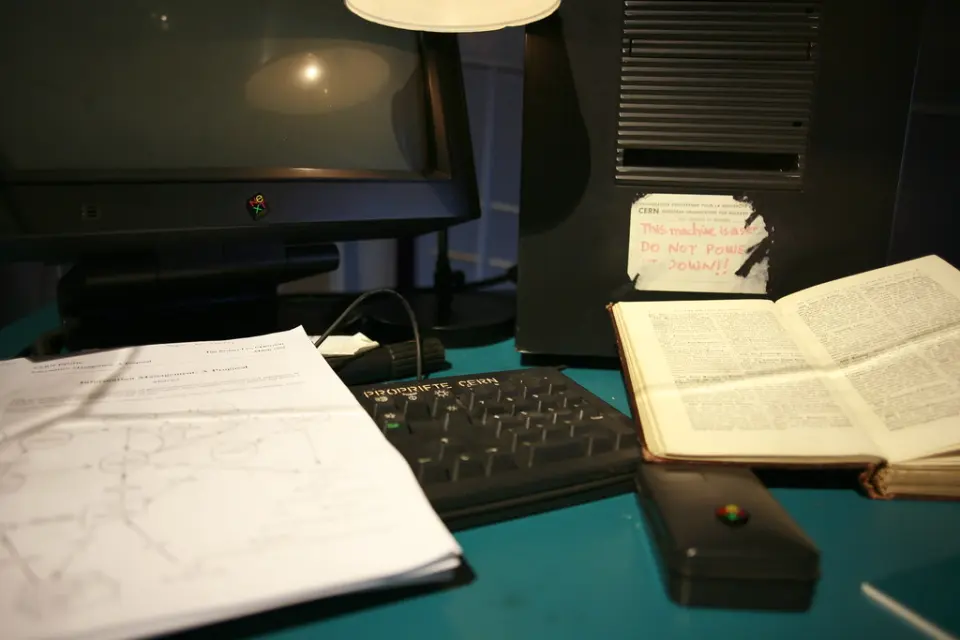
By the end of 1990, Berners-Lee had the essential components running on a NeXT computer at CERN: a Web server, a browser and editor called WorldWideWeb, and early versions of HTML, HTTP and URL. The computer hosting the server was also the environment in which the program was developed.
These terms refer to different parts of the same idea. HTML structures a document and includes links; a URL identifies the address where a resource can be found; HTTP sets out how a client requests that resource from a server. As an analogy, think of a text with references, an address for locating each document, and a protocol for requesting it. This is an explanatory comparison, not a literal account of every technical detail. Those early tools were not today’s Web and should not be confused with later technologies such as HTTPS.
From CERN to other computers
In March 1991, the software became available to CERN colleagues. In August of that year, Berners-Lee announced the project on Internet newsgroups, extending its circulation beyond the laboratory. These milestones describe dissemination, not the invention of the Web or the first server, which was already running in 1990.
The original browser was tied to the NeXT environment, which was not widely available. To make access possible on other platforms, Nicola Pellow developed a line-mode browser: less visual and more limited, but able to run on different systems. Institutional timelines do not entirely agree on how to date its launch; they do distinguish the distribution of the software in 1991 from the broader availability of a readily accessible line-mode browser in 1992.
Internet, Web and browser: three different things
| Term | What it is | Its role in this history |
|---|---|---|
| Internet | An infrastructure of interconnected networks | Carries data between computers and supports services beyond the Web. |
| World Wide Web | A system of documents and links, using conventions such as HTML, URLs and HTTP | Makes it possible to locate and consult linked documents across the network. |
| Browser | A client program | Requests and displays Web documents; its capabilities depend on the program and the system it runs on. |
A wider journey through linked documents
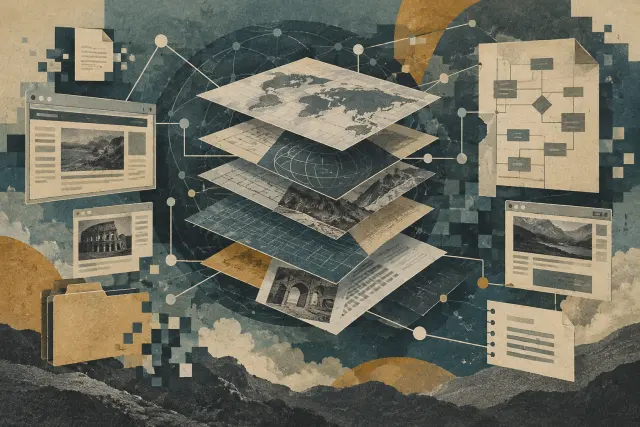
Link-based browsing turned reading into a possible route: one document could point to another, which could lead to further information. Publishers created connections; readers chose which ones to follow. The Web was not a complete catalogue, nor did it guarantee that every link was accurate or permanent. It was a way to organise and explore distributed information.
The original browser combined reading with editing. That choice matters: the Web was conceived not only as a display for consulting pages, but as a system in which documents could also be created and changed. Publishing and linking were part of its design, even though practical access depended on the computers and programs available.
More browsers appeared in 1993, and the Web became more visible in academic settings. Mosaic helped extend its reach, but it was neither the first browser nor the first graphical browser: programs such as Viola and Erwise already existed. Mosaic for X appeared as an alpha version in February 1993; that milestone was not a general release for every system. Its contribution lay in making use easier and in the later appearance of versions for personal computers and Macintosh.
On 30 April 1993, CERN put the Web software in the public domain and made it available royalty-free. This applied to the relevant Web software, not to all content published on the Web or to the Internet as a whole. It helped ensure that development and use did not depend on paying royalties to CERN.
Coordinating open standards
In October 1994, the World Wide Web Consortium (W3C) was founded in response to the need to coordinate standards as more groups developed Web tools. Its role was to foster a coherent, open architecture so that documents and programs from different teams could work together. Founding the W3C was a step towards coordination; it did not mean all standards were completed at once.
The shift from scientific research towards broader audiences and commercial interest was gradual. Browsers for more platforms and royalty-free software made wider use easier, but did not make access universal or establish one year in which the Web became commercial. Between 1989 and 1994, ideas, programs and ways to coordinate development took shape; other uses grew on that foundation later.
A short timeline
| Year | Event | Why it matters |
|---|---|---|
| 1989 | Berners-Lee proposes at CERN an information system based on hypertext and networks. | It sets out the problem and idea that would lead to the Web. |
| 1990 | The proposal is formalised with Robert Cailliau; by year’s end, a server, browser/editor and early components are running. | The idea becomes a working system, not just a written proposal. |
| 1991 | The software reaches CERN colleagues and is announced on Internet newsgroups. | It begins circulating among users and developers beyond the initial team. |
| 1993 | Mosaic for X appears as an alpha version; CERN releases the Web software royalty-free. | Opportunities to use and develop the Web expand, though Mosaic is not the first browser. |
| 1994 | The W3C is founded to coordinate standards. | International cooperation helps preserve an open, interoperable Web. |
How to interpret the dates and historical resources
When studying this history, ask what kind of milestone a date describes:
- Proposal: When was the idea put forward?
- Working prototype: When were the essential components operating?
- Distribution: When did the software reach other users or systems?
- Legal terms: Which software or material was made royalty-free, and under what terms?
- Standardisation: When did coordination around shared rules begin?
These are not interchangeable; treating them all as one “birth date” leads to muddled timelines. CERN’s preserved first website and its recreation of the WorldWideWeb browser are resources for historical research, not complete archives of the early Web or current services whose availability is guaranteed. They offer a glimpse of a fundamental idea: linking documents so that reading could also mean choosing where to go next.
Documentary gallery
- Decade
- 1990s
- Region
- Europe
- Level
- Enthusiast
- Entities
- World Wide Web, Internet
Sources and references 5
- CERN — The birth of the Webhome.cern · 2026-11-17
- CERN — A short history of the Webhome.cern · 2026-11-17
- W3C — Web at25: Web Historywww.w3.org · 2026-11-17
- W3C — Historywww.w3.org · 2026-11-17
- CERN — World Wide Web at35home.cern · 2026-11-17