Silhouettes changed; denim stayed
Fashion in the 2000s was not a uniform succession of trends. Denim, by contrast, remained a constant presence as its cuts changed. The Fashion Institute of Technology’s (FIT) timeline places low-rise flared jeans at the start of the decade and notes that bootcut styles gained ground in the middle years. According to the same source, skinny jeans appeared in 2005 and became commonplace the following year. This sequence describes shifts in silhouette, not a universal way of dressing.
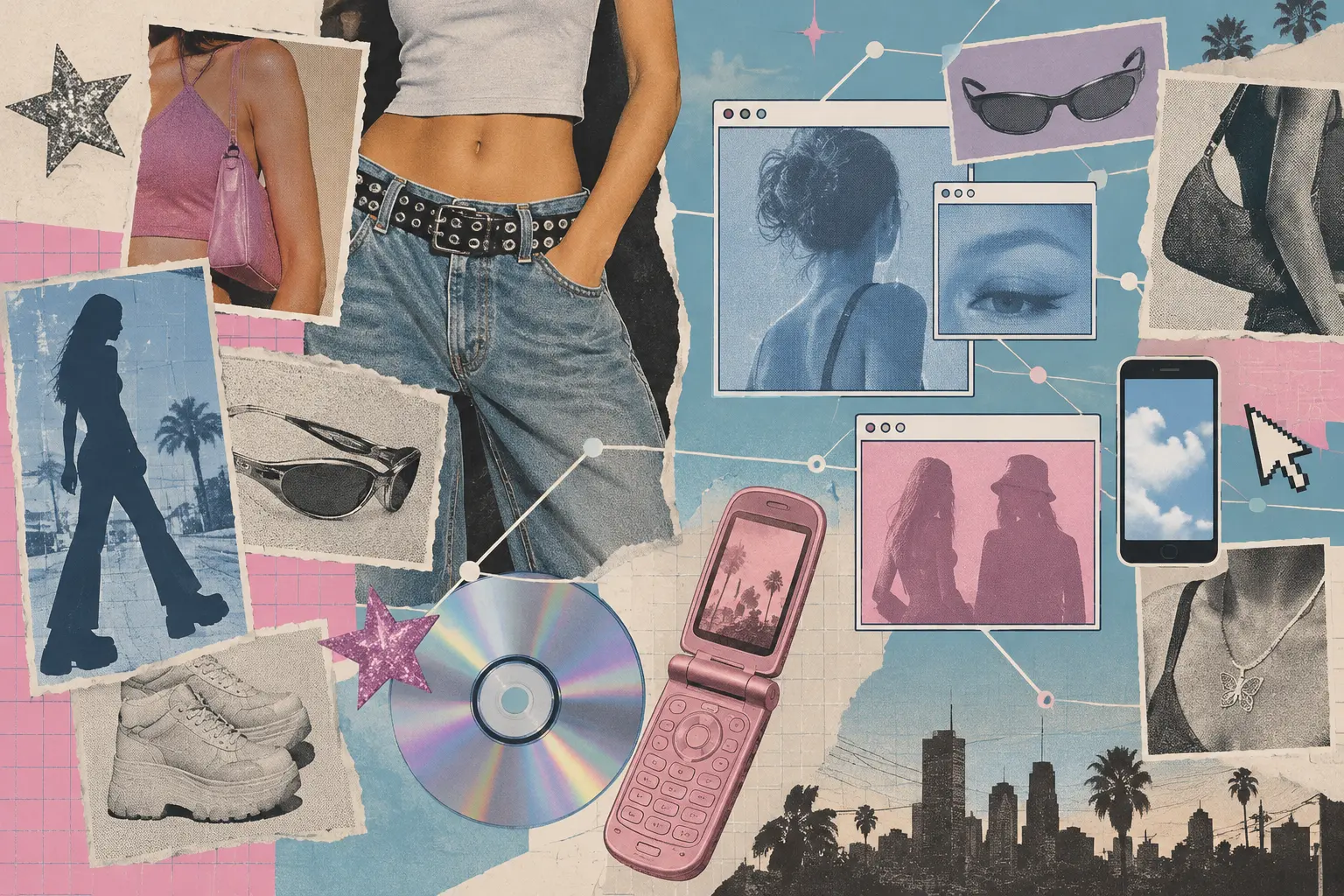
Low-rise jeans became one of the period’s most recognizable images. Levi’s introduced a Superlow silhouette in 2001, while Britney Spears wore very low-rise jeans with cropped tops in 2003. The pairing reflects a fashion that exposed the midriff and put the body in the foreground. It coexisted with distressed, embellished and designer denim, extending jeans from everyday wear to the red carpet.
Boho and accessories: the force of styling
The boho look of the early and mid-2000s revolved less around a single garment than around how pieces were combined. Fashion historian Lilah Ramzi describes in Vogue a style associated with Sienna Miller and Mary-Kate and Ashley Olsen: layers, vintage-inspired dresses and accessories that made the outfit a visual signature. The FIT timeline notes that boho mixed second-hand pieces with designer clothes and affordable fashion. This combination made the look adaptable to different wardrobes and budgets, even though its most widely circulated images were tied to famous figures.
Handbags acquired similar prominence. Vogue presents Fendi’s Baguette, launched in 1997, as one of the earliest bags considered an It bag. In the 2000s, it was joined by models such as Balenciaga’s Motorcycle City, introduced in 2001, and Chloé’s Paddington, created in 2005. The attention paid to these accessories often made a recognizable object the focal point of an outfit and a marker of status or aspiration. Brand culture also spread across belts, garments and logo-covered prints.
Celebrity fashion, however, is not the same as the everyday experience of an entire decade. Paparazzi photographs and magazine pages show particular appearances, selected and repeated; on their own, they cannot tell us how widespread a look was among people of different ages, regions or social groups. Casual clothes, music-linked styles and ways of dressing outside fashion coverage were also part of the period.
From magazines to online search
In the early years of the decade, magazines and tabloids remained central sources of fashion news. Blogs and websites grew alongside them, spreading pictures of celebrities away from the runway and in their public daily lives. Vogue describes this environment as a culture in which paparazzi images helped shape interest in clothing. The FIT timeline links the expansion of the internet and e-commerce to faster circulation of looks and an easier search for similar garments.
The collaboration between H&M and Karl Lagerfeld, introduced in November 2004, showed another way to narrow the distance between designer fashion and the mass market. The collection, sold by an affordable retailer, drew strong demand: the FIT timeline notes that many pieces sold out on the first day. The episode anticipated the growing importance of collaborations between designers and retail chains. Design mattered, but so did availability, distribution and the pace of sales.
Digital circulation did not replace earlier media; it joined them. Magazine pages, tabloids, blogs and online stores formed a circuit in which an image could prompt people to find, identify and buy a similar garment. Vogue recalls that online image search began to gain momentum after the attention surrounding the Versace dress Jennifer Lopez wore to the 2000 Grammy Awards. The anecdote illustrates how a fashion image could prompt new ways of searching and shopping; it does not make that dress the sole explanation for digital fashion.
Music, identity and menswear
Music brought other visual codes into the mix. The FIT account distinguishes a hip-hop-associated menswear aesthetic—with baggy jeans, sports jerseys and sneakers—from indie-linked looks featuring skinny jeans, band T-shirts and jackets. During Hedi Slimane’s tenure at Dior Homme, he promoted a slim menswear silhouette associated with bands such as The Strokes and The Libertines. These connections show exchanges between music, the runway and commercial clothing, without reducing musical scenes to a single uniform.
Taken together, 2000s trends make more sense as part of a transformation in how fashion circulated. Garments and accessories became recognizable through repeated images in the press, on television and in digital spaces; retail collaborations and e-commerce brought those images closer to consumption. Runway, street and music each contributed in different ways, while surviving photographs allow us to study particular uses. Reading them carefully means asking who appears, where and in what context, rather than treating a media image as a portrait of an entire public.
- Decade
- 2000s
- Region
- Global
- Level
- Introduction
- Entities
- Televisión, Internet, Vogue, Karl Lagerfeld
Sources and references 5
- 2000-2009 | Fashion History Timelinefashionhistory.fitnyc.edu · 2026-11-21
- A 2000s Fashion History Lesson: Logos, Low-Rise, and It Bagswww.vogue.com · 2026-11-21
- 10 iconos de estilo de los años 70 – VEIN Magazinevein.es · 2026-11-21
- Años 70: los mejores momentos de la moda que hoy queremos imitarwww.harpersbazaar.com · 2026-11-21
- Historia de la modaes.wikipedia.org · 2026-11-21