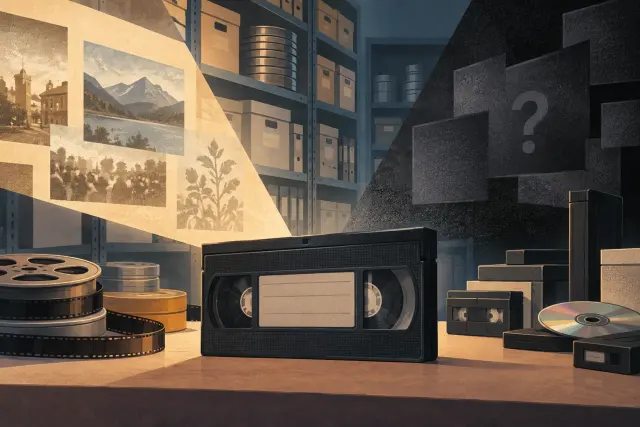
Documentary record of the VHS video format, connected to the archive’s verified stories, dates and resources.
Selected excerpts from our archive offer more context on this subject. Each reading links to the original article and its sources.
What VHS Can—and Cannot—Tell Us in a Film Archive
A preserved VHS tape can be a useful clue to the circulation of cinema in the home, but it is not a complete record of that experience. To study it, we need to ask what kind of object it is, who assembled it, what documentation accompanied it, and what the source describing it actually allows us to claim. The presence of VHS in film-library and archival collections shows that the format forms part of certain holdings and consultation practices. It does not, by itself, prove how many people watched a film at home, what they thought of it, or how its reception compared with its theatrical release.
That distinction matters because archives preserve objects, records, and conditions of access—not a transparent collective memory. The material available here supports an examination of that distinction; it does not, however, suffice to reconstruct reception on a film-by-film basis.
A 2017 study by Andrea Cuarterolo places VHS within a discussion of the archive and technical reproducibility. The reference offers a framework for asking what changes when a work circulates in reproducible copies, but the excerpt available does not support more specific claims about the study’s conclusions. We should therefore distinguish the question of format—how a copy is recorded, reproduced, or preserved—from questions about a film’s meaning and reception.
We should also avoid treating every VHS tape as a direct copy of a cinematic original. The sources provided do not identify the provenance, generation, or circumstances of creation of the particular tapes they mention. Without that information, it is not possible to describe their quality, playback history, or relationship to a version released in cinemas with confidence.
Snow White in the Living Room: How VHS Rewrote the Experience of a Classic
The reception of a film is rarely limited to its script or soundtrack. It is deeply anchored in the device that broadcasts it and the physical space where the viewer sits. When Walt Disney presented Snow White and the Seven Dwarfs in 1937, he was not just releasing a film; he was inaugurating a new paradigm of cultural consumption. The work was designed for the cinema hall, a shared dark environment where the experience was ephemeral, collective, and above all, solemn. However, the history of this film does not end with its premiere. Its subsequent trajectory, especially from the 1980s and 1990s onwards, offers a privileged window to understand how domestic technology reconfigured the relationship between the audience and audiovisual art.
In its original context, Snow White functioned as a massive cultural event. The cinema hall imposed a specific discipline: joint attention, immobility, and the acceptance of the narrative without interruptions. This spatial and temporal configuration created an aesthetic distance that elevated the perception of artistic quality. For the child and adult audience of the time, seeing the film was an experience that required travel, economic expenditure, and a time commitment that distinguished it from other forms of entertainment. Academic literature on film history points out that this mode of exhibition established a clear hierarchy, where cinema was positioned as a superior art form to other more accessible consumption media.
The massive introduction of VHS in homes during the 80s and 90s broke this structure. For the first time, a high-budget and culturally recognized film could be owned, stored, and reproduced in the living room. This change was not merely technical, but ontological. The film ceased to be a service provided by a cinema and became personal property. Immediate availability and the possibility of infinite repetition altered the perception of scarcity that surrounded the theatrical release. What was once a unique moment transformed into an accessible routine, available at any time and without the social pressure of the public hall.
One of the most significant effects of this transition was the creation of an intimate familiarity with the work. Constant repetition in the domestic environment allowed new generations to know Snow White not as a discovery, but as an element of their everyday landscape. This familiarity diluted the solemnity of the original premiere. The film became an everyday consumer object, similar to a television program or a background song. Cultural criticism observes that this process of domestication reduced the aesthetic distance, causing the work to be judged less by its technical or narrative innovation and more by its ability to generate comfort and nostalgia in the viewer.
KEY FACTS
- Type
- Format
- Year
- 1976