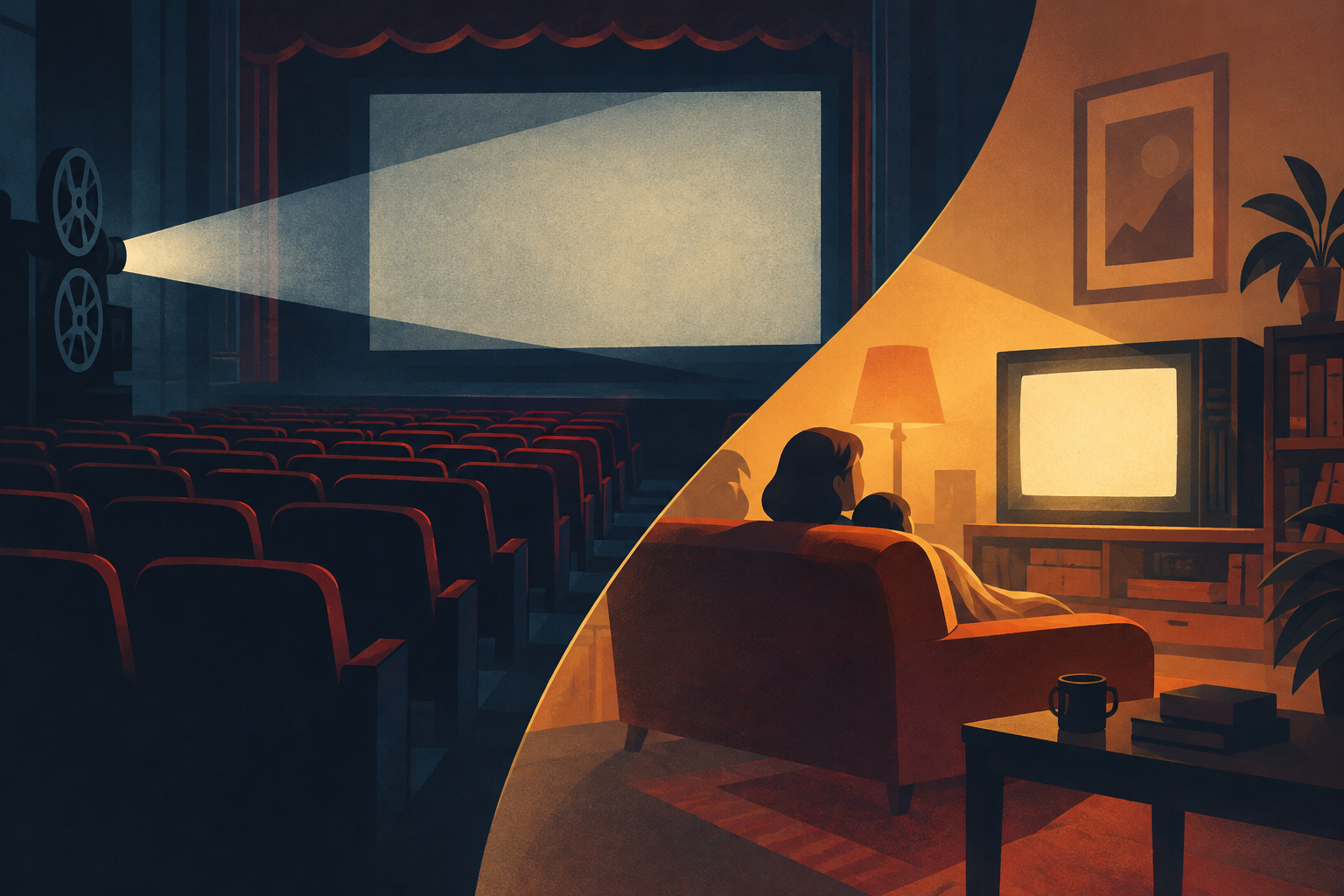
The reception of a film is rarely limited to its script or soundtrack. It is deeply anchored in the device that broadcasts it and the physical space where the viewer sits. When Walt Disney presented Snow White and the Seven Dwarfs in 1937, he was not just releasing a film; he was inaugurating a new paradigm of cultural consumption. The work was designed for the cinema hall, a shared dark environment where the experience was ephemeral, collective, and above all, solemn. However, the history of this film does not end with its premiere. Its subsequent trajectory, especially from the 1980s and 1990s onwards, offers a privileged window to understand how domestic technology reconfigured the relationship between the audience and audiovisual art.
The Cinematic Event as a Shared Ritual
In its original context, Snow White functioned as a massive cultural event. The cinema hall imposed a specific discipline: joint attention, immobility, and the acceptance of the narrative without interruptions. This spatial and temporal configuration created an aesthetic distance that elevated the perception of artistic quality. For the child and adult audience of the time, seeing the film was an experience that required travel, economic expenditure, and a time commitment that distinguished it from other forms of entertainment. Academic literature on film history points out that this mode of exhibition established a clear hierarchy, where cinema was positioned as a superior art form to other more accessible consumption media.
The Arrival of Magnetic Media in the Home
The massive introduction of VHS in homes during the 80s and 90s broke this structure. For the first time, a high-budget and culturally recognized film could be owned, stored, and reproduced in the living room. This change was not merely technical, but ontological. The film ceased to be a service provided by a cinema and became personal property. Immediate availability and the possibility of infinite repetition altered the perception of scarcity that surrounded the theatrical release. What was once a unique moment transformed into an accessible routine, available at any time and without the social pressure of the public hall.
Familiarity as the Dilution of Solemnity
One of the most significant effects of this transition was the creation of an intimate familiarity with the work. Constant repetition in the domestic environment allowed new generations to know Snow White not as a discovery, but as an element of their everyday landscape. This familiarity diluted the solemnity of the original premiere. The film became an everyday consumer object, similar to a television program or a background song. Cultural criticism observes that this process of domestication reduced the aesthetic distance, causing the work to be judged less by its technical or narrative innovation and more by its ability to generate comfort and nostalgia in the viewer.
The Fragmentation of the Narrative Experience
In the cinema hall, the narrative was consumed in a linear and uninterrupted manner. In home video, the experience was fragmented. The possibility to pause, rewind, or skip scenes introduced a new form of interaction with the film text. The viewer passed from being a passive receiver to an active user who controlled the pace of the narrative. This technical agency modified the cultural interpretation of the film. Iconic scenes, such as the dwarfs' sequence in the mine, could be isolated and repeated, becoming decontextualized from the complete plot. This fragmentation contributed to the construction of a cultural memory based on fragments rather than the totality of the work.
The Reconfiguration of Genre Hierarchies
The move to the domestic medium also affected the hierarchy of film genres. By being available on the same medium as low-budget films or television productions, Snow White shared space with forms of entertainment previously considered inferior. The materiality of VHS, with its technical limitations and association with mass consumption, influenced the critical valuation of the work. Some studies suggest that the perception of artistic quality was affected by the exhibition context, as the domestic medium tended to equalize the experience of all content, regardless of its origin or budget.
Limitations of Historical Evidence
It is important to note that the available evidence on this phenomenon is predominantly theoretical and based on academic literature on the evolution of media. There are no precise quantitative data measuring the change in public perception between 1937 and 1990. Furthermore, the reception experience varies significantly according to region and socioeconomic context. While in some areas the arrival of VHS was an elite phenomenon, in others it was rapidly massified. Therefore, conclusions about the reconfiguration of reception should be interpreted as general trends rather than universal facts.
Conclusion: The Medium as Part of the Meaning
The trajectory of Snow White from projector to television demonstrates that the meaning of a film is not static. It is conditioned by the device that broadcasts it and the context in which it is consumed. The transition from cinema to home video not only changed the way we watched films, but also the way we understood them. By turning a work of art into an everyday consumer object, VHS redefined the relationship between the viewer and audiovisual culture, establishing a new reception model that continues to influence how we interact with digital media today.
- Decade
- 1990s
- Region
- Global
- Level
- Enthusiast
- Entities
- VHS, Televisión, Snow White and the Seven Dwarfs, Walt Disney
Sources and references
- versiones transgresoras y polémicas de blancanieveswww.academia.edu · 2026-10-17
- SNOW WHITE AND THE SEVEN DWARFSdoi.org · 2026-10-17
- Magia y poder en las villanas de Disney: dominio y transformaciónopenalex.org · 2026-10-17
- BLANCANIEVES (SCHNEEWITTCHEN, SNOW WHITE)www.cine-de-literatura.com · 2026-10-17
- nuevas lecturas en torno al personaje de Cenicientawww.researchgate.net · 2026-10-17
- Cuento de hadases.wikipedia.org · 2026-10-17