A tape in an archive is not a verdict on a film
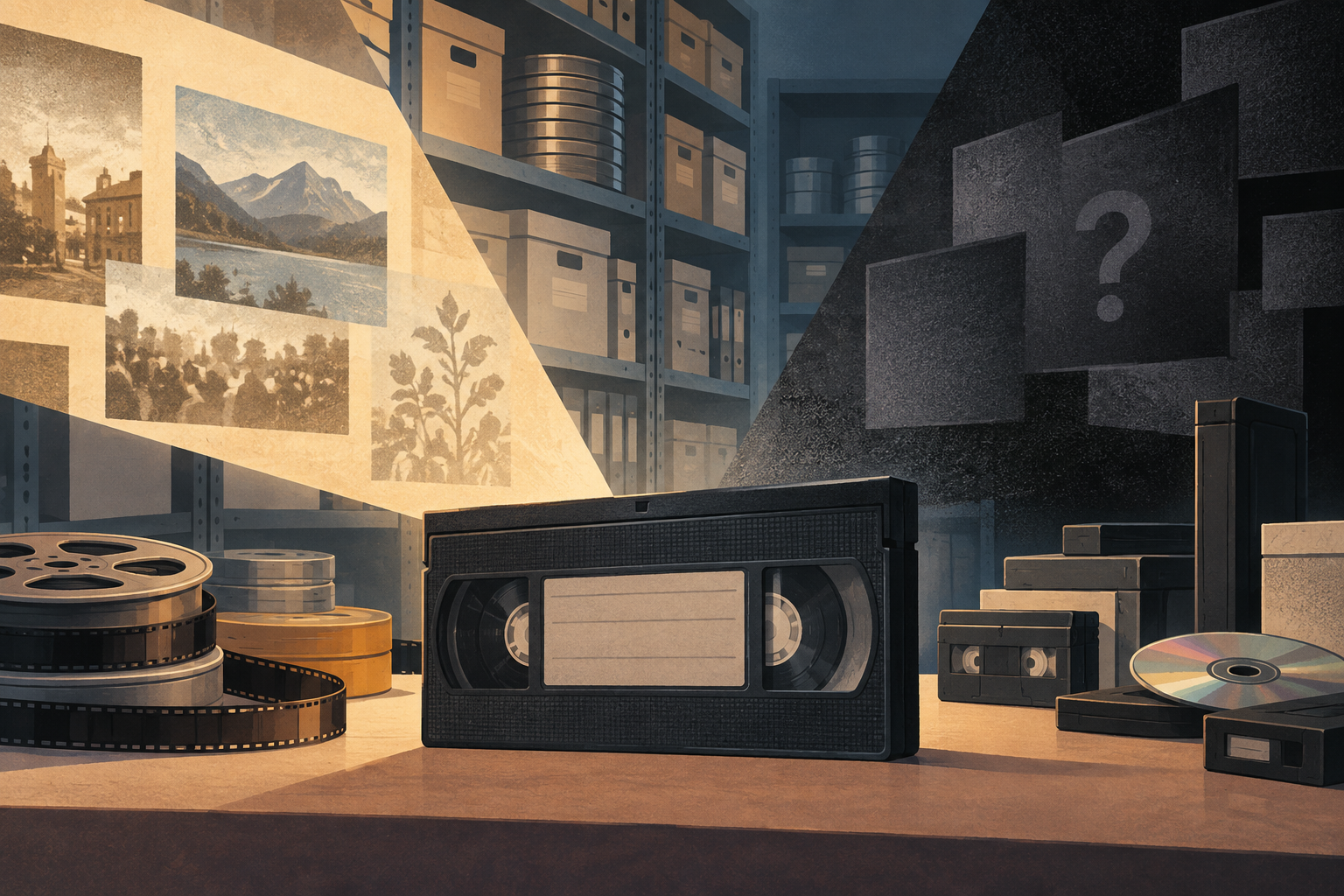
A preserved VHS tape can be a useful clue to the circulation of cinema in the home, but it is not a complete record of that experience. To study it, we need to ask what kind of object it is, who assembled it, what documentation accompanied it, and what the source describing it actually allows us to claim. The presence of VHS in film-library and archival collections shows that the format forms part of certain holdings and consultation practices. It does not, by itself, prove how many people watched a film at home, what they thought of it, or how its reception compared with its theatrical release.
That distinction matters because archives preserve objects, records, and conditions of access—not a transparent collective memory. The material available here supports an examination of that distinction; it does not, however, suffice to reconstruct reception on a film-by-film basis.
Format and content are different questions
A 2017 study by Andrea Cuarterolo places VHS within a discussion of the archive and technical reproducibility. The reference offers a framework for asking what changes when a work circulates in reproducible copies, but the excerpt available does not support more specific claims about the study’s conclusions. We should therefore distinguish the question of format—how a copy is recorded, reproduced, or preserved—from questions about a film’s meaning and reception.
We should also avoid treating every VHS tape as a direct copy of a cinematic original. The sources provided do not identify the provenance, generation, or circumstances of creation of the particular tapes they mention. Without that information, it is not possible to describe their quality, playback history, or relationship to a version released in cinemas with confidence.
Collections document practices of access
Institutional references do show that some collections include home video among their holdings. A project for creating a film museum in Spain describes a video library of more than 1,300 titles in several formats, including VHS, Betacam, and DVD, for consultation on site. According to an article in the journal BID, the Filmoteca de Catalunya holds a collection of 16,000 films on Blu-ray, DVD, and VHS, focused on educational cinema, as well as audiovisual documentation for research.
These figures describe particular holdings and services; they should not be turned into general claims about all archives, their audiences, or their policies. They do invite research into how access changes when a film is available for consultation in a collection, and what information accompanies that availability. To establish who consulted a tape, or why, we would need usage records or other sources not present in the material available here.
Archives bring together formats with different histories
The archive for the Museo Reina Sofía’s Archivos del común V project includes more than five hundred videocassettes in VHS, Hi8, MiniDV, and Betacam formats. A notice from Chile’s National Library, meanwhile, lists VHS and DVD among a range of media that also includes paper, negatives, photographs, and digital files. A university study of the Filmoteca de Extremadura describes its film holdings as tapes in various formats.
Taken together, these examples show that audiovisual preservation and organization involve more than one medium. They do not, however, describe the specific technical procedures of each collection: they provide no information about storage conditions, digitization, restoration, losses, or selection criteria. Those questions require institution-specific documentation and cannot be inferred from the mere mention of a format.
What can be said about cinema and video
The question “How did reception change between cinemas and home video?” is worth asking, but the sources gathered here do not answer it directly. They provide evidence of collections, consultation formats, and debates about archives and reproduction. They do not provide audience surveys, comparative reviews, rental data, or attributable testimony that would allow us to trace changing responses to a particular film.
The most rigorous conclusion is more modest: VHS can be studied as part of the material history of access to cinema and of the composition of certain archives. Going further would require identified objects, searchable catalogues, acquisition dates, documentation about particular editions, and comparable critical or press sources for theatrical exhibition and home video. The tape does not replace the film or the evidence of its reception. It opens a question that archival research must make more precise.
- Decade
- Contemporary
- Region
- Global
- Level
- Enthusiast
- Entities
- VHS, Museum, Museo Reina Sofía
Sources and references
- La Filmoteca de Catalunya: conservación y difusión de ... - BIDbid.ub.edu · 2026-10-01
- Documentación audiovisual, septiembre 2013openaccess.uoc.edu · 2026-10-01
- El archivo en la época de su reproductibilidad técnicawww.vivomatografias.com · 2026-10-01
- PROYECTO DE CREACIÓN DE UN MUSEO DE CINE EN ...eldocumentalistaudiovisual.com · 2026-10-01
- universidad poliriunet.upv.es · 2026-10-01
- Archivos del común V - Memorias fúngicaswww.museoreinasofia.es · 2026-10-01
- Diecinueve candidaturas fueron aprobadas para ser ...www.bibliotecanacional.gob.cl · 2026-10-01