Sources have purposes
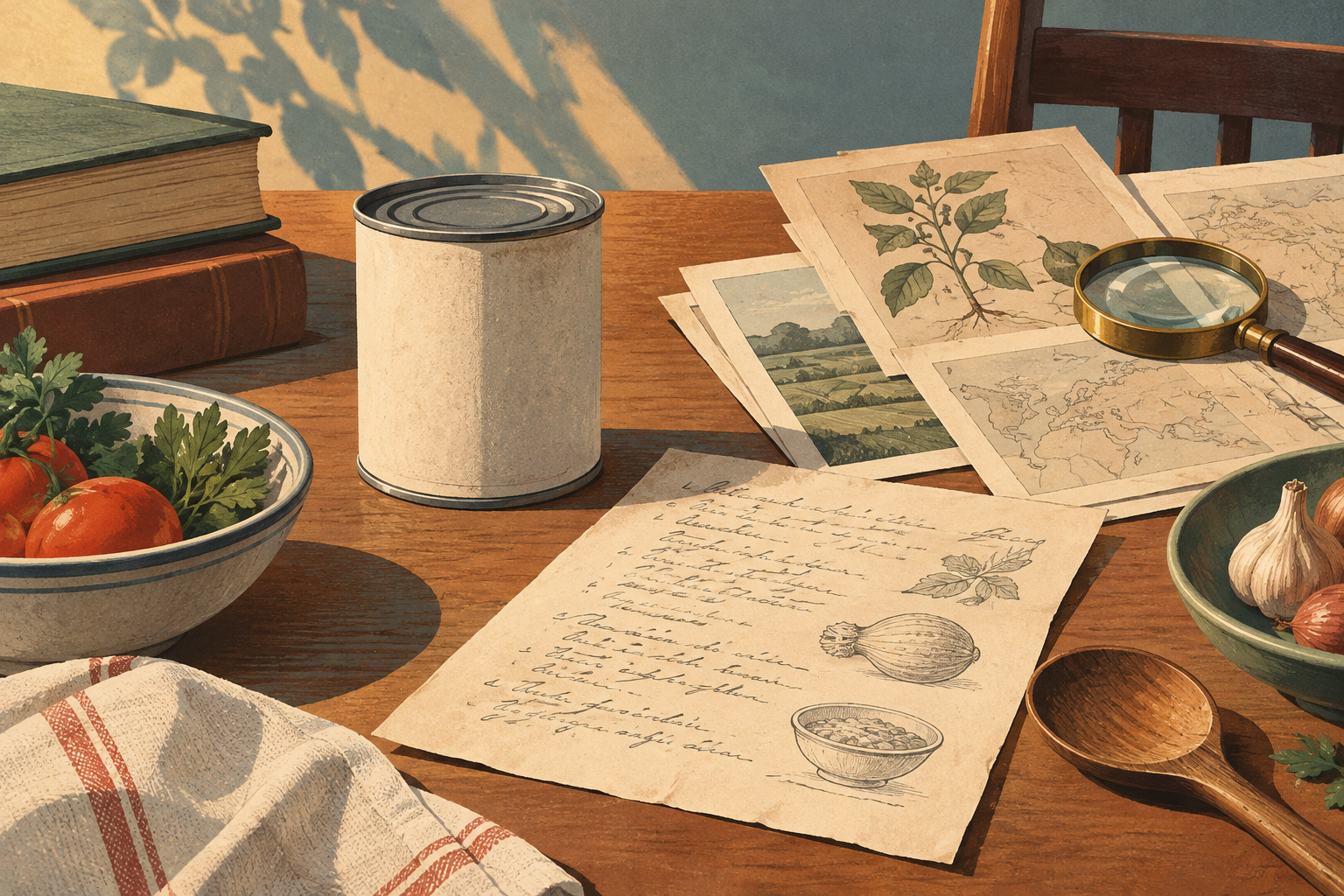
A recipe may record ingredients and steps; packaging may show how a product was presented; an advertisement tries to persuade; an archival file is a trace of activity preserved by an institution. None of these items, on its own, is a complete account of what people ate. Reading them together helps ask better questions, but it does not erase their differences.
RetroPause’s page on Spanish food presents a journey through foods and recipes from different periods. A video featuring María de los Ángeles Pérez Samper describes a similar historical approach. These are starting points for treating food as documentary subject matter, not proof that a particular recipe was common in every household.
Archives: documents in context
The Castile and León Archives initiative “Archives and Gastronomy” points to documentary and bibliographic sources for learning about gastronomy. Its framing recalls a basic precaution: a document has a history of creation, preservation and selection. Before interpreting it, ask who produced it, why, and what kind of activity it could record.
An administrative or bibliographic document may tell us something different from a recipe intended to circulate in a home. The evidence available here does not describe specific cases or reconstruct individual habits. It does support the value of combining documentary and bibliographic sources, and of considering what kind of source each one is before drawing conclusions.
Promotion and everyday practice
Packaging and advertisements should first be read as forms of commercial presentation. They may show how a food was represented or what language was used to offer it, but they do not by themselves prove that audiences accepted that image or consumed the product as suggested. This distinction separates what a company communicates from what a person does.
Recipes also require caution. A recipe can preserve a written or transmitted preparation, but its existence does not automatically show that it was cooked frequently, that its ingredients were accessible to everyone, or that every household followed the same practice. Research into habits benefits from comparison with other kinds of documents and from clearly labelling interpretation as such.
The table as cycle and image
The Museo Reina Sofía exhibition “Sobre la mesa” describes food through cycles such as germination and fermentation, relating it to rhythm and time. This frame takes the discussion beyond consumption: it lets us ask which processes and relationships are included in, or left out of, representations of a meal.
An exhibition’s perspective does not replace research into a domestic kitchen or the reading of a package. It is another kind of source, with its own purpose. It can help organize questions about production, transformation and presentation, provided curatorial interpretation is not mistaken for a direct record of what happened at every table.
Sweets, heritage and limits
The curatorial text for “Edible Heritage: A History of Sweets and Their Female Pastry Makers” frames its subject around sweets and pastry makers. Mercasa’s book “Alimentos con historia” is presented as a work of food-related popularization. These records identify research directions and resources, but the excerpts supplied do not support detailed claims about particular products, recipes or dates.
That limitation is not a problem to conceal. It is part of the work: distinguish what an institutional description says from what would require consulting the full document, exhibition or publication. The useful question is not only what people ate, but which source could answer it—and what gaps it would leave.
Reading sources side by side
To distinguish advertising from habits, begin by describing each item without giving it more reach than it has. Then compare its purpose and context with sources of another kind. A campaign documents a communication strategy, a recipe preserves a preparation, and an archive offers traces shaped by the materials it holds. Bringing them together can enrich an inquiry, but a missing record does not prove that a practice never existed.
Packaging, advertisements and recipe books tell different stories about food. Analysis becomes more precise when it preserves those differences and states its limits. Food culture then appears not as a single illustration of the past, but as a field of questions requiring comparison between representation, documentation and everyday life.
- Decade
- Contemporary
- Region
- Spain
- Level
- Introduction
- Entities
- María de los Ángeles Pérez Samper, Sobre la mesa, Museo Reina Sofía
Sources and references
- De la mesa al archivo: cómo la alimentación se convirtió en ...www.retropause.com · 2026-10-09
- Oriente | María de los Ángeles Pérez Samperwww.youtube.com · 2026-10-09
- Archivos y Gastronomía | Archivos | Junta de Castilla y Leónarchivoscastillayleon.jcyl.es · 2026-10-09
- Patrimonio Comestible: Una historia de dulces y de sus ...www.cultura.gob.es · 2026-10-09
- Alimentos con historiawww.mercasa.es · 2026-10-09
- Sobre la mesawww.museoreinasofia.es · 2026-10-09