A photograph does not arrive alone
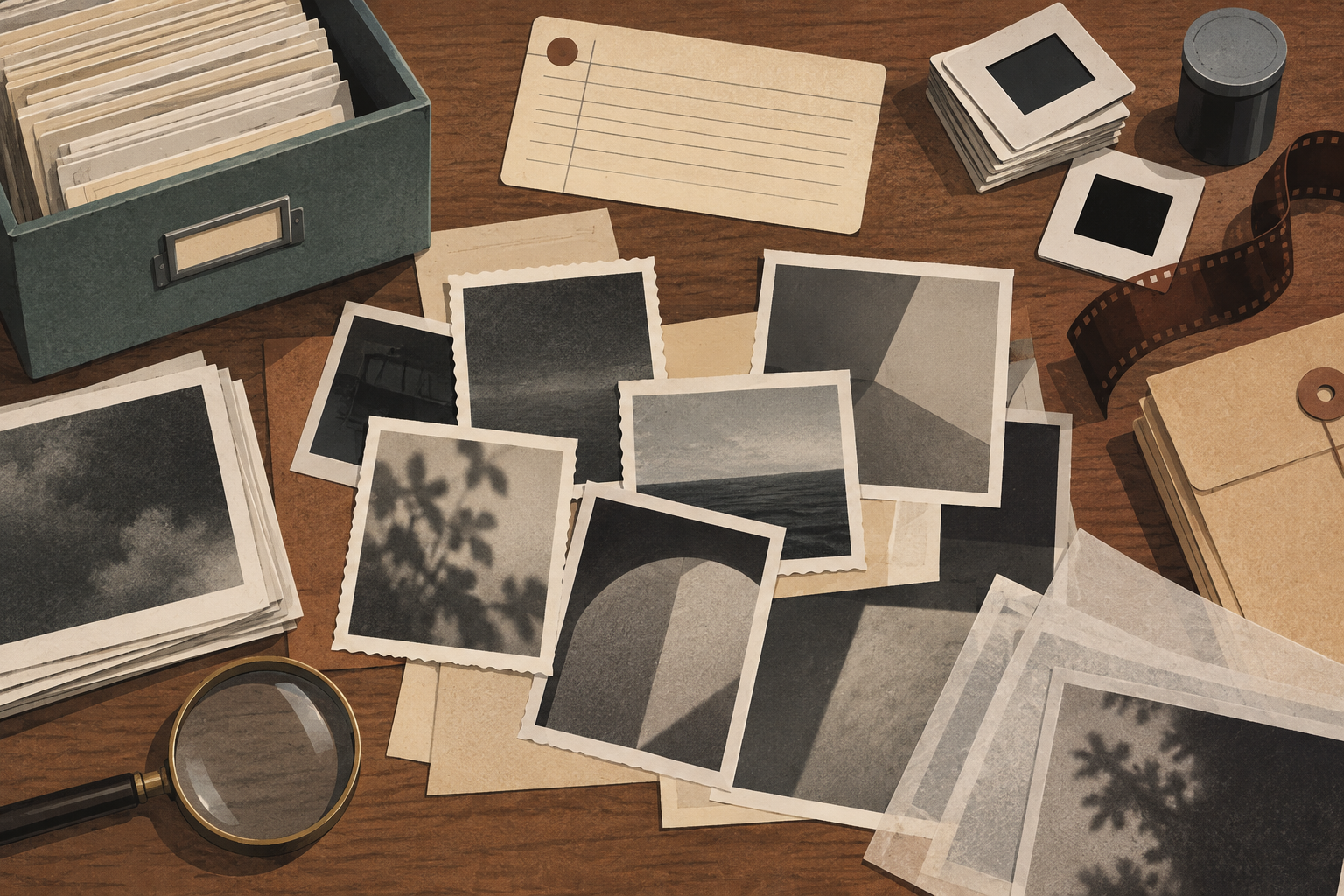
An archival photograph can function as a document, but it is not a self-sufficient document. Interpreting it means attending both to what it depicts and to the information accompanying it: the collection in which it is kept, its description, and the purpose for which it was assembled or consulted. The supplied sources support this approach from different angles. The Photographic Archive of Spain’s Institute of Cultural Heritage (IPCE) reports holding almost half a million images, dating from 1844 to the present. The National Archaeological Museum (MAN), in turn, describes its photographic holdings as valuable for their subject matter, chronology and typology. These facts tell us about collections and their documentary potential; they do not establish how any particular photograph was made.
A collection offers context, not an automatic answer
A collection can help place an image within a documentary grouping, but it does not justify assuming that all items share an author, process or purpose. The MAN photographic archive description says its holdings include documentation produced by the museum since its founding in 1867, as well as donations and purchases. This allows us to distinguish broad categories of provenance. It does not establish the provenance of an individual photograph without consulting its own record.
The distinction matters because a collection may group images by institution, subject, chronology or acquisition history. These are different criteria, and none can replace item-level information. An archive should not become an imagined explanation: it is a framework for asking questions and locating evidence.
Description is also documentation
The Ibermuseos visual documentation protocol stresses that photographing heritage objects is essential to museums’ inventory, registration and documentation processes. Photography can therefore form part of an institutional workflow as well as become an object of study. This function helps explain why a documentary image should be read alongside its record, rather than treated as a transparent window onto the object depicted.
A description helps identify what the institution says about an image and what information has been recorded. It also reveals what remains unspecified. It is not permission to infer details absent from the record: if support, technique or circumstances of exposure are not documented, they should remain open questions.
Archive, circulation and interpretation
The supplied scholarship broadens the picture without authorising a single history of photography. Isabel Argerich’s article “Photography and Archive” is listed in Fotocinema. Another study examines underground photography through the fanzine Rockocó and the Miguel Trillo Archive at the Museo Nacional Centro de Arte Reina Sofía. Its title establishes a research relationship between photography, publication and archive; the supplied description does not give specific images, supports or conclusions, so it would be inappropriate to claim more.
There is also a study of old photographic holdings relating to Aragonese art at the National Library, with notes on the Prado Museum and the National Historical Archive. Together, these titles show that photographs can be investigated through their documentary and institutional associations. They do not, on their own, prove that a particular image circulated in a specific way or that its meaning remained unchanged.
Conservation and the limits of appearances
An IPCE video describes the preventive conservation challenge facing the photographic collection of the Museum of History of Madrid. Another publication from the institute presents intervention work on the Conde de Manila Archive, held by its Photographic Archive. These references make specialist collection work visible, but the supplied information does not detail materials, treatments or outcomes. It would be unsound to turn them into conservation instructions or attribute particular procedures to them.
The question “what process and support explain each image?” requires evidence connected to the item: a record, examination and sufficient documentation. Visual appearance may offer clues, but it cannot by itself confirm a photographic process. Nor does the date range of a collection establish the date of every image it contains.
Reading with evidence and reservations
A photograph’s documentary value emerges from the relationship between image, description, collection and use, without conflating them. Institutional collections show the chronological and thematic breadth an archive can encompass; the cited studies offer examples of research based on collections and publications; museum documentation explains one practical role of photography. Each source allows different questions to be asked.
The editorial conclusion is deliberately cautious: looking at an image begins an investigation; it does not settle it. When information about support, process or context is unavailable, identifying it as unknown is a way to preserve accuracy. A photograph can document, but understanding exactly what it documents also requires reading the archive around it.
- Decade
- Contemporary
- Region
- Spain
- Level
- Enthusiast
- Entities
- Museo Nacional Centro de Arte Reina Sofía, Museum, Archivo Histórico Nacional, Museo Arqueológico Nacional, Museo de Historia de Madrid, Fototeca del Instituto del Patrimonio Cultural de España
Sources and references
- Fotografía y archivodoi.org · 2026-10-09
- Fondos de fotografía antigua sobre el arte aragonés en la Biblioteca Nacional y unas notas sobre el Museo del Prado y el Archivo Histórico Nacionaldoi.org · 2026-10-09
- Una mirada documental de la fotografía underground a través del fanzine Rockocó. Análisis del Archivo Miguel Trillo en el Museo Nacional Centro de Arte Reina Sofía (MNCARS)doi.org · 2026-10-09
- La colección fotográfica del Museo de Historia de Madrid. Un ...www.youtube.com · 2026-10-09
- Archivo fotográfico - | Ministerio de Culturawww.man.es · 2026-10-09
- Fototeca - Instituto del Patrimonio Cultural de Españaipce.cultura.gob.es · 2026-10-09
- protocolo-documentacion-visual.pdfwww.ibermuseos.org · 2026-10-09