The object does not tell the whole story
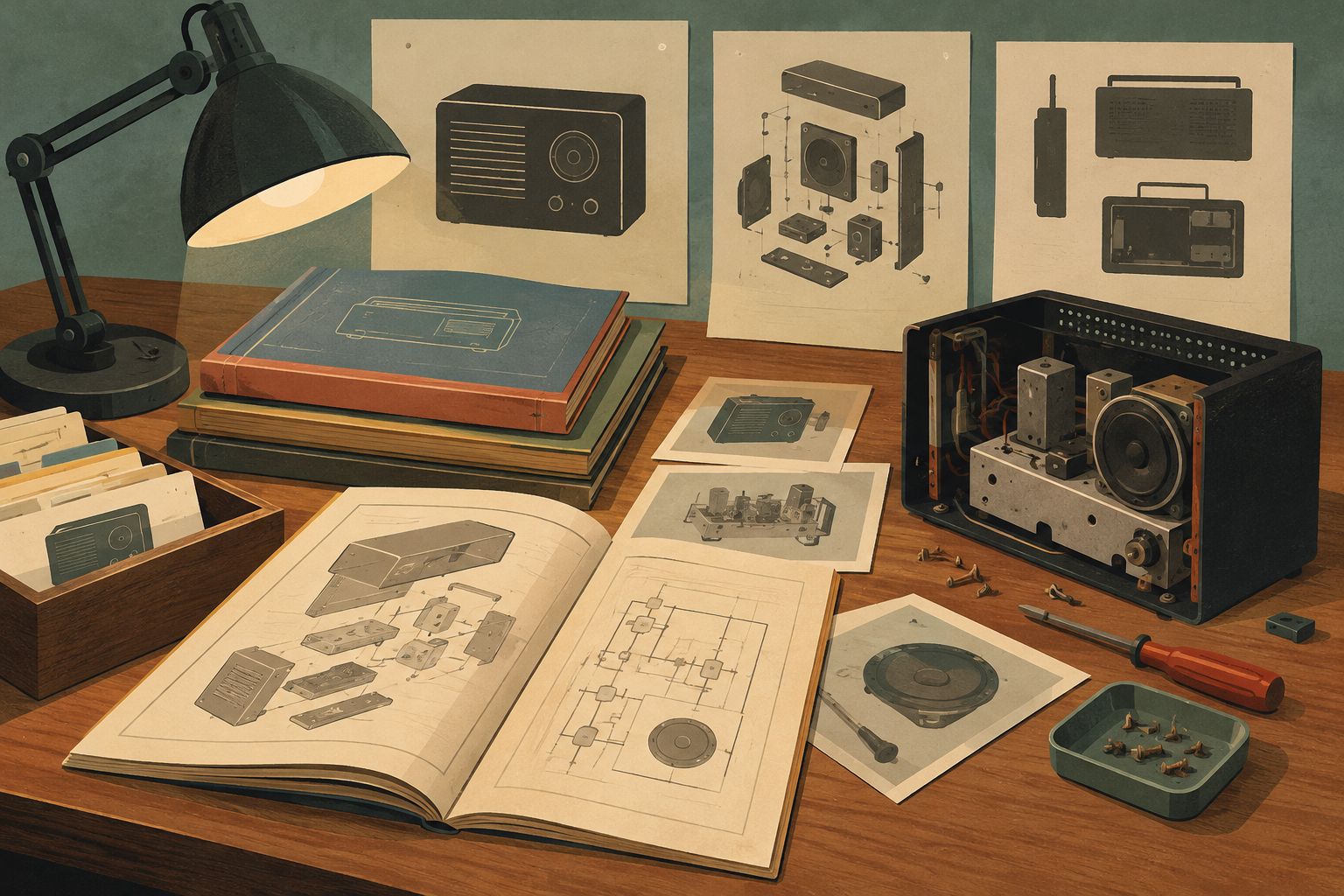
A preserved device lets us observe an object; by itself, it is not enough to reconstruct how it was used, what it promised its users, or what limits it encountered in practice. Those questions require other traces. Archival documentation can help place an object within a history of production, administration or use, but each claim must rest on specific documents rather than on an imagined retrospective scene.
The available sources support a general point: archives play a relevant role in science and technology museums, and their preservation and dissemination form part of those institutions’ work. They do not, however, provide detailed examples of manuals or advertisements for a particular device. This analysis therefore considers how objects and documents might be read together, rather than assigning specific uses to a product the sources do not identify.
What an archive can add
The National Archaeological Museum’s historical archive describes its purpose as facilitating public access, providing information tools that are subject to revision, and encouraging use of its collections. The MUNCYT Archive, for its part, organizes, processes and stores historical and administrative documentation. These descriptions show distinct but complementary archival functions: making holdings accessible and keeping them organized and preserved.
For technology research, this suggests looking for verifiable relationships between an object and its documentation: what records exist, who produced them, what activity they concern, and whether they describe a proposal, an administrative process or an experience of use. It does not justify assuming that every device has a complete file, or that an administrative document describes how the public used it.
Documentation is also interpretation
Documentation is not a neutral supplement that simply fills gaps. Decisions about what is described, preserved or made available for consultation shape the questions that can be asked later. The Tábula article on archives in science and technology museums emphasizes their role in preservation and dissemination. That supports the institutional importance of archives; by itself, it does not establish the content or coverage of any particular collection.
It is therefore useful to distinguish kinds of evidence. An archival record may establish that a document exists or belongs to a collection; its contents can support a more specific claim if they have been consulted and understood in context. Here, the available material consists only of general descriptions of services and bibliographic summaries. We have no transcriptions of manuals, advertisements or usage documents. That limitation matters: it would be wrong to turn a research possibility into a documented fact.
Digital tools extend the record; they do not replace analysis
An academic article on 3D digitization of cultural heritage in museums presents digitization and 3D technologies as resources related to documentation, conservation and dissemination. The source provided does not contain enough detail to say how they were applied to a particular device. It does allow us to note that digital representation can be part of contemporary heritage documentation practices.
A representation, however, is not automatically equivalent to the object or its history of use. Studying a device’s experience would require knowing what the model records, how it was produced and which documents can be used to check it. Without those details, a digital image may help us observe a form, but it cannot prove what a user did, what instructions they received or what result they achieved.
Limits make the history more reliable
Other supplied references address preventive conservation of documents in archives and libraries, preservation of audiovisual documents, and the use of digital technology in conserving architectural heritage. These are different fields; they should not be treated as if they described the same kind of device. Taken together, they do show that preserving documents and applying digital tools are subjects studied in their own contexts.
The practical conclusion is modest and useful: connect an object to identifiable documents, distinguish consulted content from catalogue descriptions, and make gaps explicit. The question “what real uses distinguished each device?” cannot be answered from an apparatus’s shape or a general story of technological progress. It requires sources documenting those uses. When they have not yet been found, acknowledging that fact does not weaken the history; it marks precisely where research should continue.
- Decade
- Contemporary
- Region
- Spain
- Level
- Introduction
- Entities
- Museum, Museo Arqueológico Nacional
Sources and references
- Conservación y Restauración del Patrimonio Cultural en soporte Papel - Museo Jesuítico Nacional de Jesús Maríadoi.org · 2026-10-07
- Conservación preventiva de documentos en archivos y bibliotecas. Experiencias, metodologías y políticasopenalex.org · 2026-10-07
- Conservación y preservación de documentos audiovisualesopenalex.org · 2026-10-07
- El archivo en los museos de ciencias y tecnologías | Tábulapublicaciones.acal.es · 2026-10-07
- Archivo histórico - | Ministerio de Culturawww.man.es · 2026-10-07
- Archivomuncyt.es · 2026-10-07
- La digitalización 3D del patrimonio cultural en museosrevistaseug.ugr.es · 2026-10-07