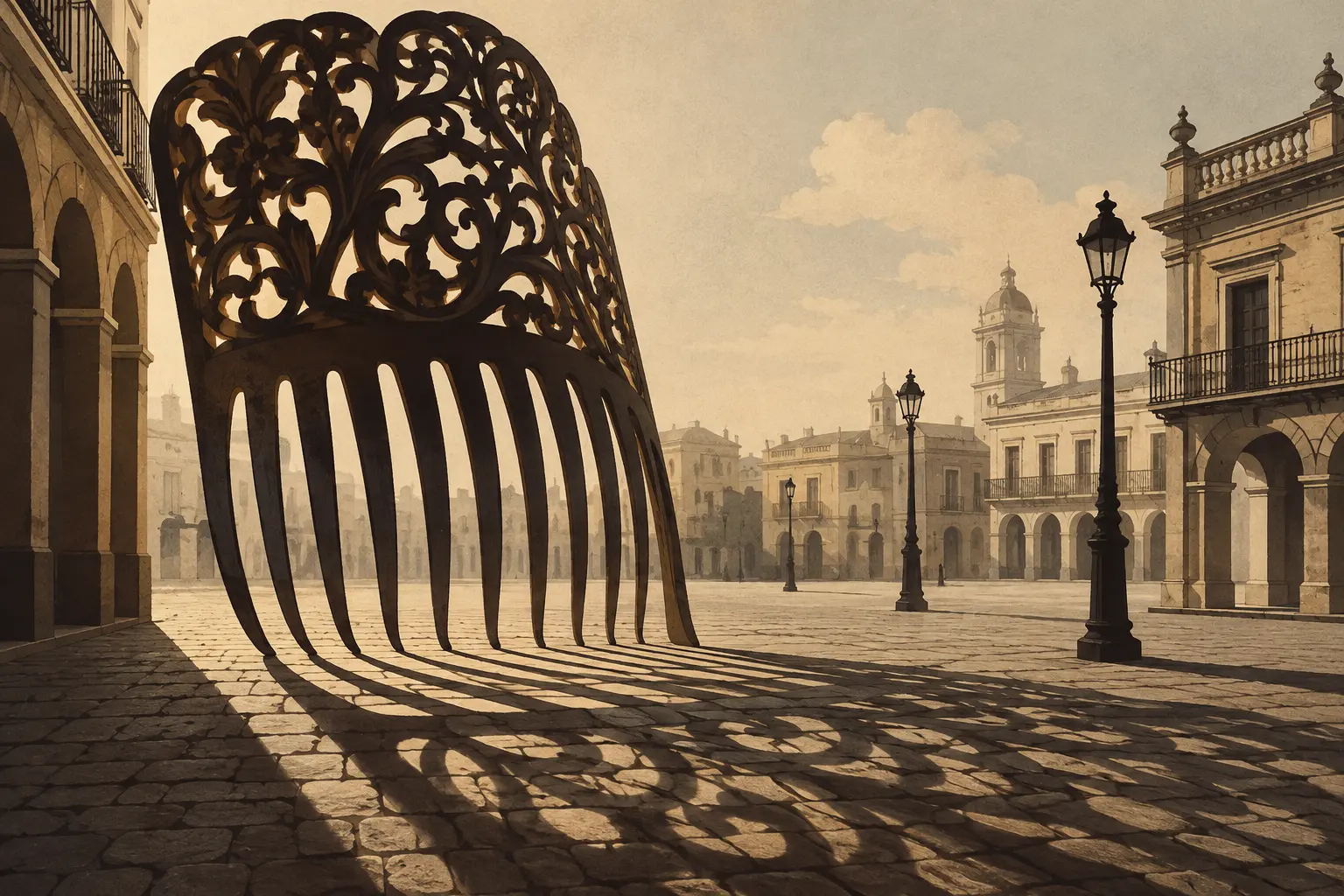
The peinetón, an oversized ornamental comb that became fashionable in Buenos Aires and Montevideo from the late 1820s to the mid-1830s, turned an accessory into a subject of public debate. Its scale made it hard to ignore; its production relied on skilled labor, and its use appears in portraits, lithographs, newspapers and travel accounts. Together, these traces make it possible to study fashion as material culture and social practice, though they do not provide a complete record of what the population wore.
From peineta to peinetón
The peinetón was related to the Spanish peineta and European fashions, but it was not simply a copy of either. Researchers describe it as a Río de la Plata adaptation, shaped by outside references and transformed in a local context. The fashion for increasingly large combs gathered pace in the 1820s; commercial competition and customer demand encouraged conspicuous designs.
Manuel Masculino was one of its most prominent makers and promoters. Yet his role as inventor is disputed: the evidence does not establish one person as its creator with certainty. Some studies interpret the peinetón as a product of competition and the market, and emphasize women’s role in establishing the fashion.
The object combined a comb that held it in the hair with a visible ornamental field. It was made mainly from tortoiseshell, although horn and other materials were also used. Pieces varied in shape, size and decoration, so the maximum dimensions cited in some accounts convey the impression its scale made rather than describing every example. In portraits, the peinetón appears with different hairstyles and outfits, often alongside fitted-waist dresses, voluminous sleeves and rebozos.
A fashion seen from different angles
Portraits by Charles Henri Pellegrini and other artists show how some women wore the peinetón. The genre lithographs of César Hipólito Bacle offer a different perspective: they depict urban scenes and sometimes turn the accessory’s size into a joke. Newspapers and travel accounts record astonishment, praise and criticism. Each kind of source has its own purpose: a portrait presents a selected person and outfit; a caricature exaggerates; a chronicle conveys its author’s point of view.
Images and commentary therefore cannot be treated as a survey of dress. They help reconstruct representations and possible uses, but cannot establish that all women wore the peinetón or that depicted scenes reflected everyday practice. Read alongside inventories, surviving objects and records of production, they offer a fuller history without turning the appearance of visible groups into a description of society as a whole.
Price, labor and unequal access
Imported tortoiseshell and skilled workmanship made the peinetón expensive, which is why it is often associated with elite women. Studies nevertheless note that the desire to own one, and some ways of wearing it, were not necessarily limited to that group. The evidence does not justify claiming that all women wore it or that it was equally accessible to everyone. It is more accurate to describe a highly visible fashion, with objects at different price points and unequal distribution.
Production also brings into view the labor that can disappear when the comb is treated only as decoration. Accounts of workshops describe several stages of preparation and finishing and mention racialized workers, including enslaved and formerly enslaved people. The history of the peinetón thus connects taste and consumption with the organization of labor and social hierarchies in the region.
The street as a site of contest
In a region marked by post-independence change, the peinetón has been studied as part of the formation of a Río de la Plata identity, in dialogue and tension with Spanish and French references. This does not mean it had a single political meaning: interpretations of its significance do not erase the varied experiences of those who wore it.
Its size made women wearing it highly visible in urban space. Caricatures about people struggling to pass one another and chronicles commenting on its volume show that the accessory prompted debate. Some academic interpretations see this visibility as a form of women’s intervention in public spaces where their presence was restricted. Other readings stress that becoming visible did not automatically mean emancipation: luxury consumption, gender norms and social criticism also shaped its use.
That tension is central to understanding the peinetón. It could amplify women’s presence in the street while also making them targets of comment or caricature. Fashion did not suspend social constraints; it made them visible and, at times, open to dispute.
From a brief trend to material evidence
The peinetón was especially popular in the first half of the 1830s and had fallen out of fashion by the end of the decade, although sources do not always agree on the pace of its decline. Its historical significance does not depend on how long the trend lasted. Portraits, prints, newspapers and surviving objects allow researchers to examine materials, techniques, representation and debates over gender, belonging and public space.
Peinetones are now held in Argentine museum collections, including the Museo Histórico Nacional and the Museo Histórico de Buenos Aires Cornelio de Saavedra. Studied alongside images and documents, these objects help reconstruct not only what a fashion looked like, but who could make it, acquire it and occupy the street in it. The peinetón does not show what everyone wore; it reveals how an accessory and its representations can illuminate taste, inequality and social negotiation.
- Decade
- Before 1950
- Region
- Latin America
- Level
- Enthusiast
- Entities
- Museum, Peinetón, Buenos Aires, Peinetón rioplatense, Museo Histórico de Buenos Aires Cornelio de Saavedra
Sources and references
- Los tejidos en las colecciones de los museos españoles, una larga historia de valoración y conservaciónopenalex.org · 2026-11-03
- Museos de moda del mundo: por qué son archivos vivosinstitutodemoda.com · 2026-11-03
- Los mejores —y más elegantes— museos de moda del ...es.qz.com · 2026-11-03
- El archivo y lo análogo como MEMORIA, haciendo resistencia ...valeriaakl.substack.com · 2026-11-03
- Peinetónes.wikipedia.org · 2026-11-03