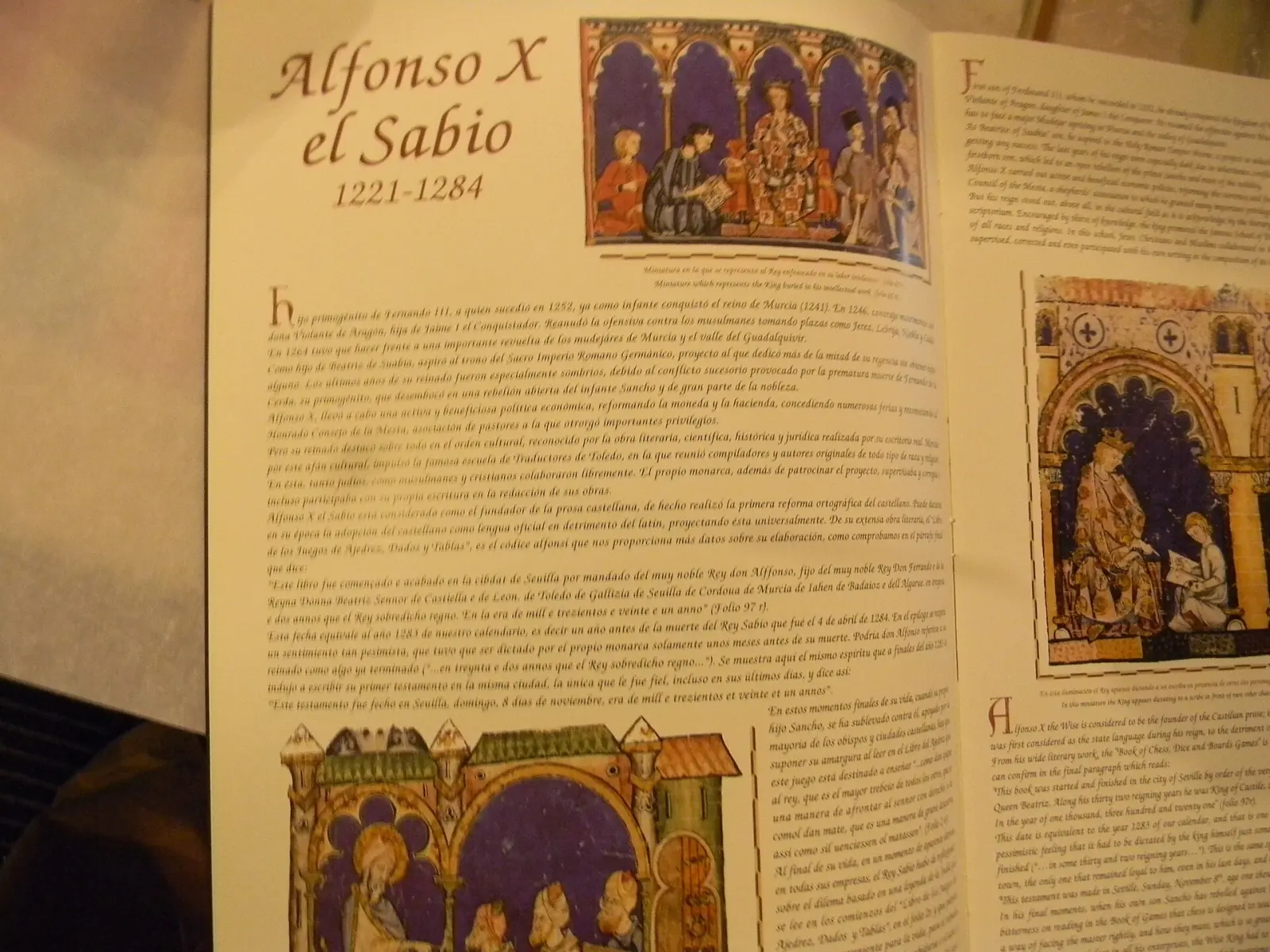
The history of board games in Europe is often narrated as a succession of inventions, but there is a document that marks a paradigm shift: the Libro de acedrex, dados e tablas. Compiled under the mandate of Alfonso X the Wise in 1283, this manuscript is not a simple pastime, but a tool of social order. Unlike the scattered mentions in earlier chronicles, this work dedicates its entire structure to the technical description of three game systems: chess, dice, and tables. Its relevance lies in the fact that it transforms oral and local practices into a written, standardized, and visually documented text, laying the foundations for what we today understand as a rulebook.
The context of a court in conflict
The production of this book did not occur in a vacuum of peace, but amidst internal political tensions in the Crown of Castile. Alfonso X, known for his patronage and interest in science, used culture as an instrument of legitimation and cohesion. The fact that the manuscript was created during a period of instability adds a layer of complexity to its interpretation. It was not just a book of entertainment, but a statement of cultural power. By systematizing the game, the Castilian court positioned itself as a center of knowledge and refinement, capable of codifying even the rules of chance and strategy.
The structure of the manuscript
The document consists of 98 pages and contains over 150 illustrations. This combination of text and image is crucial. The miniatures are not decorative; they are visual instructions. They show how pieces were arranged, the geometry of the boards, and the specific positions of the players. For chess, the illustrations allow us to see the initial arrangement of the pieces and the movement rules that, although they would evolve later, were already clearly defined. For tables, the images show the 30-square board and the pieces, offering tangible evidence of how this game was played on the Iberian Peninsula during the 13th century.
Chess: from Persian tradition to European norm
The chess described in the book has roots in Indian chaturanga and Persian shatranj, but the Castilian version presents its own particularities. The text details the rules of capture and the objective of checkmate, although the pieces and their movements may vary slightly from the modern form that would be consolidated in the 15th century. This manuscript is fundamental for tracing the transition of the game from a flexible courtly practice to a system of rigid rules. By writing the rules, Alfonso X contributed to the standardization that would allow future competitions and the spread of the game across European borders.
Dice and the management of chance
The importance of games of chance in medieval culture is often underestimated. The Book of Games devotes a significant section to dice, documenting not only how they were thrown, but also the bets and the rules of the different dice games. This reveals a society that had a complex relationship with luck. Dice are random number generators, and their regulation in a royal text indicates that chance was not seen as something chaotic, but as a system that could be understood, regulated, and even strategically exploited. This aspect is key to understanding the evolution of board games as systems of decision under uncertainty.
Tables: a game of strategy and speed
Tables, also known as tawla, are the third pillar of the manuscript. Unlike chess, which is a game of pure strategy, tables combine strategy with chance, as the movement of the pieces depends on the result of the dice. The text describes the rules of blocking, doubles, and the conditions for victory. The illustrations show boards with 30 squares, confirming the spread of this variant in Europe. The study of tables in this context allows us to understand how board games evolved to incorporate elements of risk, a characteristic that persists in many modern games.
The visual and material legacy
The over 150 illustrations of the manuscript are an invaluable source for art and game historians. They allow the reconstruction of the aesthetics of the boards and pieces of the time. The colors, shapes, and symbols used in the miniatures offer clues about the cultural symbolism of the Alfonsine court. In addition, the manuscript serves as a testimony to the technique of medieval miniature, showing how art and science intertwined in the production of knowledge. The quality of the illustrations suggests that the book was a work of great value, intended to be preserved and studied, not just read.
Conclusion: the game as a system of knowledge
The Libro de acedrex, dados e tablas is not just a historical document, but a milestone in the history of material culture. By systematizing the game, Alfonso X contributed to the creation of a common language for strategy and chance. This manuscript marks the starting point for the standardization of board games in Europe, laying the foundations for the evolution of these decision systems. Its study reminds us that the game is not just entertainment, but a way of organizing the world, of establishing rules, and of understanding uncertainty. In an increasingly digital world, this medieval manuscript remains a source of inspiration for understanding how rules and chance interact in game systems.
- Decade
- Before 1950
- Region
- Spain
- Level
- Enthusiast
- Entities
- Ajedrez, Chaturanga, Libro de los juegos
Sources and references
- (PDF) Estudio sobre la evolución del juego de mesa y su ...www.academia.edu · 2026-10-23
- Historia del juego - Wikipedia, la enciclopedia librees.wikipedia.org · 2026-10-23
- La influencia del juego para potenciar el desarrollo infantil ...www.cervantesvirtual.com · 2026-10-23
- Libro de los Juegos de Alfonso X | Facsímil, historia y miniaturascodicesybeatos.com · 2026-10-23
- El antiguo invento que dio origen al juegotranslate.google.com · 2026-10-23
- Ajedrezes.wikipedia.org · 2026-10-23