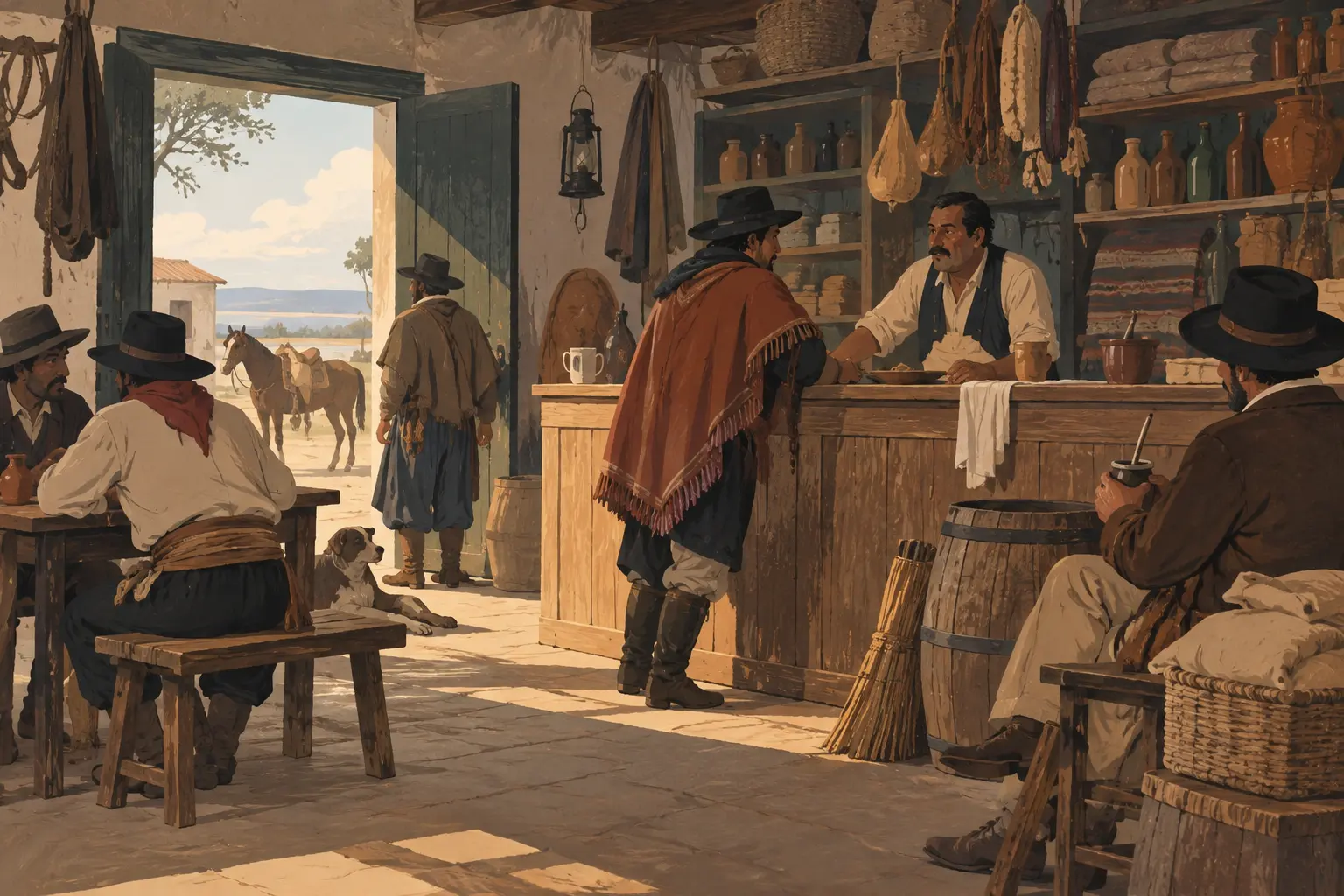
A pulpería was a neighborhood shop and, in some contexts, also a place to meet. Studying it through social history means doing more than listing the goods it sold. It means asking how material exchange, everyday needs, and sociability intersected—and who could take part. The answer depends on the locality and the people who frequented each establishment.
The volume Vivir en la frontera. La casa, la dieta, la pulpería y la escuela (1770-1870), edited by Carlos Mayo, places these shops within a broader history of everyday life. Housing, food, schooling, and the pulpería appear as related settings rather than isolated subjects. This framework helps situate the Río de la Plata frontier in its material and social dimensions, but it does not establish that every shop operated in the same way.
Objects in their social context
Cecilia Moreyra’s study of household furniture in late-eighteenth-century Córdoba offers a way to think about the relationship between objects and social life. Moreyra argues that objects acquire meaning through their use in concrete practices and relationships. Drawing on inventories, she examines furniture in reception rooms, estrados, and bedrooms, showing how furnishings could serve practical purposes while also expressing distinctions of social position and gender.
Her study concerns homes, not pulperías, so it does not show how any particular shop was organized. It does, however, suggest relevant questions: Who had access to an establishment? What exchanges took place there? How did relations between sellers and visitors vary? Answers require evidence tied to each shop and community. Material culture provides an avenue of analysis, not a substitute for such evidence.
One setting, different experiences
The possibility of shopping and meeting in the same place makes the pulpería worth examining as a point where material needs and sociability could meet. But that combination should not be turned into a universal picture of frontier life. A documented case alone cannot establish that all shops offered the same conditions, drew the same groups, or held identical importance in local life.
This care with scale also helps distinguish commerce from other everyday settings. Homes, schools, and places of exchange could meet different needs and sustain different kinds of relationships. Placing the pulpería alongside them makes it possible to ask what these spaces shared and how they differed, without reducing frontier life to a picturesque scene of gathering.
The pulpería thus offers a vantage point for studying how exchange, needs, and sociability intersected in particular contexts. Local detail matters: specifying who visited and which practices are documented turns the general idea of a meeting place into a more rigorous social history.
- Decade
- Before 1950
- Region
- Latin America
- Level
- Introduction
- Entities
- No linked entities
Sources and references
- LAS FUENTES PARA EL ESTUDIO DE LA VIDA COTIDIANAdoi.org · 2026-10-29
- FAMILIA Y VIDA COTIDIANA, II.doi.org · 2026-10-29
- LOS PROTAGONISTAS DE LA VIDA COTIDIANA, IV.doi.org · 2026-10-29
- Breve historia de la vida cotidiana de la Edad Media occidental ...www.amazon.com · 2026-10-29
- Vida cotidiana y entorno material. El mobiliario doméstico ...journals.openedition.org · 2026-10-29