A decade of overlapping styles
Fashion in the 2000s is best understood as a coexistence of styles rather than a single silhouette. Everyday clothes, runway collections, music scenes and celebrity images offer different perspectives on the decade. They show what was being proposed and circulated, but they do not establish that everyone dressed alike.
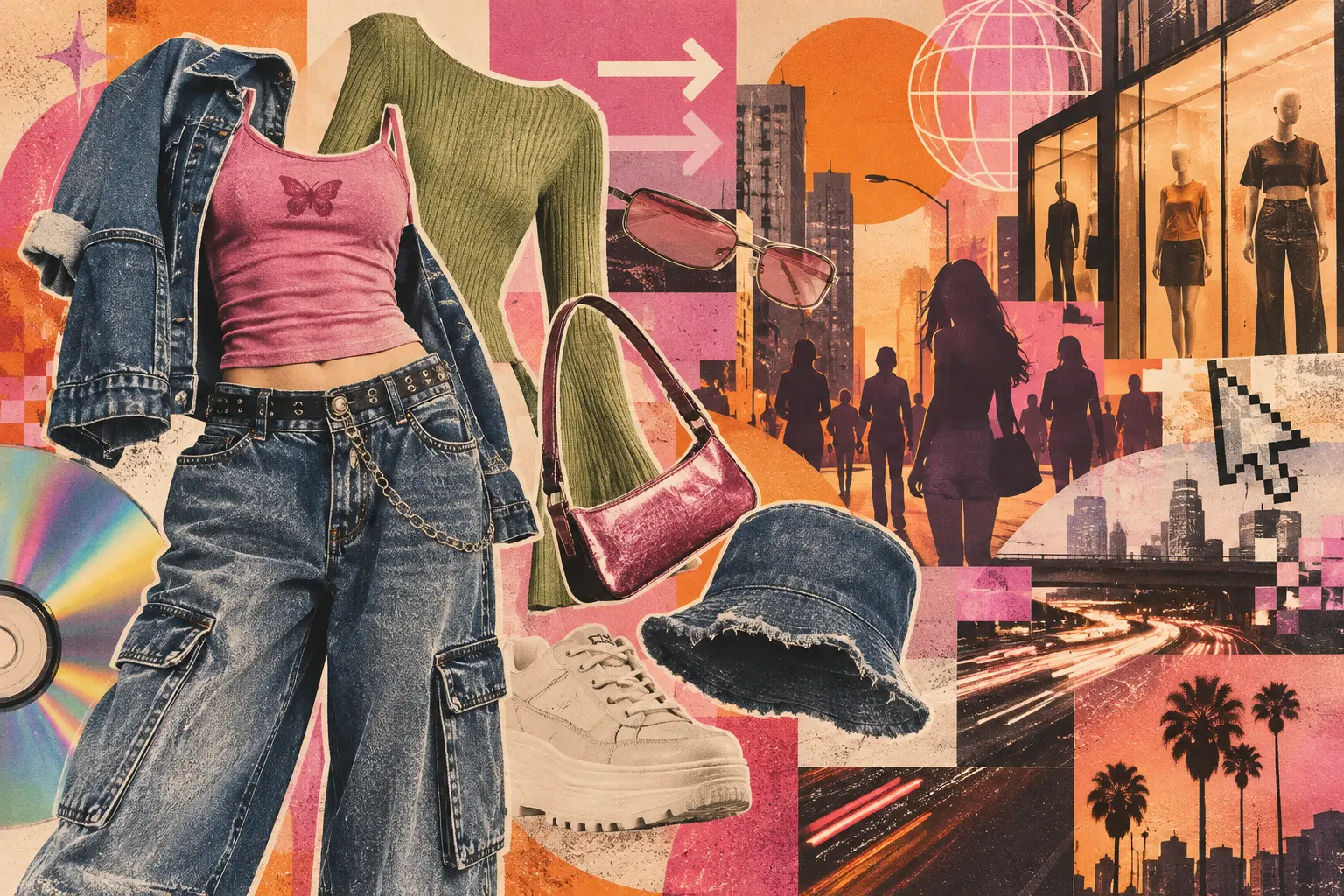
Jeans provide a useful thread through the period. In the early years, low-rise flared styles were highly visible; bootcut cuts gained ground by mid-decade, and skinny jeans became prominent from 2005. Distressed and ripped versions were also widespread. Denim appearing even on red carpets shows how a casual garment could move between settings. Photographs of public figures, however, cannot by themselves describe what the population as a whole wore.
From boho to must-have pieces
Boho style mixed vintage and second-hand references with pieces from boutiques and fashion labels. This distinguished it from the grunge of the 1990s: a worn appearance could still be a carefully assembled and commercialized choice. Sienna Miller became associated with the look; her media visibility shows how the style circulated, not how many people adopted it.
Mini skirts, cropped tops and Ugg boots coexisted with recognizable items such as Juicy Couture velour tracksuits and Von Dutch trucker hats. Roland Mouret’s Galaxy Dress, introduced in 2005, illustrates another route to visibility: a runway garment associated with celebrity appearances that prompted more affordable versions. The press and visual culture could present such pieces as “must-haves” without making them a universal uniform.
Music and menswear
The relationship between fashion and music was particularly visible in menswear. The narrow silhouette associated with Hedi Slimane at Dior Homme—slim trousers, blazers and skinny ties—engaged with the indie scene and bands such as The Strokes and The Libertines. Similar garments later appeared on the high street. Hip-hop popularized other combinations: loose jeans, sports jerseys, padded jackets and sneakers.
These were not exhaustive or mutually exclusive styles, but references that media presented as emblems of particular music scenes. Their coexistence shows that menswear in the decade did not follow a single direction.
The internet, retail and speed
The online circulation of celebrity images and the growth of e-commerce brought runway looks closer to a wider audience. Retailers could quickly offer commercial versions of high-fashion designs, while collaborations between designers and major chains made that connection explicit.
Karl Lagerfeld’s collection for H&M, launched in November 2004, was an early milestone in this strategy. Contemporary coverage described extraordinary demand and very rapid sell-outs in some stores. The episode illustrates how a collaboration could attract attention and customers, but it did not erase the difference between a luxury garment and its commercial version.
The faster circulation of images, copies and sales changed the pace at which a trend could reach the market and be reinterpreted. Wide circulation did not mean that every social group adopted a trend in the same way.
The end of the decade
By 2008, interest in handmade garments such as chunky knitwear was growing alongside a bohemian, craft-oriented aesthetic. At the same time, some collections revived structured silhouettes associated with the 1940s and 1980s: Alexander McQueen worked with 1940s references for spring 2008, while Marc Jacobs evoked the eighties in his spring 2009 collection.
Photographs, magazines, preserved garments and runway archives make the decade look like a rapid circulation of diverse styles, not a unified fashion. Read carefully, these sources show which clothes were displayed and who wore them without turning a campaign, runway show or celebrity into a portrait of everyone’s everyday life.
- Decade
- 2000s
- Region
- Global
- Level
- Enthusiast
- Entities
- Internet, Karl Lagerfeld
Sources and references
- 2000-2009 | Cronología de la historia de la modatranslate.google.com · 2026-11-04
- Historia de la moda - Wikipedia, la enciclopedia librees.wikipedia.org · 2026-11-04
- Biblioteca — Historia de la Modahistoriadelamoda.net · 2026-11-04
- ÁREA 09 - Museo del Trajemuseodeltrajevirtual.com · 2026-11-04
- Historia de Barcelonaes.wikipedia.org · 2026-11-04