From Tirabala.com to a production studio
Ánima Estudios was founded in Mexico City in 2002, growing out of the team behind Tirabala.com, the animation channel on the Alo.com portal. When the portal closed, Fernando de Fuentes and José Carlos García de Letona, together with other partners, retained part of its creative staff and drew on the experience and resources already in place to establish a studio with a different ambition: keeping teams employed and producing work for film and other media on a continuing basis.
The shift in scale mattered. Short web animation could be made on schedules and in formats quite different from those of a feature film. Producing features meant sustaining teams for months, organising workflows, and finding financing and distribution. The founders initially planned a sequence of three features, hoping to reuse technical resources and put each film’s earnings toward the next. The plan aimed to reduce the gaps between projects, but it could not remove the financial risk inherent in long productions.
The focus on family films reflected an opportunity the founders saw in the Mexican market: locally produced animation for cinemas was scarce, and family releases depended heavily on imported titles. At the same time, the studio continued to work in television formats. During the production of its first features, it developed short television projects, including Cascaritos, creating a parallel route to activity beyond cinema.
Magos y gigantes: learning through a first feature
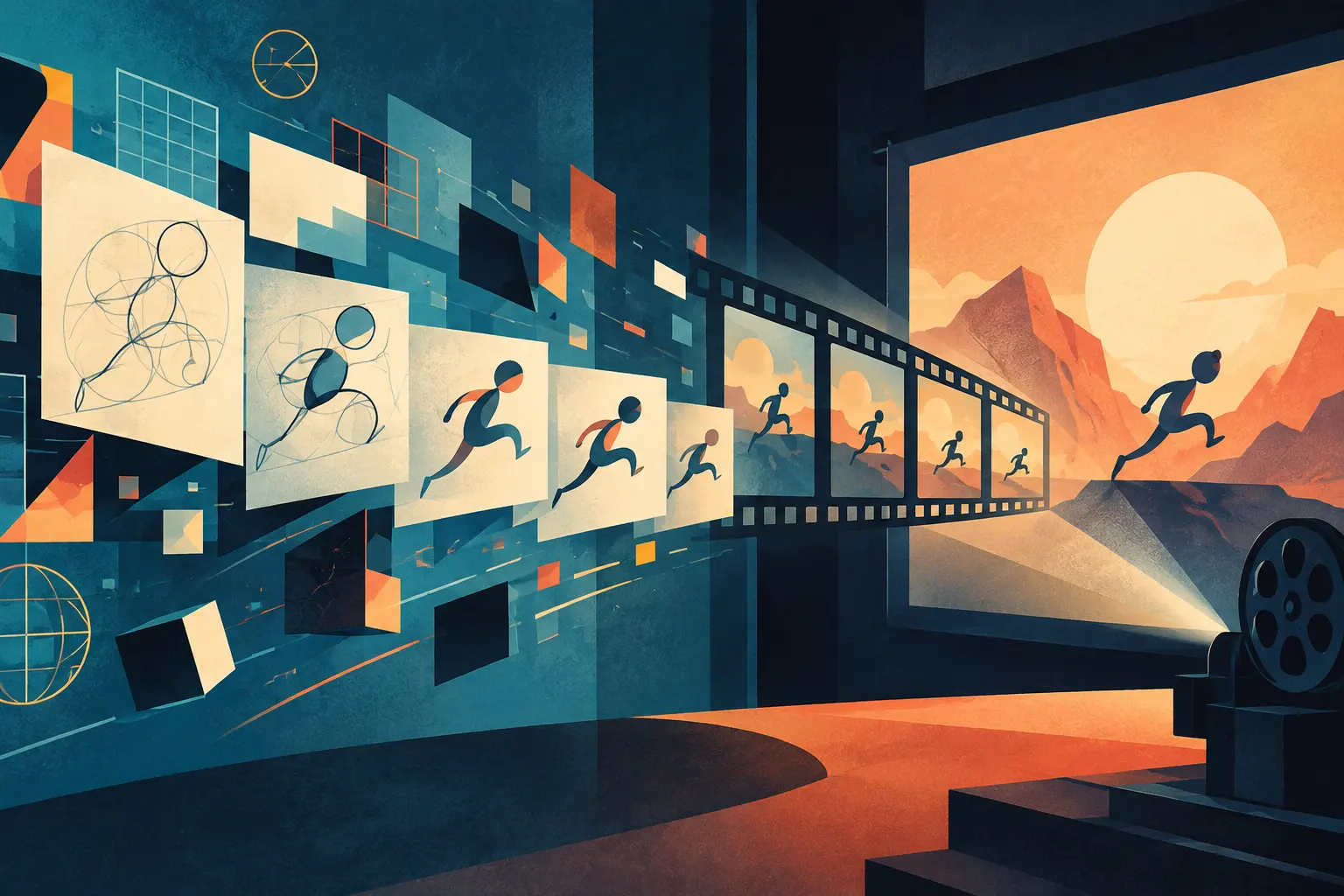
Released in November 2003, Magos y gigantes was Ánima’s first feature. It relied mainly on digital 2D animation, using cut-out techniques and a combination of motion interpolation and frame-by-frame drawing. Macromedia Flash was part of the workflow. The team was small and young, and some members learned digital tools while making the film.
The project also exposed a tension between new techniques and the experience of Mexican animation that came before. Some veteran animators did not join a fully digital process, while the film drew criticism for its distance from recognisable Mexican cultural references. Some commentators saw its fantasy setting and genre conventions as close to foreign models. This was more than a question of style: it raised the issue of what could count as a distinct cultural identity in an industry trying to revive itself and adopt new production methods.
The film received mixed reviews. Some praised its humour, story and positive values; others criticised its script and animation. Its box-office performance began moderately but ultimately remained limited. Contemporary coverage pointed to factors including competition from imported releases, promotion and release timing. The experience showed that finishing a film and reaching an audience were separate challenges: technical capacity alone was not enough without visibility and an effective distribution strategy.
Imaginum: expanding the toolkit and financing model
While its first film was being completed, Ánima began work on Imaginum, released in 2005. The production combined 2D-drawn characters with computer-generated 3D settings and objects. This broadened the studio’s technical repertoire without abandoning two-dimensional character animation. It also reflected the learning accumulated from one project to the next: combining techniques made it possible to explore greater visual depth and organise a more complex production.
The change was not only technical. Unlike Magos y gigantes, which was financed with private capital, Imaginum received support from Fidecine, the fund of the Mexican Film Institute. Alongside Una película de huevos, it was among the first animated features backed by the fund. The project also received support from private companies. Combining public and private resources offered one possible way to sustain animation production in a field where long schedules make reliance on a single source of income difficult.
Distribution changed as well. After working with 20th Century Fox on Magos y gigantes, Ánima reached an agreement with Videocine for Imaginum’s Mexican release. The theatrical opening was scheduled for August, when children returned to school: the distributor hoped word of mouth among pupils would help the film and that the timing would reduce competition from major summer releases. The decision reflected how much a film’s performance depended on factors beyond animation, without guaranteeing a larger audience.
Reviews were again mixed. Some commentators noted the film’s closeness to US animation conventions and the scarcity of recognisable Mexican cultural elements; others highlighted the production’s development and technical experimentation. Its box-office run was modest and did not, by itself, recoup the investment. In time, however, international television and home-video distribution carried the film to numerous countries. Its trajectory invites a distinction between theatrical performance and a work’s later circulation.
An industry built on continuity
Ánima’s early years show that building an animation studio was an industrial challenge as much as an artistic one. A team formed in web animation went on to develop features and television projects, retain staff between productions and reuse technical resources. That continuity could foster cumulative learning: skills acquired on one film did not necessarily disappear when production ended.
Yet organisational continuity did not mean financial stability. The results of Magos y gigantes and Imaginum made clear that production infrastructure could not guarantee an audience, cost recovery or critical success. Financing, promotion, release schedules and distribution agreements were part of the same challenge as technique. In this sense, the two films matter not only as a company’s first titles, but also as tests of a model for producing Mexican animation at a time when locally made features were scarce.
Their story also shows how an industry is built: through teams that remain in place, tools that can be reused, new funding sources, and relationships with distributors and media companies. Ánima’s first films did not solve the problems of production and reception, but they showed how an experience rooted in internet animation could become a film organisation capable of continuing from one project to the next.
- Decade
- 2000s
- Region
- Latin America
- Level
- Enthusiast
- Entities
- Televisión, Ánima Estudios, Magos y gigantes, Sobre la mesa, Internet, Computadora
Sources and references
- BREVE PANORAMA DEL CINE FANTÁSTICO MEXICANO DEL NUEVO MILENIO 2000 - 2014 TENDENCIAS Y RUTAS TEMÁTICASopenalex.org · 2026-11-04
- Ánima Estudios - Wikipedia, la enciclopedia libre - Los animadores del estudio trabajaron en cortometrajes piloto, con los que los socios de la empresa presentaron el nuevo proyect...es.wikipedia.org · 2026-11-04
- 'Hacer animación en México no es imposible' - 20 de mayo 2015www.chilango.com · 2026-11-04
- Ánima Estudioses.wikipedia.org · 2026-11-04
- Imaginumes.wikipedia.org · 2026-11-04