Preserved clothing as evidence, not a portrait of everyone
A museum garment can show how it was cut, what materials were used, how it fitted the body and what alterations it underwent. On its own, it cannot establish how many people wore something similar or how fashion was experienced beyond the groups that left objects and records behind. To study dress as a social practice, a garment must be read alongside other evidence, without turning an exceptional piece into a norm.
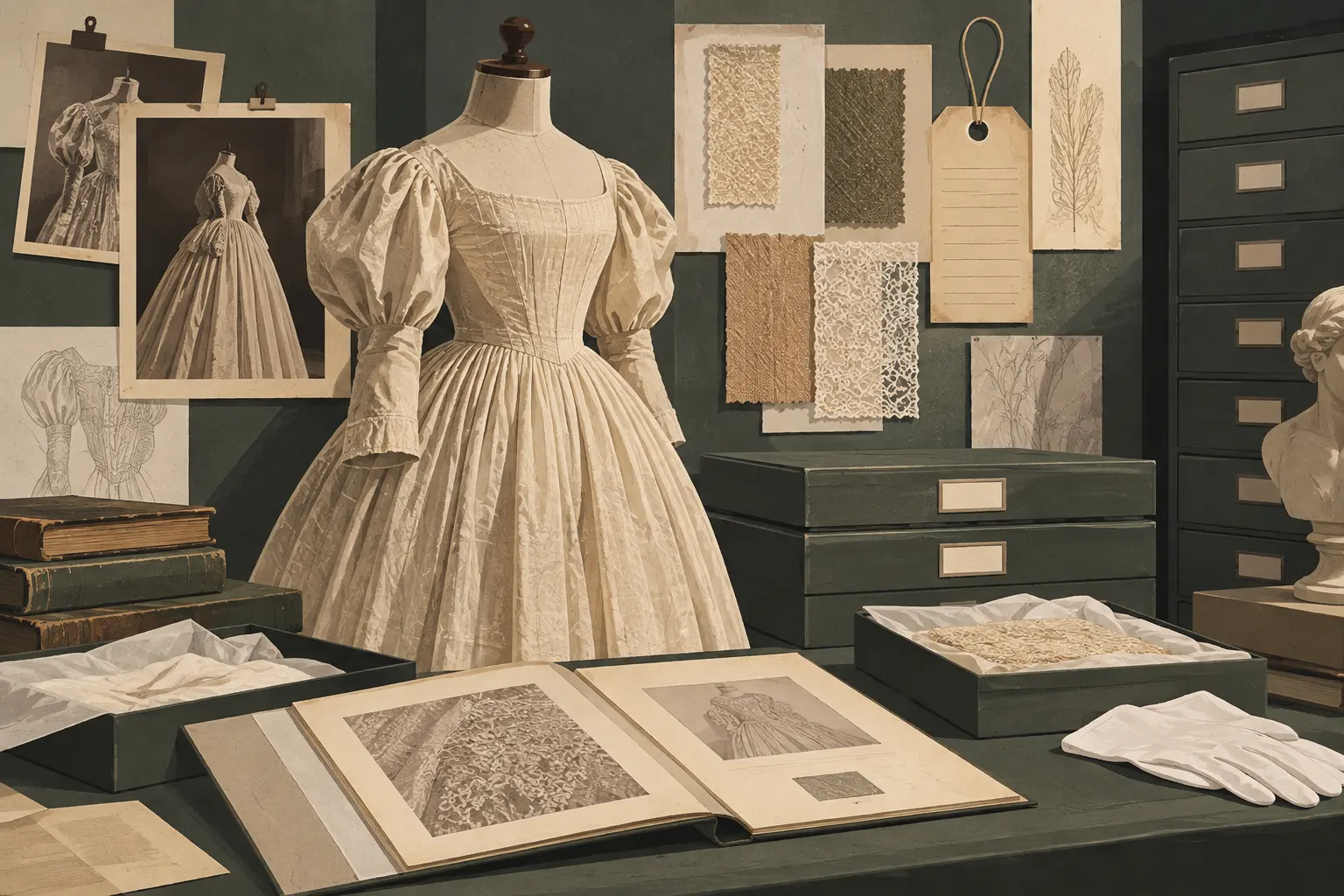
The Museo del Traje presents Spanish Romantic fashion from 1824 to 1874 within a specific historical framework. Its account connects urban life and the bourgeoisie with novelties arriving from Paris, while noting that men and women experienced these changes differently. Its objects trace the construction of silhouettes through undergarments: increasingly voluminous petticoats, metal-hoop crinolines and, later, the bustle that shifted fullness to the back. This explains the surviving forms; it does not mean every woman dressed alike.
Reading a garment’s layers
Close material observation prompts precise questions: What fabric was used? How were seams and fastenings made? Which parts were reinforced? Are there repairs or later alterations? The Museo del Traje, for example, describes an early-twentieth-century corset made of silk satin and taffeta, with metal fastenings and stays. It also records a stamp identifying the Madrid manufacturer and retailer La Hurí. These details make it possible to study construction and production, but they cannot by themselves reconstruct the wearer’s experience.
Traces of use can be just as significant. An alteration, a changed hem or a domestic repair is not necessarily damage to erase: it may show adaptation and a garment’s life after it was made. Preventive conservation also shapes what can be displayed. Light, humidity, temperature and handling affect textiles, so museums limit display periods, rotate objects and prepare suitable supports. The Cristóbal Balenciaga Museum explains that accumulated light exposure requires garments to rest and that mannequins must be tailored to each piece to prevent distortion.
From display case to archive
Images let us compare what a garment preserves with how it was presented and worn. Studio photographs, family portraits, magazines, fashion plates and commercial records do not serve the same purpose. A photograph may record an appearance, but it can also show a staged pose; a fashion plate presents a proposal, not necessarily its everyday adoption. Interpretation gains strength when different sources are compared and the kind of evidence each offers is made clear.
The Museo del Traje brings together garments and photographs that make this distinction visible. Studio portraits and family albums help examine how clothing was represented, while object records describe materials, structure and construction. A photograph of someone wearing a dress and crinoline documents one particular combination in a specific time and setting. It does not make that combination universal.
The Kyoto Costume Institute combines a clothing collection with documentation and a digital archive, and supports research through collaborations and publications. The Palais Galliera brings garments, accessories, photography and graphic arts together in a collection whose perspective is rooted in the history of Paris. These models show that an archive is more than a group of objects: it also depends on how they are documented, connected and made accessible. An institution’s context and collecting criteria are part of interpretation, not a neutral frame.
What is preserved—and what is left out
A collection is shaped by decisions: what is acquired, catalogued and exhibited, and which documents can be consulted. So, alongside asking what an object tells us, it is worth asking who made it, who wore it, who described it and which voices are missing from the account. The Cristóbal Balenciaga Museum notes that much of its collection was formed through donations and loans from former clients, relatives and collaborators. It also explains that it does not hold the fashion house’s complete archive and that its documentation has gaps. The institution is expanding its photographic and documentary holdings and digitising materials to support research.
The history of fashion archives also depends on regional perspectives. The Museo de la Moda in Chile and the Museo Nacional de la Historia del Traje in Buenos Aires preserve dress from distinct Latin American contexts. Their existence is a reminder not to treat European fashion as a universal standard or reduce Latin American practices to passive reception of outside trends. Family photographs, work clothes, textiles and local records can tell stories that large institutional archives do not cover.
A fashion archive is valuable when it makes it possible to ask new questions. The garment contributes material and traces; images and documents suggest relationships; conservation keeps study possible. None of these sources, taken alone, describes what everyone wore. Together, they allow us to reconstruct specific uses and recognise the limits of each account, without confusing a striking image with a complete history.
- Decade
- Before 1950
- Region
- Global
- Level
- Enthusiast
- Entities
- Museum, Museo del Traje, Buenos Aires, Museo de la Moda, Kyoto Costume Institute
Sources and references
- Museos de moda del mundo: por qué son archivos vivosinstitutodemoda.com · 2026-11-02
- Los mejores —y más elegantes— museos de moda del mundo.es.qz.com · 2026-11-02
- El archivo y lo análogo como MEMORIA, haciendo resistencia ...valeriaakl.substack.com · 2026-11-02
- AREA 04 - Museo del Trajemuseodeltrajevirtual.com · 2026-11-02
- Un Museo para Balenciagablog.cristobalbalenciagamuseoa.com · 2026-11-02