A toy is more than an old object
A preserved toy can offer clues about the actions it enabled, the materials available to its makers and its place in everyday life. But it does not speak for itself. Interpreting it means distinguishing what its form and wear reveal, what its history documents and what can only be proposed as an interpretation.
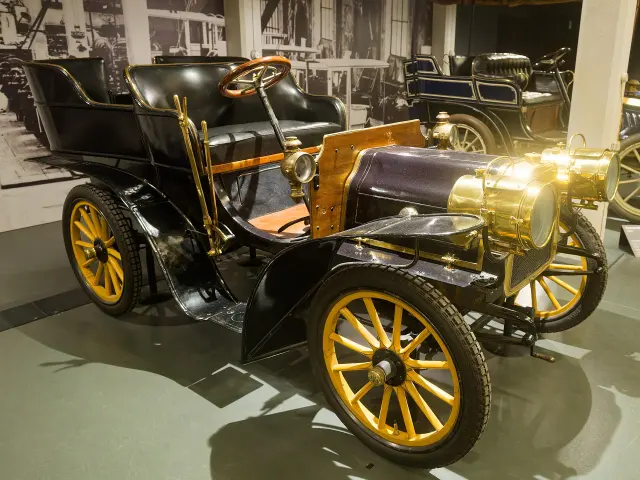
Two pedal vehicles—a car and an aeroplane dating from the early twentieth century—make that complexity visible. Made by Valencia’s Sauquillo factory, both belong to the Toy Museum of the Universitat Politècnica de València. The paper on their restoration describes objects made mainly of metal, with components of wood, textile, rubber and plastic. Their mixed materials and traces associated with their original function called for treatment to stabilise the structures and preserve their components.
Conserving these vehicles was not simply a matter of repairing industrial objects. Their restorers note that their social and cultural dimensions, as well as each piece’s use and identity, also had to be considered. In a toy, traces of operation are part of the object’s history: conservation must care for its material substance without erasing the evidence that identifies it as a play object.
Collections tell stories, too
A collection or exhibition can change the scale of interpretation. Rather than viewing an object as an isolated curiosity, it can be connected to a body of production, a period or shared practices. In 2011, Santiago’s Centro Cultural La Moneda presented Juguete Nacional, an exhibition of more than 600 toys made in Chile between 1915 and 1975 and belonging to Juan Antonio Santis’s collection. Brought together across a broad time span, the objects could be seen as part of a history of national production as well as individual artefacts.
Madrid’s National Museum of Anthropology offers further examples of how a toy can acquire meaning within a material-culture collection. Its American collection includes a toy cradle decorated in the same way as real cradles. The museum interprets this detail as expressing the importance attached to each new birth. The resemblance suggests that play could reproduce objects and conventions from the adult world; by itself, however, it cannot reconstruct how a child played with the cradle.
In Santiago, Chile, the Gabriela Mistral Museum of Education holds a wooden educational toy alongside school materials and furniture. Its place in a collection devoted to the history of education prompts questions about the relationship between play and learning. It also points to the range covered by the category of “toy”: some objects allow open-ended play, while others are also designed as educational resources. Institutional classification offers a way into the object’s history, but it cannot by itself establish how a particular piece was used.
Reading traces with care
Materials, mechanisms and wear can guide interpretation, but they are best considered alongside evidence such as instructions, packaging, catalogues, photographs or attributable testimony. In the case of the Sauquillo vehicles, the paper describes their construction and marks related to their function, but does not provide detailed rules or operating instructions. It supports discussion of pedal toys and the challenges of conserving them, not a precise reconstruction of a play sequence.
These examples bring three different levels into view: what an object physically preserves, what its collecting history documents and what can cautiously be inferred. A toy can be a material artefact, an invitation to play and evidence of social practices at once. Its historical interest does not rest solely on rarity; it also lies in the questions raised by its construction, conservation and journey into the present.
- Decade
- Before 1950
- Region
- Global
- Level
- Enthusiast
- Entities
- Museum, Museo del Juguete, Museo del Juguete de la Universitat Politècnica de València, Sauquillo
Sources and references
- Los juguetes a pedales de la factoría Sauquillo. Restauración de un coche y un avión del Museo del Juguete de la Universitat Politècnica de Valènciadoi.org · 2026-11-01
- En los capítulos anteriores se analizó la facultad de agencia y potencia performativa de los juguetes desde un marco teórico sit...repositorio.uchile.cl · 2026-11-01
- Centro Cultural La Monedaes.wikipedia.org · 2026-11-01
- Museo Nacional de Antropología (España)es.wikipedia.org · 2026-11-01
- Museo de la Educación Gabriela Mistrales.wikipedia.org · 2026-11-01