Before vinyl: from mechanical recording to the flat disc
The record’s history did not begin with plastic. In 1877, Thomas Edison introduced the phonograph, which could record and play back sound using a cylinder. A decade later, Emile Berliner developed the gramophone and the flat disc, a medium that made it easier to produce copies. Commercial 78-rpm records were commonly made from shellac: they were fragile and offered limited playing time per side.
Vinyl, named for the polyvinyl chloride (PVC) used as its material, changed what a record could do, but it did not invent mechanical recording or the turntable. Its decisive contribution was to combine a more durable material with a narrower, shallower groove. That geometry made it possible to lower the rotational speed and lengthen listening time.
1948: the LP and the battle over speed
On 18 June 1948, Columbia Records introduced its long-playing system in New York: a 12-inch disc rotating at 33⅓ rpm. Microgrooves and slower rotation allowed it to hold far more music than a conventional 78; an LP could approach half an hour per side. The actual playing time depended on the recording and on how the sound was cut into the groove.
In 1949, RCA Victor launched its answer: the 7-inch, 45-rpm single. Generally designed for one song per side, it competed with the LP, which could accommodate a longer work or several tracks. The dispute between Columbia and RCA was commercial as well as technical: each company promoted a different system, speed and set of equipment. Over time, the LP became associated with the album and the 45 with the single, although practices varied across catalogues and markets.
“Vinyl” is often used as a synonym for LP, but the word describes the material, not a single format. PVC discs were made in different diameters and speeds; conversely, microgroove records were also made from other materials. In everyday speech, however, the term became chiefly associated with the 12-inch LP.
How sound was read from the groove
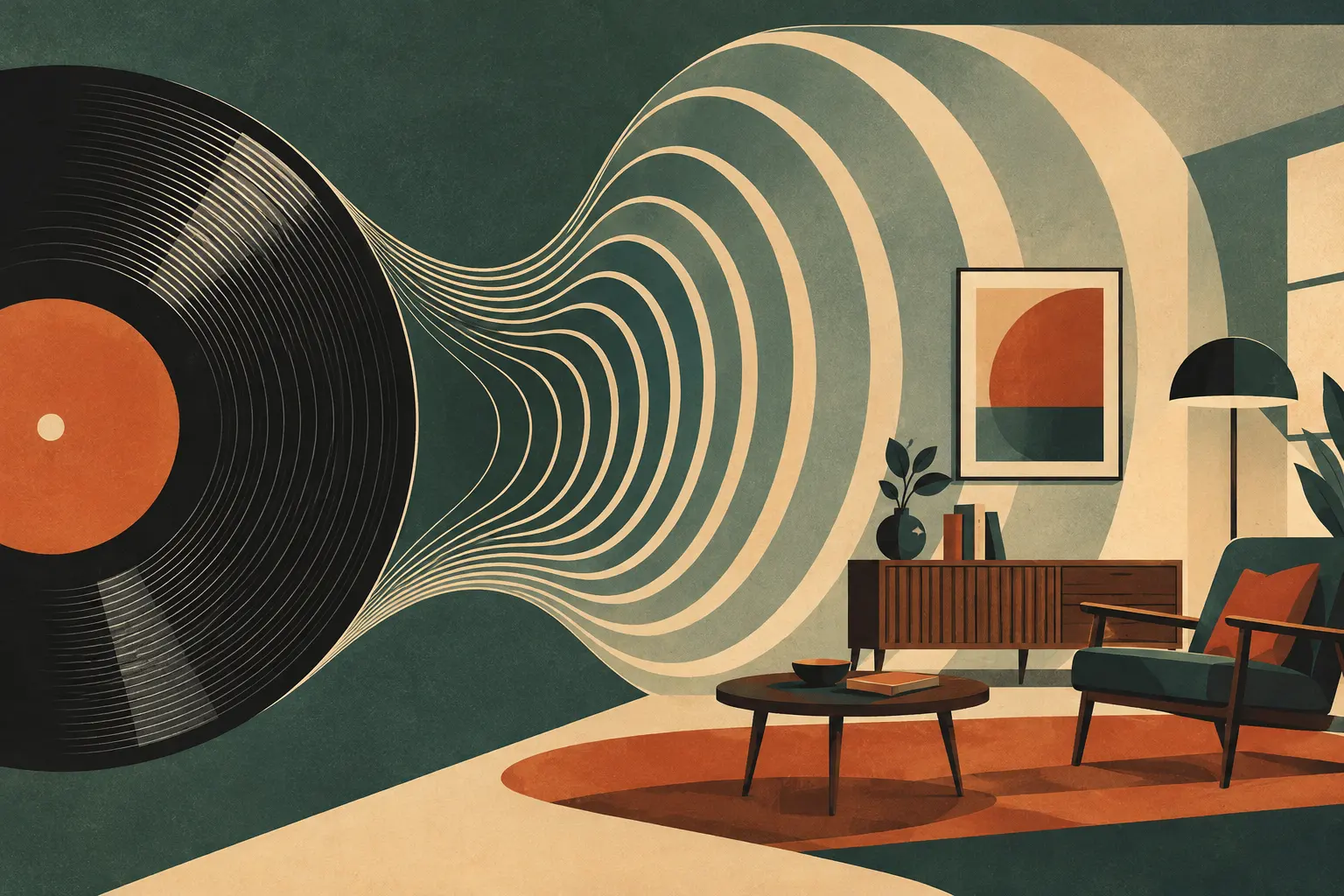
On each side, a spiral groove guided the stylus from the edge towards the centre. Variations cut into its walls made the stylus vibrate; the cartridge converted that movement into an electrical signal which, once amplified, reached the loudspeakers. The recording was inscribed as a continuous physical form, not as a sequence of digital files.
Size and speed determined both duration and use. The 12-inch, 33⅓-rpm LP could hold several songs or a long work. The 7-inch, 45-rpm single made it convenient to issue and play shorter selections. EPs and 12-inch discs at 45 rpm were also produced, among other combinations: not every record fitted the familiar association of LP with album or 45 with single.
Listening involved a set of practical actions: taking the record from its sleeve, placing it on the platter, lowering the stylus and, when one side ended, turning the disc over or changing it. Dust and scratches could cause clicks or interfere with tracking; wear and incorrect turntable adjustment could also affect playback. This physical interaction was inseparable from the format’s everyday use.
From mono to stereo—and quadraphonic experiments
The first microgroove records were monophonic. Stereophonic recording was commercialised in the second half of the 1950s and spread more widely during the following decade. In stereo, the walls of the same groove carried information for two channels; the stylus responded to movement along more than one axis, allowing equipment to separate left and right signals. The system was designed to remain compatible with mono playback, although results depended on the equipment and recording.
Quadraphonic systems were also tried in the 1960s, designed to distribute four channels between front and rear speakers. They required compatible equipment and playback systems, and never became a mass-market format. Their history is a reminder that the record remained open to technical experimentation: an innovation could expand what the medium could do without becoming a popular standard.
From one master to thousands of copies
Commercial production did not involve recording each copy separately. A master recording was used to prepare a matrix; metallisation and electroplating then produced intermediate parts and stampers. At the press, a heated portion of PVC—the “biscuit”—was compressed between moulds that formed the grooves and set the labels in place. After pressing and cooling, the edge was trimmed.
The process connected an individual recording with the production of many copies. Quality depended on several stages: preparation of the master, manufacture of the metal parts, the condition of the stamper and pressing control. The record also circulated as a visual object: its sleeve provided ample room for artwork and text that accompanied the music and distinguished each release.
The cassette and CD change vinyl’s place
For much of the 1960s and 1970s, vinyl held a central place in domestic music playback. The cassette offered a more portable, recordable alternative. Later, the compact disc introduced optical digital playback and reduced direct handling of the carrier. From the late 1980s into the early 1990s, vinyl sales and mass production gave way to the CD.
The shift did not make records disappear. They continued to be used in particular settings, including DJ culture, where physically intervening in playback was part of the working practice. The later commercial revival did not restore vinyl’s former dominance either: the format returned to shops for specialist audiences, collectors and listeners drawn to the object, the sleeve and listening on a turntable.
One medium, several ways of listening
The transition from 78 rpm to the microgroove changed the time available on each side and, with it, the organisation of recorded music. For households, the LP made it possible to hear a long work or several songs without changing discs so often. For the industry, pressing enabled the production of many copies from a master. For DJs, the record offered a medium they could physically manipulate during playback.
Vinyl did not always occupy the same place in musical life. The cassette and CD changed expectations of portability and access; later, collectors and specialist audiences valued different aspects of the format, from its sleeve to the direct relation between stylus, groove and platter. A technology that had extended the duration of listening at home thus continued, in other contexts, as a performance tool and a cultural object.
- Decade
- 1950s
- Region
- North America
- Level
- Introduction
- Entities
- Cuatro, Vinilo
Sources and references
- Disco de vinilo - Wikipedia, la enciclopedia libre - Disco de viniloes.wikipedia.org · 2026-11-08
- Disco de vinilo - Wikipedia, la enciclopedia libre - Disco de viniloes.wikipedia.org · 2026-11-08
- Disco de vinilo - Anónimowww.ecured.cu · 2026-11-08
- Disco de vinilo - Anónimoecuadmin.ecured.cu · 2026-11-08
- Disco fonográficoes.wikipedia.org · 2026-11-08