A record designed to play longer
The microgroove LP changed a familiar constraint of recorded music: having to interrupt a work to change records. Columbia Records introduced the format in 1948, with narrower grooves and a speed of 33⅓ revolutions per minute. On a twelve-inch disc, those choices could provide close to half an hour of music per side, compared with the few minutes usually available on a ten-inch 78 rpm record. The actual running time varied with groove spacing, recording level and other cutting decisions.
This was not the beginning of the gramophone record. Emile Berliner had promoted the flat-disc gramophone from the late nineteenth century, and shellac 78s dominated much of the first half of the twentieth. The LP was a defining stage in that longer history: a new balance of material, speed and groove density that made extended listening possible with fewer interruptions. Vinyl was also less brittle than shellac, though it remained vulnerable to dust, scratches and wear.
LP and single: two scales of listening
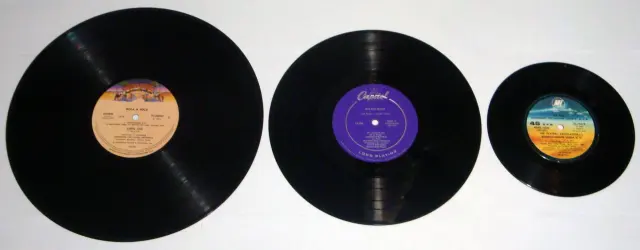
Competition between Columbia and RCA Victor produced formats that eventually coexisted. The twelve-inch, 33⅓ rpm LP became chiefly associated with albums and longer works. In 1949, RCA promoted the seven-inch, 45 rpm single, which carried a short selection on each side and could be changed quickly on automatic players. The so-called “speed war” was also a dispute about how music was packaged, sold and programmed.
The LP’s longer playing time encouraged listeners to hear several songs as a sequence and reduced record changes during extended works. But the format did not dictate the album’s form by itself: it created a possibility that musicians, labels and listeners could use in different ways. The single retained a scale suited to one song or a brief selection. The formats supported different habits without making one another obsolete.
Records also featured in domestic systems with changers, which could stack several discs, and in cabinets combining a radio and turntable. Listening still involved deliberate actions: placing the record on the platter, selecting a speed and lowering the tonearm and stylus onto the groove. A listener could choose a side, replay it or stop it. The disc fixed the sequence, but everyday use did not have to be strictly linear.
The mechanics of the microgroove
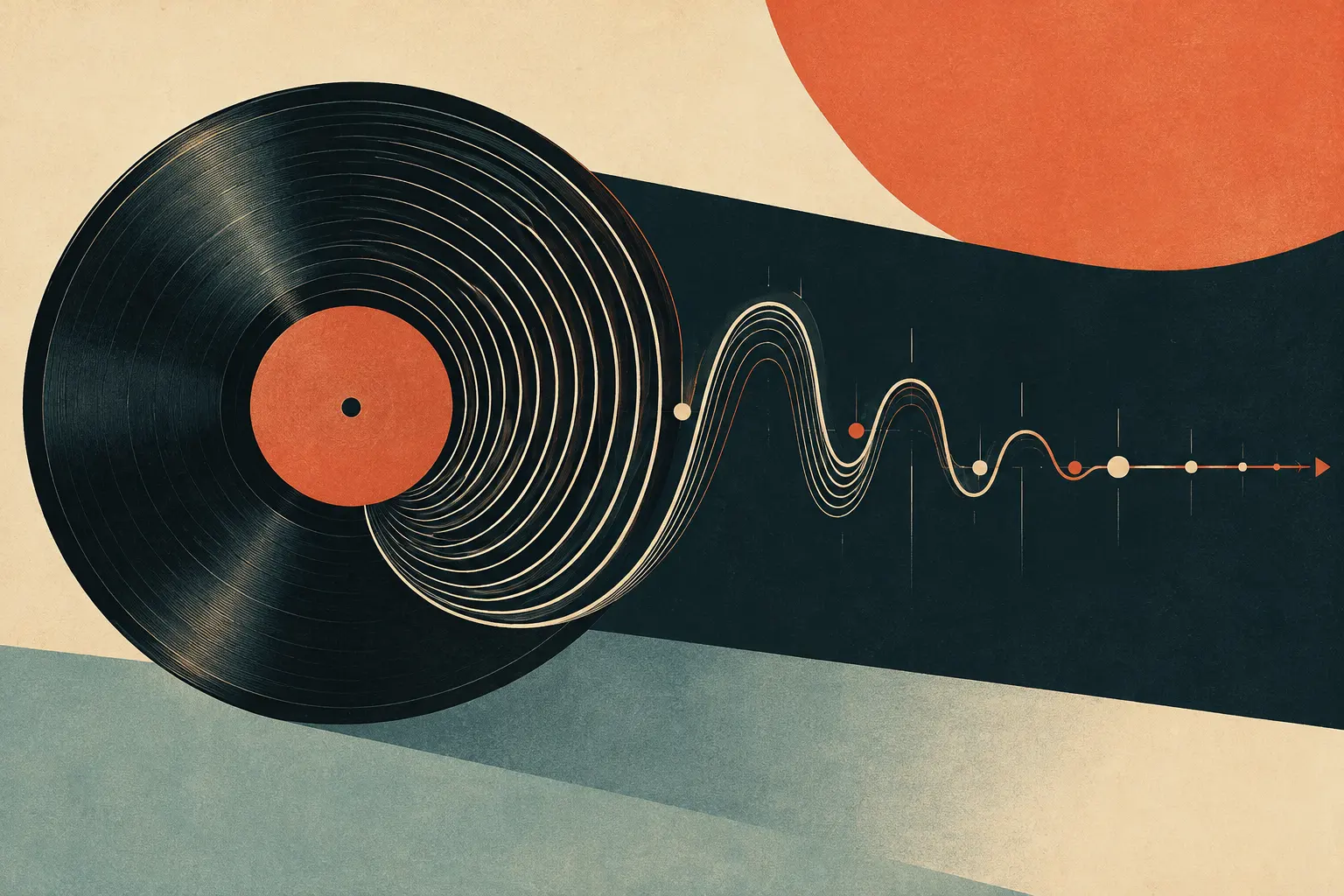
During playback, the stylus follows the spiral groove and its variations produce vibrations. The cartridge converts those vibrations into an electrical signal, which must be amplified to drive speakers. Speed and centre-hole size mattered: many turntables needed an adapter to play 45 rpm singles with a large centre hole.
Playing time was not separate from decisions about sound. Tighter groove spacing could fit more music, but cutting had to balance capacity, level and playback quality. Equalization was part of the system: the signal was altered during recording, and a preamplifier applied the reverse correction during playback. The RIAA curve was standardized in the United States in the 1950s; earlier records did not always follow a single common curve.
Manufacturing turned a master recording into metal parts through electroplating. These were used to press copies in heated vinyl. The record was therefore both a sound carrier and an industrially produced object, with material constraints that affected its playing time and preservation.
From mono to stereo—and beyond
The first LPs were monophonic. Commercial stereo spread later, especially during the 1960s, adding separation between left and right channels. Information was encoded in the two groove walls, and many mono systems could play stereo records, though the transition required new equipment and recording techniques.
There were also attempts to extend the listening experience with four-channel quadraphonic records in the 1960s and 1970s. Adoption was limited by competing systems and the need for specialist equipment. The episode is a reminder that technical innovation alone does not guarantee a change in habit: compatible players, available recordings and reasons for listeners to adopt a format all matter.
A format with changing uses
For decades, vinyl held a central place in recorded music, but it shared the market with other media. The cassette offered a portable, recordable alternative; the CD, which spread from the late 1980s, gradually displaced records in the mass market. Large-scale production fell sharply in the 1990s, but the format did not disappear.
DJs retained a distinctive use for vinyl: they could manipulate a record directly, find a passage by moving the stylus and synchronize tracks through manual control of the turntables. Collectors and enthusiasts valued physical editions, sleeves and the possibility of building a record library. Archives and heritage institutions, meanwhile, have used playback and digitization to preserve older recordings.
Vinyl’s commercial return from the 2000s strengthened its presence as a specialist format and cultural object, without restoring the dominance it had before the CD. Its persistence shows how a medium can change roles: from everyday distribution format to performance tool, collectible and source for preservation.
The history of the microgroove is not just a story of technical improvement that made more minutes available. It is also the story of a technology that organized the duration of works, the distinction between album and single, domestic equipment and the gestures of listening. Vinyl endured because those roles changed over time, not because the format always held the same position.
- Decade
- 1950s
- Region
- North America
- Level
- Enthusiast
- Entities
- Cuatro, Vinilo
Sources and references
- Vestigios para una historia musical de la sociedad chilena en la historia reciente: El Fondo Documental Sello Alerceopenalex.org · 2026-11-06
- Análisis de la Estética Gráfica aplicada a la música popular del Ecuadoropenalex.org · 2026-11-06
- Disco de vinilo - Wikipedia, la enciclopedia libre - Disco de viniloes.wikipedia.org · 2026-11-06
- Disco de vinilo - Wikipedia, la enciclopedia libre - Disco de viniloes.wikipedia.org · 2026-11-06
- Disco fonográficoes.wikipedia.org · 2026-11-06