One medium, different formats
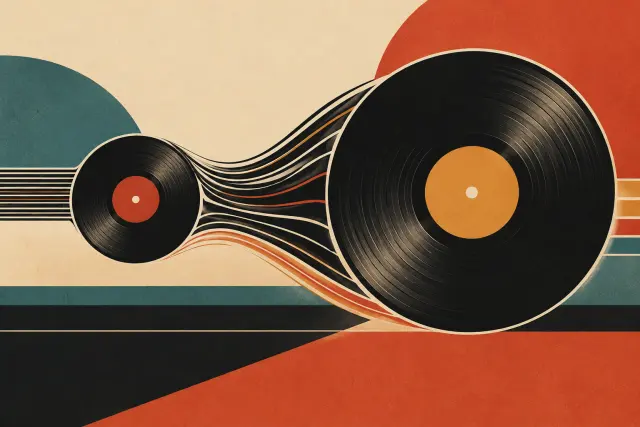
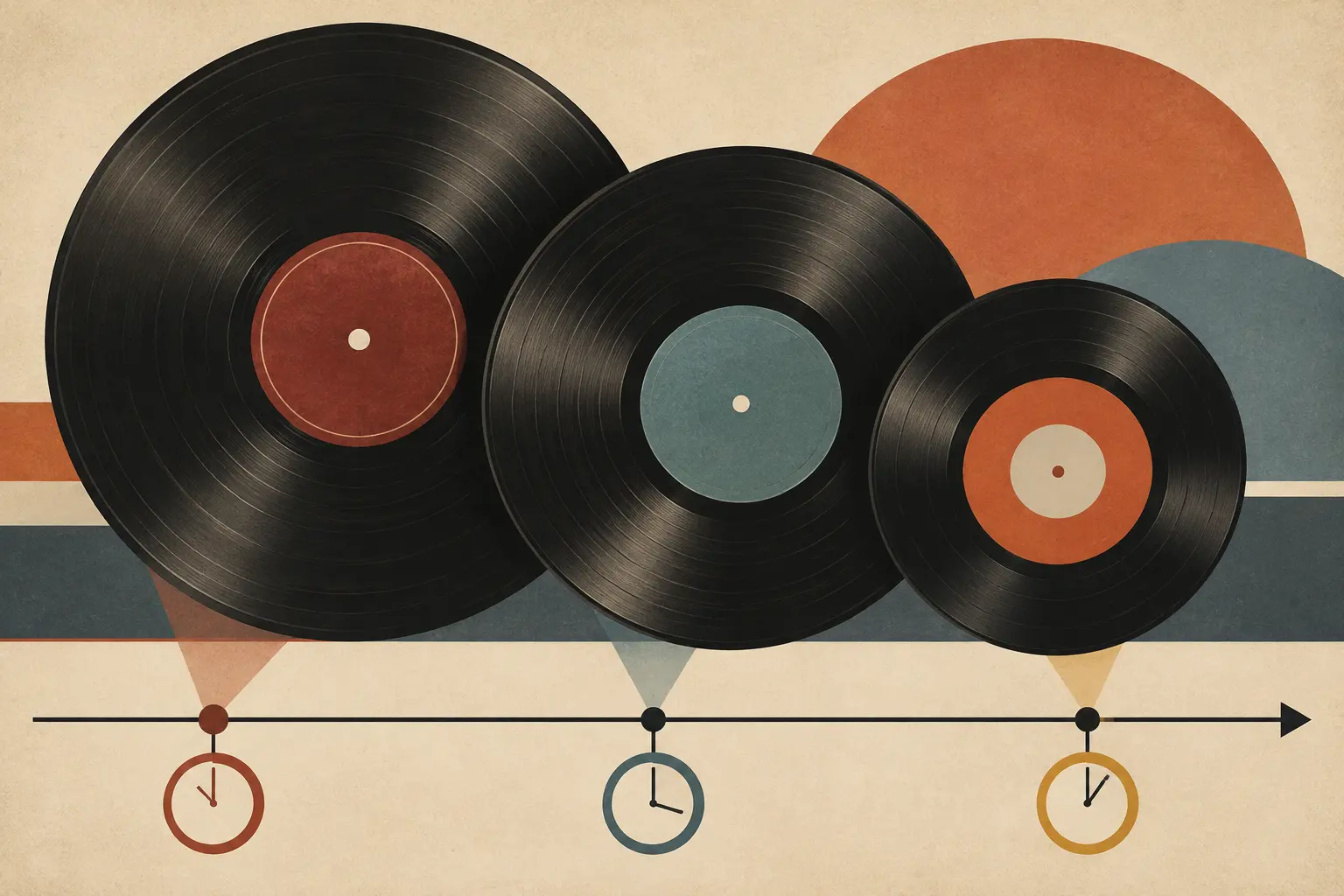
“Vinyl” is often used as a synonym for the LP, although it describes the material of many records, not a single format. Records varied in diameter, rotational speed and groove density. Those technical choices determined how much sound could fit on each side and what equipment could play it. They also shaped the commercial categories of album, single and EP.
For much of the first half of the twentieth century, the common record was the 78 rpm disc, made mainly from shellac. A typical ten-inch record held around three minutes per side. Twelve-inch discs allowed more space, but extended works could still take several records. Long recordings were therefore collected in albums: sets of discs stored in sleeves arranged like the pages of a book.
The available playing time influenced the music that was recorded. Popular-music performances were often tailored to the capacity of one side, while classical and longer works could be spread across multiple discs. The format did not determine a work’s content, but it imposed pauses, disc changes and practical limits on its release.
The LP makes duration part of the proposition
In 1948, Columbia Records commercially introduced the microgroove LP, combining vinyl records, a speed of 33⅓ rpm and grooves narrower than those on 78s. A twelve-inch LP could hold around twenty minutes or more per side, depending on the material and the cut. A work that once required several discs could be gathered on one, while a popular-music album could sustain listening longer before the break to turn it over.
The innovation also offered a new way to package and sell music. The album became an extended unit, with room for a sequence of songs and a large sleeve. Duration, design and presentation were thus linked by the format. Playing it required a stylus and equipment suitable for microgrooves; access to compatible records and turntables was part of the transition.
The LP did not introduce long-playing records by itself: RCA Victor had marketed 33⅓ rpm discs in 1931, but that effort did not take hold. Columbia’s postwar introduction made the microgroove a viable and commercially influential option, supported by a system and market different from those of the earlier venture.
The 45 rpm single and the standards dispute
In 1949, RCA Victor released a seven-inch single that played at 45 rpm. Unlike the LP, which was designed for longer programs, the 45 offered a format suited to one song—or a few—per side. Competition between Columbia’s and RCA’s proposals, known as the “War of the Speeds,” extended to players and record-changing mechanisms. For a time, consumers could encounter equipment that did not play both systems; multi-speed domestic turntables later became common.
The 45 was not simply a smaller LP. Its size and playing time served a different use. Many US singles had a large center hole, suited to certain automatic changers and jukeboxes. The EP extended the short format by gathering several songs into a release with a playing time between that of a single and an album.
Over time, the two formats settled into predominant roles: the 33⅓ rpm LP for albums and the 45 rpm disc for singles. This was not an absolute replacement of one by the other, but a coexistence organized around different uses. The division also shaped listening: the album invited audiences to follow a longer sequence, while the single focused attention on one or a few songs.
The record side as a unit of listening
The LP made longer stretches of uninterrupted listening possible, but it did not remove the importance of each side. A work might require a pause or space on the next side, and the order of songs depended on where each side ended. The physical capacity of the medium therefore became part of an album’s structure and the domestic listening experience: listening could mean getting up, turning the record over and starting again.
The groove imposed other limits. On an LP, the stylus’s linear speed decreases as it approaches the center, which can affect the reproduction of high frequencies in the inner grooves. Surface noise, scratches and wear were also part of the format’s material conditions. These are characteristics and constraints of the system, not proof that analogue sound is universally superior or inferior to other methods.
Stereo added further requirements. Its commercial adoption spread from the late 1950s: two channels were encoded in the groove walls, and the stylus and cartridge had to be able to read them. Playback therefore depended on an entire chain: recording, cutting, pressing and equipment. The record was not a neutral container, but a technology whose possibilities emerged from the interaction of its components.
From dominant format to one option among several
The compact disc displaced vinyl as the dominant format during the transition into the 1990s, but it did not end its uses. DJs continued to use records for direct manipulation and their place in dance music; collectors and listeners kept buying and preserving vinyl editions. From the 2000s, vinyl’s commercial return gave it renewed visibility, though not the singular place it had held in everyday music consumption.
The history of records shows that a musical work and the format in which it is released are distinct but related. Playing time per side, speed, size and playback equipment influenced how albums and singles were organized, how they were presented visually and how listening unfolded. The medium did not determine what a song meant; it set boundaries on how it could circulate and the conditions in which it was heard.
- Decade
- 1950s
- Region
- North America
- Level
- Introduction
- Entities
- Vinilo
Sources and references
- Disco fonográfico - Wikipediatranslate.google.com · 2026-11-10
- La historia del vinilowww.maplatine.com · 2026-11-10
- Historia del Vinilo - Diffusion Magazinewww.diffusionmagazine.com · 2026-11-10
- Disco de vinilo - Wikipedia, la enciclopedia librees.wikipedia.org · 2026-11-10
- Disco fonográficoes.wikipedia.org · 2026-11-10