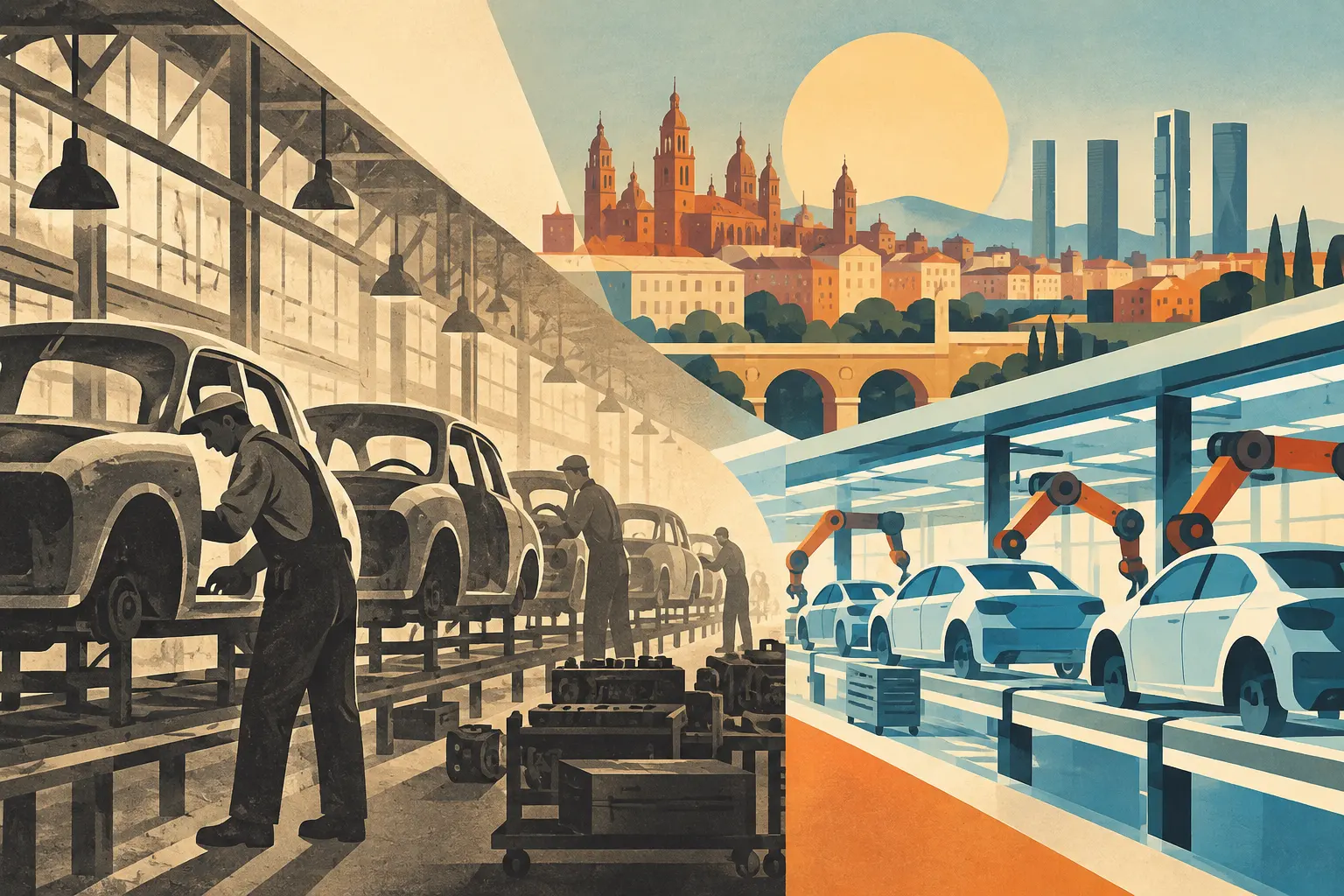
An industrial project for post-war Spain
SEAT was established on 9 May 1950 as Sociedad Española de Automóviles de Turismo. Its aim was to produce passenger cars in Spain on a scale the country’s small manufacturers could not achieve. The venture brought together the National Institute of Industry (INI), as majority shareholder, Spanish banks and Fiat, which provided technical assistance and models.
The project had earlier roots. In 1940, a group of industrial and financial interests had founded Sociedad Ibérica de Automóviles de Turismo (SIAT), also with Fiat as its technical partner. State intervention and post-war conditions prevented that initiative from reaching car production. A decade later, SEAT provided a framework for launching manufacturing on a larger scale, with the aim of developing suppliers and industrial capabilities within Spain.
Zona Franca and the 1400
The factory was built in Barcelona’s Zona Franca, where it could draw on the city’s industrial infrastructure and transport links. The assembly line was inaugurated on 5 June 1953. The first SEAT 1400 left the factory on 13 November.
The 1400 was based on the Fiat 1400. The partnership supplied design and technical support as the company built up its own manufacturing capacity and a local supplier network. The share of components made in Spain increased during the early years; according to figures published by SEAT, by the middle of the decade the model was being made almost entirely from domestic components. That local production did not, however, mean that the car relied on technology developed independently in Spain.
The 1400 was comfortable, but its price put it beyond the reach of many families. Expanding production and establishing a supporting industry also required models aimed at a broader market. The launch of the SEAT 600 in 1957 marked a change in scale: its spread coincided with rising production and demand for private transport.
The 600 and mass motorisation
The 600 became a symbol of the expansion of car ownership in Spain and the first car for many families. Its cultural significance is considerable, but it cannot by itself explain the social transformation of those years. Motorisation also depended on industrial growth, incomes, the availability of vehicles and the economic policies of the period.
The company expanded production alongside its model range. Later cars, including the 850 and 124, served different segments and needs, while SEAT consolidated a central position in Spain’s automotive industry. The spread of car ownership rested on an increasingly extensive production network, not on the popularity of any single model alone.
From Fiat partnership to greater autonomy
During its first decades, much of SEAT’s range derived from Fiat models. The relationship included manufacturing licences and technical cooperation, as well as shareholding links and commercial agreements. At the same time, the company sought to expand its ability to adapt and develop vehicles. The Martorell Technical Centre began operating in the 1970s, and SEAT created its own derivatives, including the 800, a four-door version of the 600 with no direct equivalent in Fiat’s range.
The relationship deteriorated when SEAT’s investment needs clashed with Fiat’s priorities. In 1980, Fiat declined to participate in a capital increase and withdrew its stake; the state resumed control. SEAT had to build a more independent industrial and commercial identity and seek new partners. The separation did not immediately remove technical dependence: the company still needed agreements that could support production, exports and access to technology.
The Ronda, launched in 1982, became the focus of a dispute with Fiat over whether the revised model differed sufficiently from its Italian basis. In presenting its case, SEAT visually highlighted the modified parts. The arbitration decision allowed the company to market the car as its own product. The episode captured the challenge of the new phase: turning a range developed in close partnership with Fiat into a recognisable, differentiated offer.
Volkswagen and the move to Martorell
In 1982, SEAT signed industrial and commercial cooperation agreements with Volkswagen, including arrangements to build German-group models in Spain. Volkswagen acquired a majority stake in 1986 and completed its purchase of the company in 1990.
The change in ownership did not immediately erase SEAT’s identity. The Ibiza, introduced in 1984, was developed as a SEAT project with contributions from outside firms. The 1991 Toledo was the first model developed fully under Volkswagen ownership. The new phase therefore combined the company’s own brand and manufacturing history with membership in an international group.
The opening of the Martorell plant in 1993 reorganised production. Car manufacturing moved progressively from Zona Franca, which shifted towards component production. This was not a complete break with Barcelona’s industrial history: the original factory changed its role within an industry that continued to make cars in Spain, but was now integrated into a multinational structure.
Industry, dependence and memory
SEAT’s trajectory is not simply a succession of popular models or a change of ownership. It shows how industrial policy, foreign investment, technical learning and changes in the market shaped one another. The early cars were made in Spain, but they drew on Fiat designs and technical knowledge. Autonomy came gradually, through adaptation, training, local suppliers and the development of in-house capabilities.
It is also useful to distinguish corporate history from cultural memory. The 600 has come to represent an era of expanding mobility, although SEAT first made vehicles for different purposes and customers and later had to redefine itself as its partners and markets changed. From Zona Franca to Martorell, the company’s history reveals both the continuity of car production in Spain and the changing forms of cooperation, dependence and autonomy that made it possible.
- Decade
- 1950s
- Region
- Spain
- Level
- Introduction
- Entities
- SEAT, Cuatro, SEAT 600
Sources and references
- ASIENTOtranslate.google.com · 2026-11-10
- Fabricamos coches desde 1950 – Historia de SEATwww.seat.es · 2026-11-10
- SEAT: 70 años sobre ruedaswww.seat-cupra-mediacenter.es · 2026-11-10
- SEAT - Wikipedia, la enciclopedia librees.wikipedia.org · 2026-11-10
- De SEAT a CUPRA: cómo se transforma una marca y qué ...www.extradigital.es · 2026-11-10