A transformation with several directions
The evolution of motorcycles in the 1970s and 1980s was not simply a matter of building faster machines. During these decades, different ideas of what a motorcycle could be took hold: a large touring bike, a sports machine close to competition, or a trail bike able to combine roads and tracks. Engine layouts, cooling systems and chassis solutions changed too. Specific models help trace these shifts without reducing them to a single technological race.
The Honda CB750 Four, introduced in 1969, is an important starting point for the rise of large Japanese road bikes with transverse inline-four engines. The 1971 Suzuki GT 750 took a different path, with a two-stroke triple and liquid cooling; Moto1Pro describes it as the first Japanese motorcycle to use that system. In 1972, Kawasaki answered with the Z1 900, whose four-cylinder engine raised the stakes in displacement and performance. There was no single formula that immediately prevailed.
More cylinders, but other priorities too
Put into production in 1973, the Benelli 750 Sei brought a six-cylinder engine to the road. Moto1Pro highlights the engine’s linear delivery and the reduced vibration associated with that layout. In 1978, the Honda CBX 1000 and Kawasaki Z 1300 extended the exploration of large-displacement six-cylinder engines. Their historical interest does not depend on deciding which was “best”: power and speed figures vary by version and measurement method, and cannot by themselves describe handling, ease of use or reliability.
The following decade showed that innovation did not mean simply adding cylinders. The 1984 BMW K 100 RS introduced electronic fuel injection, which Moto1Pro identifies as a first for a BMW production motorcycle. That same year, the Kawasaki GPZ 900 R paired a 16-valve engine with a layout in which the engine contributed to the chassis structure. These are distinct examples of how manufacturers responded to expectations of performance and the search for new technical solutions.
The road was no longer the only destination
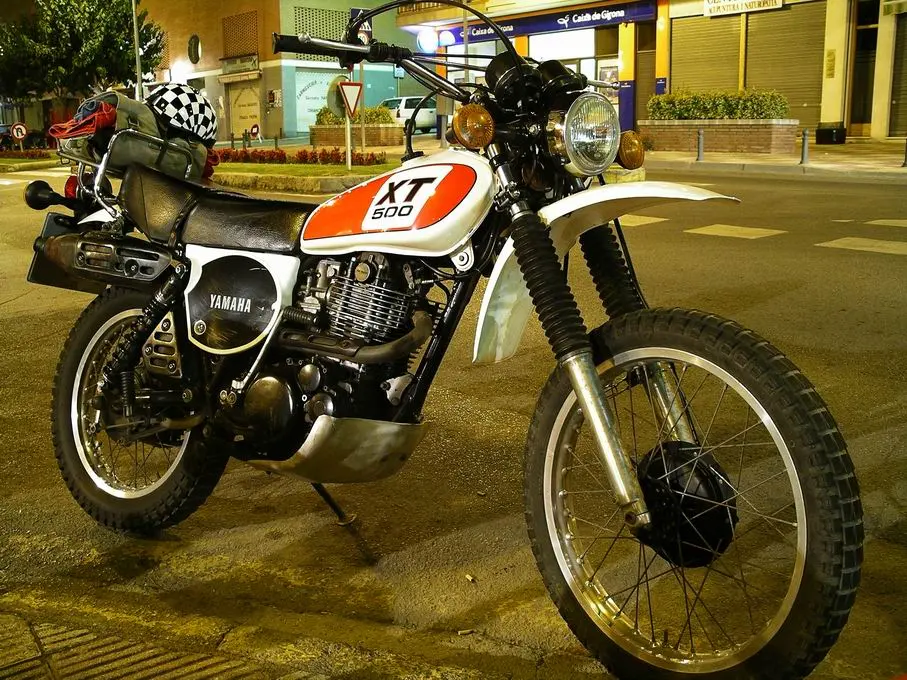
The 1976 Yamaha XT 500 and the 1980 BMW R 80 G/S help explain the consolidation of the trail category. Moto1Pro describes the XT as one of the first modern trail bikes and credits the R 80 G/S with helping to establish the maxi-trail. Their significance lies in combining uses: motorcycles designed for the road that could continue onto tracks, expanding the possibilities of touring by motorcycle.
The combination of road and off-road riding had precedents and took different forms in different models. The Yamaha XT 500 was a simple single-cylinder machine; the BMW R 80 G/S was larger and used a boxer engine. Rather than being defined by one displacement or engine layout, trail riding expressed a new promise of versatility. That idea helped prepare the way for adventure and touring motorcycles that would grow in popularity later.
At the same time, some 1980s sports bikes brought competition engineering closer to production motorcycles. The 1985 Suzuki GSX-R 750 and the 1986 Honda VFR 750 R RC30 exemplify this direction. The RC30 used a V4 engine and a single-sided swingarm; the GSX-R was conceived as a road-legal sports bike with a strong connection to racing. Homologation allowed some competition ideas to reach motorcycles usable on public roads without making them pure racing machines.
A history that does not fit into a ranking
Retrospective lists of the “best motorcycles” can show which models have remained in enthusiasts’ memories, but they combine different criteria: innovation, popularity, sporting results, design and personal recollections. Devitt’s selection, for example, thanks members of its community for their contributions and acknowledges that readers may disagree. It is a way to gauge collective memory, not a uniform technical assessment.
Comparing performance requires attention to the specific version and to how the figures were obtained. Understanding a bike’s function also means considering its configuration and intended use. Seen in this light, the 1970s and 1980s do not form a straight line toward greater speed. They represent a wider repertoire, from engines with very different layouts to sports bikes shaped by competition and touring machines capable of leaving the pavement behind.
- Decade
- 1980s
- Region
- Global
- Level
- Enthusiast
- Entities
- Benelli, Cuatro
Sources and references
- Las 80 mejores motocicletas de todos los tiempostranslate.google.com · 2026-10-26
- 100 motos para la historia: La vertiginosa evolución de ...www.moto1pro.com · 2026-10-26
- Carrera ilegales.wikipedia.org · 2026-10-26
- Historia de la industria en la Argentinaes.wikipedia.org · 2026-10-26
- Benelli (motocicletas)es.wikipedia.org · 2026-10-26