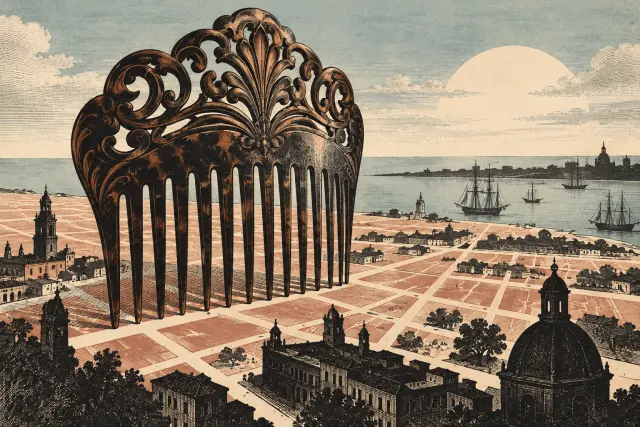
A large ornamental comb associated with Buenos Aires and Montevideo from the late 1820s to the middle or later part of the 1830s. The source describes its scale, materials, and social and political associations.
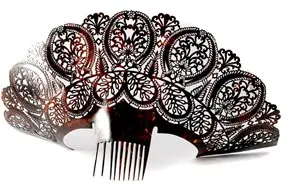
Selected excerpts from our archive offer more context on this subject. Each reading links to the original article and its sources.
The Río de la Plata peinetón: an accessory that refused to go unnoticed
The peinetón was not a discreet detail. According to the available account, this large ornamental comb became fashionable in Buenos Aires and Montevideo from the late 1820s to the middle or later part of the 1830s. Some examples could reach 120 centimetres in both height and width. Its scale helps explain why the accessory drew attention from contemporaries and later observers, but size alone cannot tell us what wearing it meant.
The account traces an antecedent to the Spanish peineta, introduced in Buenos Aires around 1815. Interest in larger, more elaborate models reportedly began to grow in 1824, eventually producing the peinetón. These details deserve qualification: they describe an evolution in the source, not a complete history of every workshop, design or wearer.
The accessory reached its peak between 1830 and 1837. It was worn with dresses featuring narrow waists and voluminous sleeves, a silhouette the source connects to Western Romantic fashion. Its scale should therefore not be considered in isolation: the peinetón formed part of an appearance assembled from garments and accessories.
Tortoiseshell is described as the usual material, while horn offered a cheaper alternative, especially when tortoiseshell was scarce. The account explains that imported tortoiseshell was worked in city workshops: it was cut, heated, pierced, engraved and polished. It also mentions printing and inlay in some cases.
The Buenos Aires peinetón: a hair ornament and its documentary limits
The peinetón was a large hair ornament associated with women's dress in Buenos Aires during the early decades of the nineteenth century. Available academic documentation and historical records place its main use between 1820 and 1837, with specific mentions of the periods 1829-1830 and 1836-1837. This article examines what can be stated with certainty about this object, separating documented facts from cultural interpretations that circulate around it.
The provided sources establish a clear timeframe for the presence of the peinetón in the Argentine capital. An academic work summarizes its use between 1820 and 1837, while other records highlight its characterization of Porteño fashion in the years 1829-1830 and 1836-1837. These dates help delimit a specific fashion phenomenon, but they do not indicate that it was universal among all women in the city. The evidence suggests a documented practice at certain moments, not an uninterrupted or mandatory custom for the entire female population.
The evidence mentions that peinetas are originally from Spain and were introduced in Argentina, specifically in Buenos Aires, in 1815. However, the available snippets do not by themselves demonstrate the specific trajectory of the peinetón as a distinct object. A genealogical connection with Spanish peinetas is established, but the exact process of transformation or the precise date of the peinetón's appearance as such is not detailed. This distinction is crucial to avoid attributing to the object a history older or more complex than current data allow verifying.
The peinetón is directly linked to the history and evolution of garments and typology related to dressing the body in Buenos Aires. Documentation describes it as an element that represented tone and good taste in its time. This association with aesthetics and personal presentation places it at the center of the era's fashion practices. It is not a functional garment, but an accessory that defined the silhouette and public appearance of the women who wore it.
KEY FACTS
- Type
- Device
- Country or region
- Argentina
References
- Peinetónes.wikipedia.org