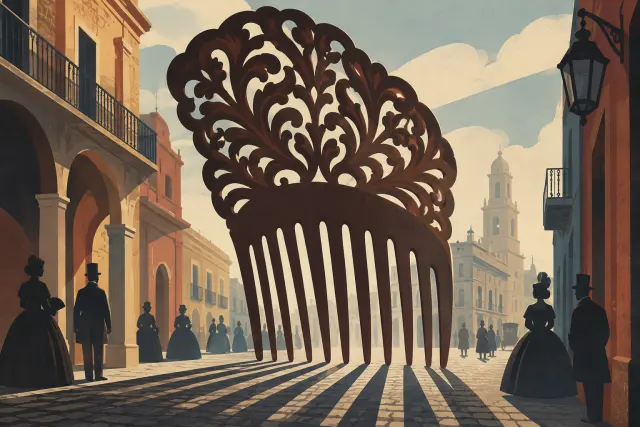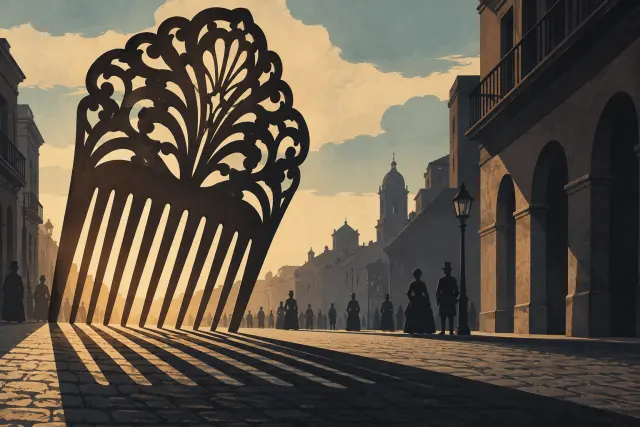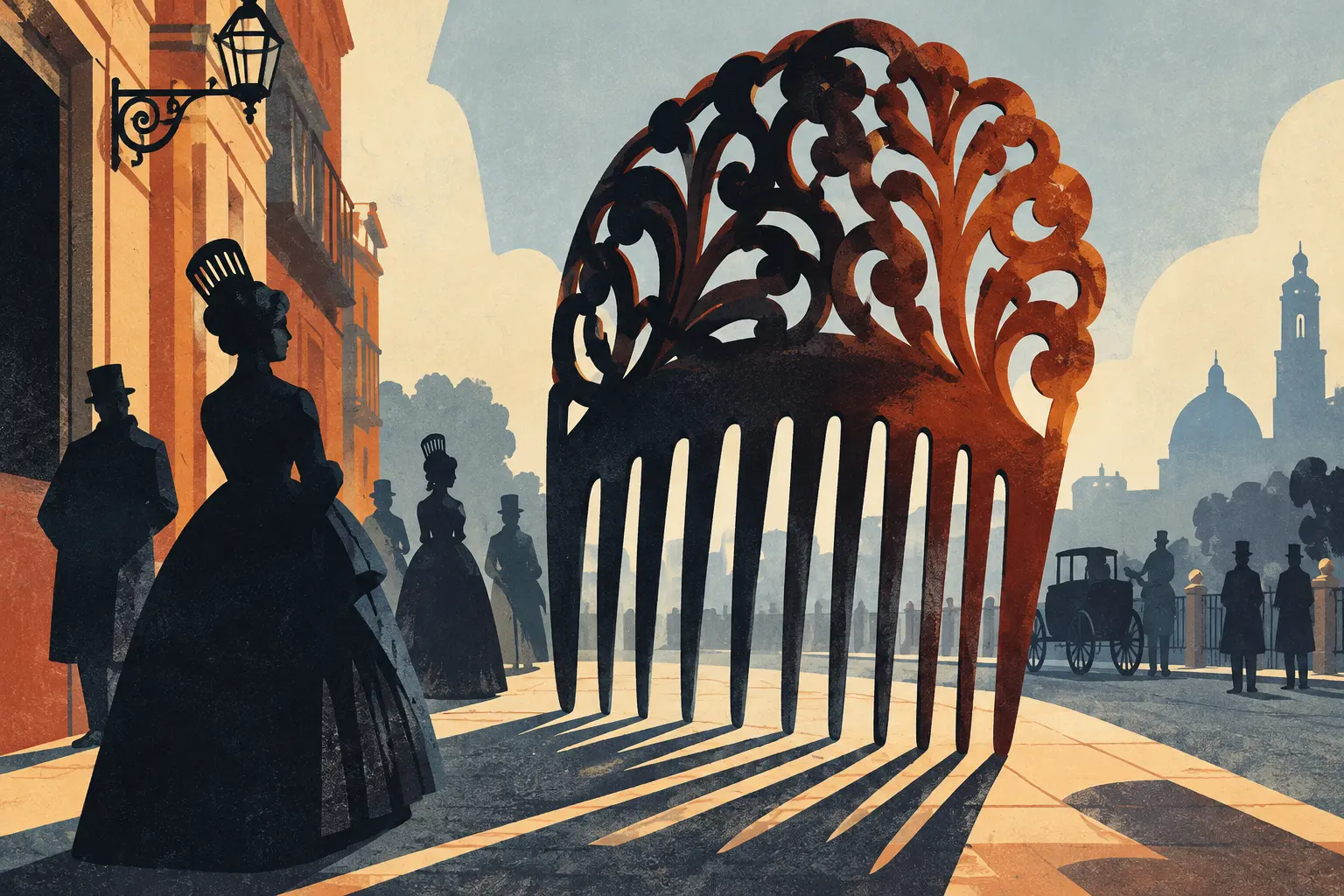
From the late 1820s to the mid-1830s, an oversized ornamental comb became one of the most recognizable features of fashion in Buenos Aires and Montevideo. The peinetón descended from the Spanish peineta, but its scale, production and circulation gave it a distinct character in the Río de la Plata. Its history links dress to craft labour, print culture and disputes over who could occupy and move through the streets.
From peineta to peinetón
The peineta reached Buenos Aires around 1815. From 1824, larger and more elaborate versions gained popularity alongside the period’s high hairstyles and Romantic silhouettes: narrow-waisted dresses with voluminous sleeves. The peinetón was held in the hair by a comb and featured a pierced ornamental panel, which could take different shapes and designs.
Tortoiseshell was among the most common materials; horn, which was less expensive, was also used, as were other materials to a lesser extent. Some examples grew to extraordinary dimensions. The press and travellers singled it out as a distinctive regional fashion, while portraits show how it was worn with dresses and shawls. When women went out, a shawl might rest on the shoulders or partly cover the peinetón.
The accessory cannot be understood apart from the rest of the appearance. In Charles Henri Pellegrini’s portraits, for example, the peinetón forms part of a complete composition of hairstyle, dress, sleeves and posture. César Hipólito Bacle depicted it in lithographs of urban dress and customs. These images make it possible to compare styles and ways of wearing the comb, but they are not a visual census: many depict well-to-do women, and all reflect the conventions of their makers.
Workshops, trade and labour
Production and sales were concentrated in Buenos Aires’s commercial district around Plaza de la Victoria, now Plaza de Mayo. Manuel Mateo Masculino was among the most prominent makers and promoters. Yet the peinetón cannot confidently be credited to a single inventor. Research describes a gradual development involving several makers and merchants, and European influences adapted to local circumstances.
Making the combs required working sheets of material, cutting and joining them, shaping the comb and decorative panel, piercing designs and polishing the finished piece. Records of the workshops also bring into view a less visible dimension of fashion. Studies describe a division of labour involving artisans of different social conditions, including enslaved and free Black people. Behind the finished object, then, lies a history of skill and labour relations that images of its wearers often leave out.
An accessory that became a public issue
The peinetón was not merely seen; it was discussed. The English-language weekly The British Packet devoted an article to it in 1831, while newspapers, caricatures and travellers’ accounts recorded both fascination and criticism. These sources show that the accessory became a subject of public comment, though each offers a particular perspective rather than a complete account of Río de la Plata society.
One of Bacle’s satirical lithographs turns the peinetón’s size into a problem for people sharing the pavement: passers-by are shown struggling over space. The scene plays on the accessory’s comic potential, but also points to a wider discussion about women’s presence in the street. Some fashion historians interpret the peinetón as a way for its wearer to become visible and claim attention in spaces where women faced strong social expectations. Other readings stress the gesture’s ambiguity: taking up space could also invite ridicule, scrutiny and judgement of women’s conduct.
The fashion’s relationship to class was not straightforward either. Tortoiseshell and skilled workmanship helped associate the peinetón with luxury and status. Some studies connect its use chiefly with affluent women; others point to wider circulation and record the desire to own one among people who could not easily afford it. Images of elite women alone cannot establish who wore it across society.
Local fashion and political codes
The peinetón developed in a postcolonial society shaped by debates over identity and political conflict. Its form combined Spanish and French references with local production and use, making it difficult to describe as simply an imported fashion. Its distinctive character helped connect it with porteño and Río de la Plata identities.
During Juan Manuel de Rosas’s period, clothing could express political allegiance. Some peinetones carried Federal emblems or slogans, and the accessory became associated with Federal women. That association does not make every example a political statement: pieces bearing inscriptions should be distinguished from the fashion as a whole.
Portraits, lithographs, newspapers and museum objects make it possible to study the peinetón from several angles: its form and materials, the people who made it, those who wore it and the interpretations it provoked. It was a fashion accessory, but also an object of urban culture whose presence made the relationships between appearance, status and public space visible—and open to debate.
- Decade
- Before 1950
- Region
- Latin America
- Level
- Enthusiast
- Entities
- Museum, Peinetón, Buenos Aires
Sources and references 5
- Museos de moda del mundo: por qué son archivos vivosinstitutodemoda.com · 2026-11-18
- Exposición permanente - Museo del Trajewww.cultura.gob.es · 2026-11-18
- Un Museo para Balenciagablog.cristobalbalenciagamuseoa.com · 2026-11-18
- Casa sobre el Arroyoes.wikipedia.org · 2026-11-18
- Peinetónes.wikipedia.org · 2026-11-18