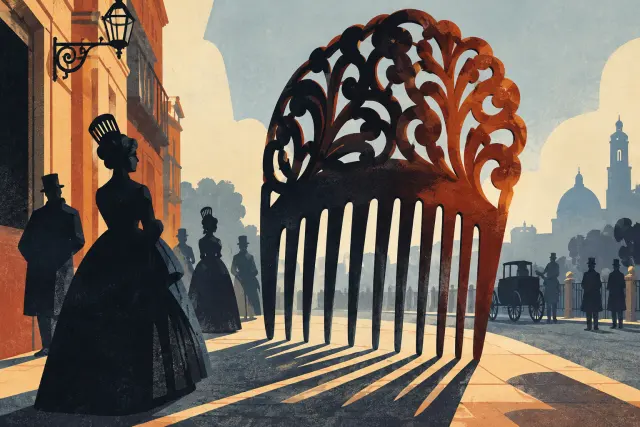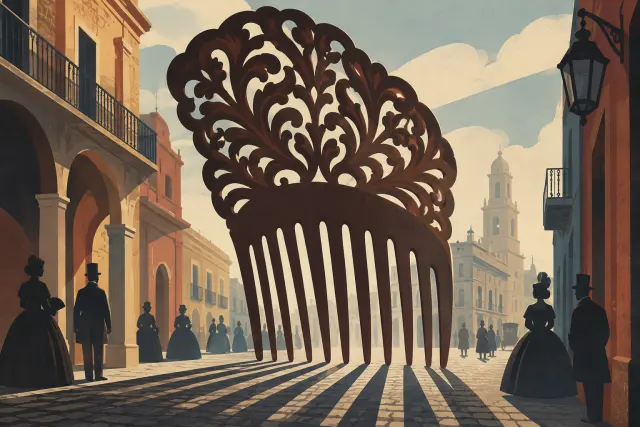
The peinetón was a single-piece ornamental comb: secured in the hair, it spread around the head as a conspicuous, often openwork surface. In Buenos Aires and Montevideo, its scale made it more than an accessory. It became a local fashion, a marker of prestige and a subject of debate about who could command attention in the streets. Its peak is usually placed between 1830 and 1837, though it circulated more broadly during the decade.
From peineta to Río de la Plata fashion
The Spanish peineta was known in the region by around 1815. From 1824, interest grew in larger and more elaborate versions. The peinetón retained the comb that held the ornament in place, but developed its own scale and decoration. There was no single standard design: pieces varied in shape, size and ornament, with vegetal, animal and neoclassical motifs.
Tortoiseshell was a common material; horn, which was more affordable, was also used. In urban workshops, artisans cut, heated, joined, pierced and polished the sheets. This demanding process made each piece a crafted object rather than a uniform accessory. Accounts of workshop labor also point to the involvement of workers of different statuses, including enslaved and formerly enslaved Black artisans, as historical research on the subject has noted.
The evidence does not allow the invention of the peinetón to be securely attributed to one person. Manuel Mateo Masculino, a maker who arrived from Spain in 1823, opened a shop in Buenos Aires in 1825 and helped spread new models. His role as a prominent promoter, however, does not establish that he invented the accessory. Fashion historian Regina A. Root and other researchers suggest that it may have emerged through competition among makers and demand from the women who wore it.
Images, accounts and urban life
Portraits by Charles Henri Pellegrini and other artists show the peinetón worn with particular hairstyles, dresses and rebozos. César Hipólito Bacle’s lithographs, especially those published in Trages y costumbres de la provincia de Buenos Ayres, offer another view: they depict clothing and scenes of urban life, not only idealized figures. Some distinguish morning dress from walking attire, suggesting that the accessory was not simply part of every outfit on every occasion.
Written accounts record both the impression the peinetón made and the viewpoint of those describing it. In 1831, the English-language weekly The British Packet devoted an article to the large comb that characterized the headwear of fashionable women in Buenos Aires. French naturalists Alcide d’Orbigny and Arsène Isabelle commented on its scale and visual effect. During his travels, Charles Darwin noted the admiration of rural men for the peinetones worn by women from Buenos Aires. These are valuable contemporary observations, but they are mediated by their authors’ perspectives and do not neutrally represent what the entire population wore.
The peinetón’s size also inspired satire. In one of Bacle’s lithographs, a caricature imagines the collisions it might cause on narrow pavements; newspapers, meanwhile, debated the fashion. Its scale made the wearer difficult to overlook. In a city where women’s presence in the street was contested, a walk in a peinetón could take on a public dimension as well as an aesthetic one.
Some scholarship interprets that visibility as an ambiguous way of contesting urban space. The accessory attracted attention and occupied room, but visibility did not in itself amount to full freedom: it could provoke criticism and reinforce expectations about women’s roles. The fashion therefore offers neither a simple story of emancipation nor one of control. It reveals how a garment could expose tensions between public presence and gender norms.
Prestige, politics and unequal access
Tortoiseshell was imported and costly, and the labor involved in making a peinetón could make it a luxury item and a status marker. Yet the evidence does not support restricting its use to one social class. Images and written accounts also record the aspirations of women with fewer resources. Wanting to own a peinetón did not necessarily mean being able to buy one; keeping that distinction in view prevents a striking fashion from being treated as universally accessible.
During Juan Manuel de Rosas’s government, some models incorporated federalist effigies and slogans. Dress could thus make political affiliations visible, although not every peinetón had this function. The accessory brought European influences together with local transformation: it developed in Buenos Aires and circulated in Montevideo, where it also became part of the period’s fashion. This adaptation helps explain its relevance to studies of postcolonial identity without turning an urban trend into a uniform expression of the entire region.
There is no single established explanation for the fashion’s decline. Changing tastes and disputes over women’s public presence are among the interpretations proposed. The evidence allows us to trace the accessory’s rise and waning, but does not justify reducing that process to one cause.
From use to museum collections
Peinetones preserved in Argentine museums allow researchers to study their materials, techniques and forms. Portraits, lithographs, advertisements and written accounts help reconstruct how they were worn and discussed. Each kind of evidence has different limits: a surviving object does not automatically reveal who wore it, while a caricature is a satirical representation, not a transparent record of everyday life.
Taken together, these traces show the peinetón as an object of material culture where manufacture, trade, prestige, politics and debates about gender and urban space intersected. Its history also shows how a local fashion can transform outside influences and acquire meanings of its own. The ornamental comb cannot document a shared experience for all women, but it offers a concrete way into the social tensions of Buenos Aires and Montevideo in the 1830s.
- Decade
- Before 1950
- Region
- Latin America
- Level
- Enthusiast
- Entities
- Museum, Peinetón, Buenos Aires, Peinetón rioplatense, Trages y costumbres de la provincia de Buenos Ayres
Sources and references 5
- Museos de moda del mundo: por qué son archivos vivosinstitutodemoda.com · 2026-11-15
- El archivo y lo análogo como MEMORIA, haciendo resistencia ...valeriaakl.substack.com · 2026-11-15
- Los mejores —y más elegantes— museos de moda del mundo.es.qz.com · 2026-11-15
- La moda como registro cultural: lecciones de conservación ...translate.google.com · 2026-11-15
- Peinetónes.wikipedia.org · 2026-11-15