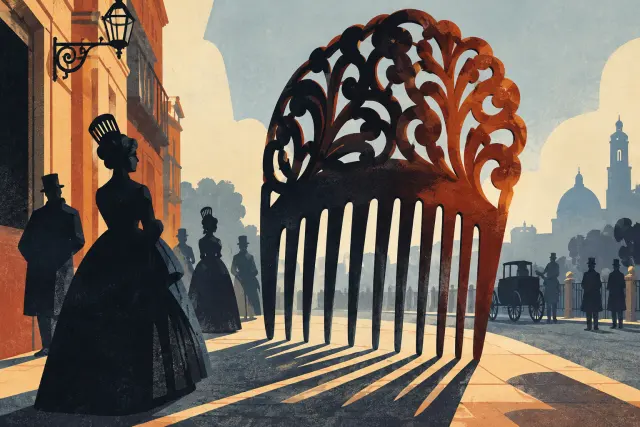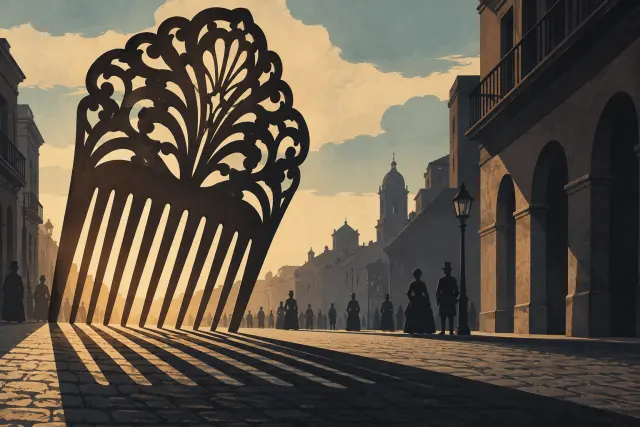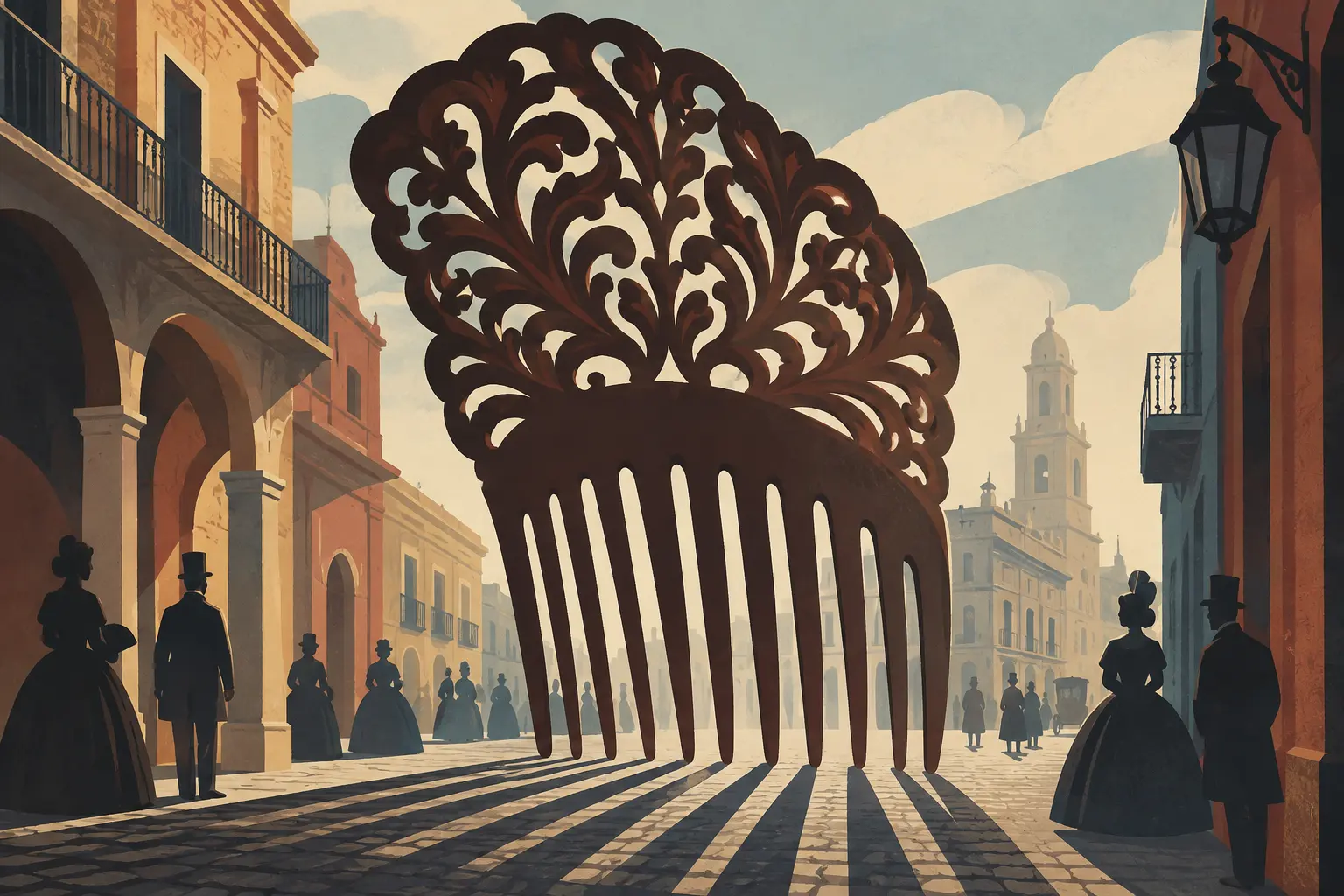
The peinetón, an oversized ornamental comb, became a distinctive feature of Buenos Aires and Montevideo from the late 1820s to the middle or later 1830s. Portraits, lithographs, newspapers, travellers’ accounts and museum objects help reconstruct its circulation, though they do not offer a uniform picture of who wore it. Its historical significance also lies in the reactions it provoked: the object made tensions over luxury, fashion and women’s presence in the streets visible.
From peineta to Río de la Plata fashion
The peinetón developed from the Spanish peineta, introduced to the Río de la Plata around 1815, and from European hairstyles and adornments. This combination was not simply a matter of copying: scholarship describes it as local appropriation and transformation. From 1824, interest grew in larger and more elaborate models, and the fashion reached its height in the following decade.
Tortoiseshell was a common material, while the less expensive horn was also used. In urban workshops, pieces underwent processes such as cutting, piercing, engraving and polishing. The materials and labour could make a comb costly, although size and finish varied. Accounts of exceptionally large examples document the extremes of the fashion, not necessarily the everyday experience of all its wearers.
Manuel Mateo Masculino was a prominent maker who helped popularise the accessory, but its invention cannot be attributed with certainty to one person. Regina A. Root and other scholars have suggested that the peinetón may have emerged from demand and competition among merchants and wearers. This possibility shifts attention away from an individual designer and towards a fashion shaped by production, trade and the choices of those who adopted it.
Portraits, lithographs and observers
Portraits by Charles Henri Pellegrini and other artists show women in Buenos Aires and Montevideo wearing peinetones with narrow-waisted dresses and full sleeves associated with Romantic-era fashion. César Hipólito Bacle’s lithographs offer a different perspective: his costumbrista scenes place the accessory in urban life, including movement through the streets. Comparing images with surviving objects reveals differences in shape, size and ornament; it does not mean that any one image represents all women.
Newspapers and travel writing recorded the impression the combs made. In 1831, an article in The British Packet described the comb as a prominent feature of fashionable women’s coiffure in Buenos Aires. Alcide d’Orbigny and Arsène Isabelle also commented on their size and visibility. These are observations by particular writers, not systematic counts of wearers. Read alongside portraits, caricatures and museum objects, they help explain how the fashion was perceived and why it became a subject of discussion.
The sources do not allow the peinetón’s social reach to be settled simply. The cost of tortoiseshell and the complexity of manufacture point to an association with luxury and elite women. Other research suggests that women from different social groups also aspired to wear it or used more affordable versions. Images of wealthy women alone do not prove that the accessory reached the whole population; its presence in visual culture does not establish universal use either.
The street: visibility and contest
The size of some peinetones could make it difficult to pass along the city’s narrow pavements. Sources mention a police ordinance regulating pedestrians’ right of way on the right. Caricatures exaggerated the comb’s dimensions and turned it into a comic subject. Their ridicule also points to unease about women’s visible presence in the street: the peinetón drew attention to the dressed body and the space it occupied.
Its political meaning also needs qualification. During Juan Manuel de Rosas’s government, some examples featured Federal images or slogans, and the accessory came to be associated with Federal women. That does not describe every peinetón or every wearer. It could serve as adornment and an expression of taste or wealth, while also belonging to a local fashion in which transatlantic references mingled with political and social signs.
Regina A. Root interprets the public use of the peinetón as a way of making women’s presence visible in a period shaped by strong domestic expectations. Other readings stress its ambivalence: it could attract attention and symbolically extend its wearer’s presence, while its price and social associations also affected access and how wearers were judged. These interpretations draw on images, press and documentary evidence; they are not direct testimony from every woman who wore one.
What surviving examples can tell us
Peinetones are held in Argentine museum collections, including those of the Museo Nacional de Bellas Artes, the Museo Histórico Nacional and the Museo Histórico de Buenos Aires Cornelio de Saavedra. Alongside portraits and lithographs, the objects allow researchers to study materials, techniques, shapes and decorative motifs. Current museum cataloguing distinguishes peinetas from peinetones by size, although the terms were used less consistently at the time.
The peinetón was neither an accessory worn by every woman nor a symbol with a single meaning. Its history shows how a material object could connect fashion with consumption, identity and disputes over urban space. In the streets of Buenos Aires and Montevideo, the comb made women’s presence—and the reactions it provoked—hard to ignore.
- Decade
- Before 1950
- Region
- Latin America
- Level
- Enthusiast
- Entities
- Museum, Peinetón, Buenos Aires, Peinetón rioplatense, Museo Histórico de Buenos Aires Cornelio de Saavedra, Museo Histórico Nacional
Sources and references 5
- Conservación y Restauración del Patrimonio Cultural en soporte Papel - Museo Jesuítico Nacional de Jesús Maríadoi.org · 2026-11-16
- Los tejidos en las colecciones de los museos españoles, una larga historia de valoración y conservaciónopenalex.org · 2026-11-16
- Diseño y Modaopenalex.org · 2026-11-16
- exposición Archives - Página 3 de 9evemuseografia.com · 2026-11-16
- Peinetónes.wikipedia.org · 2026-11-16