A garment does not speak alone
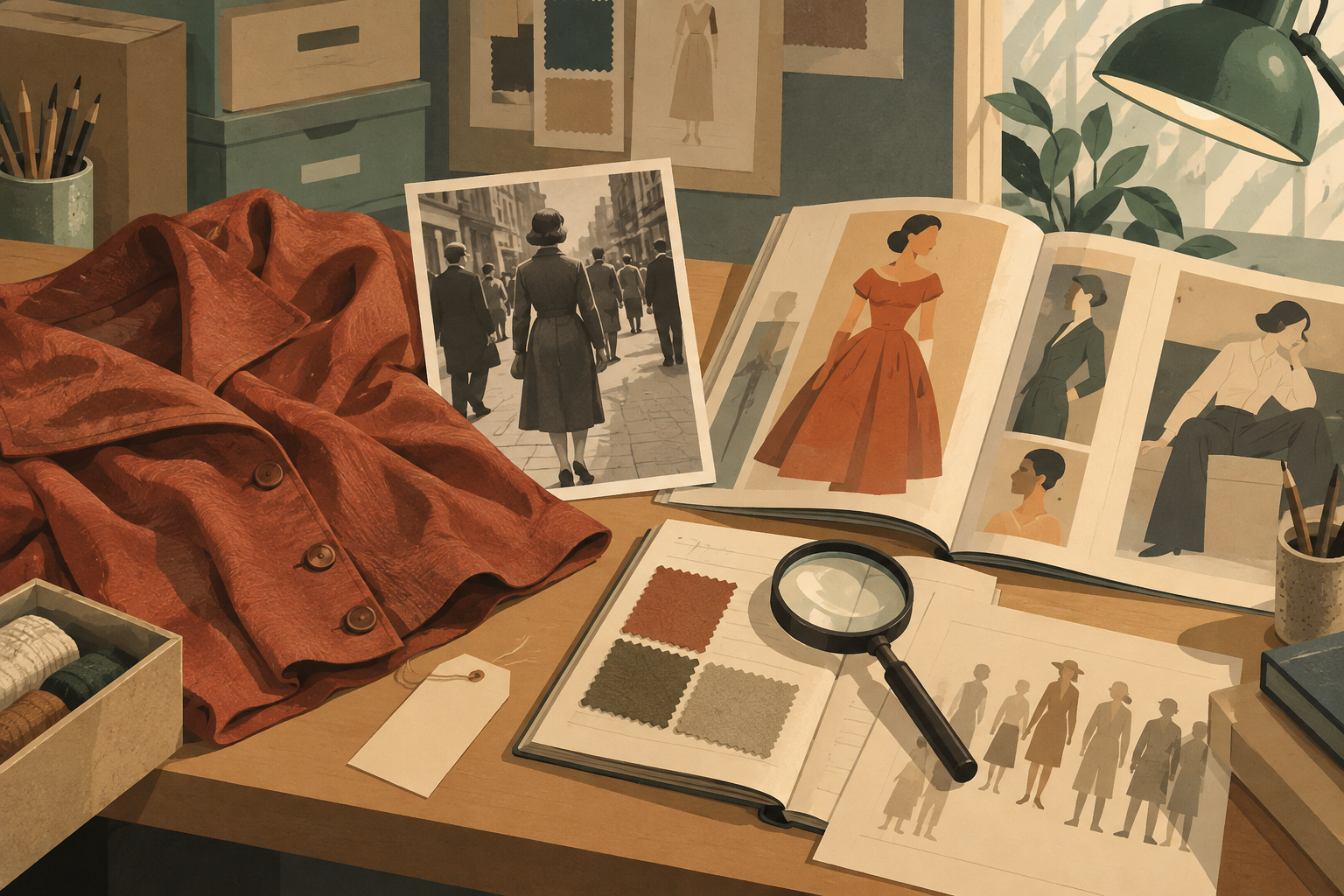
A preserved garment lets us examine materials, shapes and details that an image may conceal. But its presence in a collection does not, by itself, prove who wore it, how often it was used or how widely a particular way of dressing was shared. To investigate those questions, the object must be considered alongside other sources, and observation must be kept distinct from interpretation.
The Museo del Traje’s collections illustrate both the potential and the limits of this work: the museum says it holds nearly 30,000 items of dress and fashion, as well as jewellery and accessories. That figure describes a substantial collection, not a statistical sample of what a population wore. A collection reflects decisions about preservation and acquisition. The absence of an item does not prove that it was not worn; the presence of another does not establish widespread use.
Photographs: people in context, frames with limits
A photograph can bring clothing closer to a particular situation: it shows how it appears on a body and within a scene. Yet it also frames, selects and leaves things out. A commissioned portrait, a fashion photograph and an everyday image need not have the same purpose. They should not be treated as equivalent testimony, nor should a single image be made to stand for an entire period.
The Biblioteca Virtual del Patrimonio Bibliográfico’s Fashion, Dressmaking and History of Dress collection includes 116 photographs alongside books, magazines, manuscripts and plates. The presence of these different formats is useful for asking questions, not for answering them automatically. A photograph may show an outfit; a magazine may propose a style; a document may provide written information. Their agreement strengthens an interpretation only when there is evidence that they refer to the same object, context or period.
Promotion is not proof of use
Magazines and promotional images can show how a garment or silhouette was presented. They cannot, on their own, establish that audiences adopted the proposal or could afford it. Claims about use need traces connected to actual situations: objects with documented provenance, photographs with known contexts, attributable testimony, or records that indicate circulation and use. The evidence may be uneven; where it is missing, conclusions must remain open.
This distinction does not make advertising useless. It makes it a source for studying aspirations, visual language and ways of presenting fashion, rather than a transparent mirror of everyday life. The academic article on fashion as a performative tool in the contemporary museum opens another question: how exhibitions organise looking and produce meaning. That reflection concerns museum representation; it does not replace the historical investigation of a particular garment.
Reading archives together
The archive and collection associated with Lorenzo Caprile, acquired by Spain’s Ministry of Culture, include more than 500 garments and accessories and more than 5,000 documentary holdings, alongside other material whose description available here is incomplete. The point is not to treat this collection as a complete history of fashion, but to note that garments and documents can be preserved within the same research context.
Studies of textile conservation in Spanish museums and of the creation of the Museo del Traje add two different dimensions: the conditions of preservation and the institutional decisions that shape a collection. Neither, by itself, proves how an individual item was used. Both help remind us that the heritage available for study is also the result of choices about what to collect, preserve and display.
What can be claimed
A careful investigation identifies each source, asks what function it may have served and records its limits. It compares objects and images only when there are grounds to connect them; separates material description from cultural interpretation; and avoids presenting a runway outfit, a selected photograph or an exceptional object as representative of an entire society.
An archive’s value does not lie in supplying a complete answer in advance. It lies in allowing garments, photographs, magazines and documents to be compared—and in making visible where the evidence ends. Fashion can then be studied as a social practice without confusing the image someone wished to project with the everyday experience that remains to be documented.
- Decade
- Contemporary
- Region
- Spain
- Level
- Enthusiast
- Entities
- Museum, Museo del Traje
Sources and references
- La moda como herramienta performativa en el museo contemporáneoopenalex.org · 2026-10-05
- Los tejidos en las colecciones de los museos españoles, una larga historia de valoración y conservaciónopenalex.org · 2026-10-05
- La representación del poder y el poder de la representación: la política cultural en los museos de Antropología y la creación del Museo del Trajeopenalex.org · 2026-10-05
- El Ministerio de Cultura adquiere el archivo y la colección ...www.cultura.gob.es · 2026-10-05
- Cuando la moda entra en el museo: conservación, contexto y ...www.retropause.com · 2026-10-05
- Moda: De la pasarela al museoigeca.net · 2026-10-05
- La moda en la historia - Museo del Trajemuseodeltrajevirtual.com · 2026-10-05
- Coleccion de Moda, Costura e Historia del Trajebvpb.mcu.es · 2026-10-05