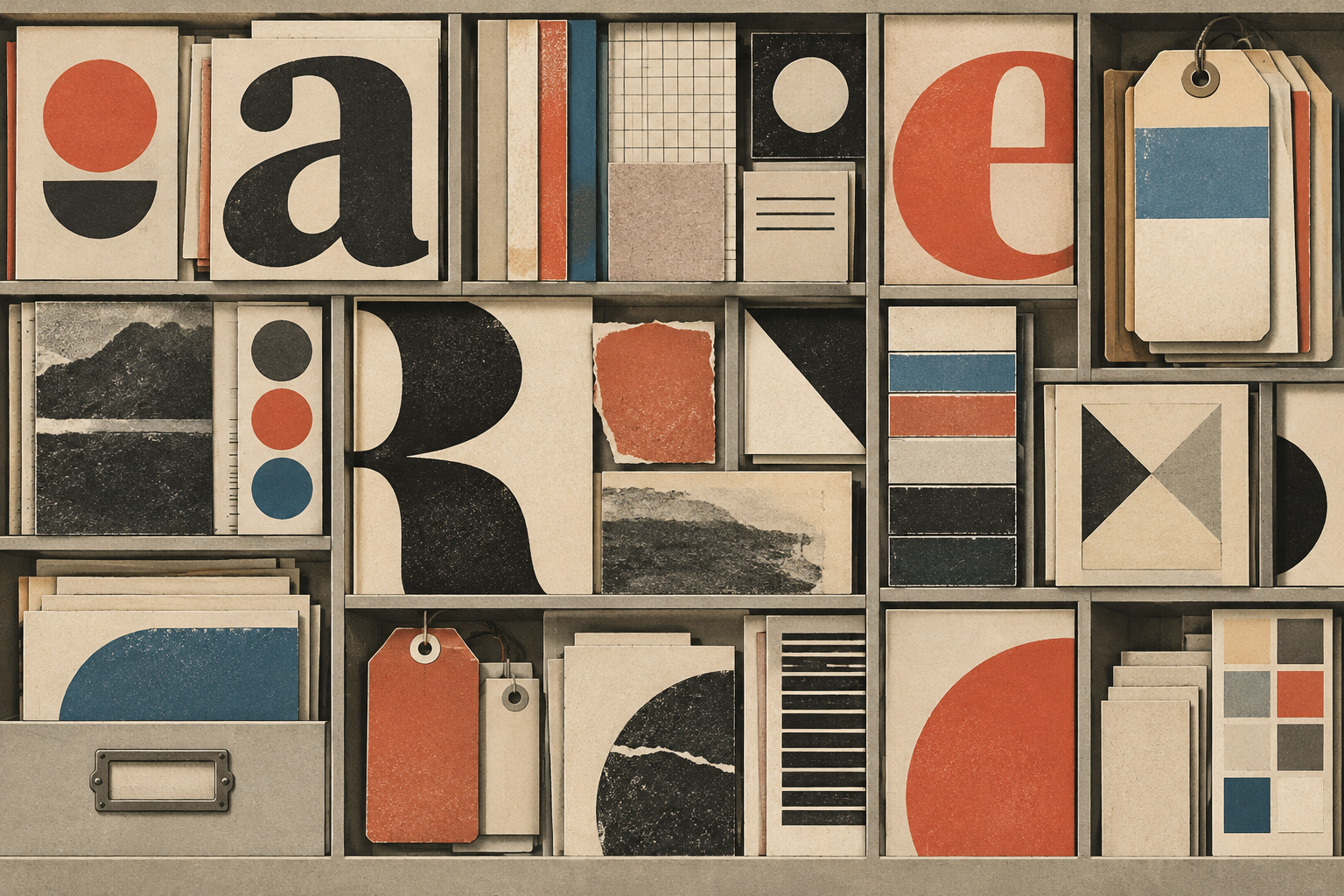
In everyday conversation, a brand is often reduced to a name or logo. Research on advertising heritage suggests a broader reading: an identity can also be studied through the records that describe it, the visual elements that represent it, and the ways that information is arranged. That does not justify reconstructing an entire history from a single item. It does allow us to ask what a document shows and where its limits lie.
A logo is one item, not the whole archive
The academic article on the MUVAP virtual museum describes a project devoted to documenting the history of advertising from 2001 to 2016. In the available summary, trademark registration and the founding record appear as distinct matters, and the logo is described as incorporating a barcode. These details allow us to treat the logo as an identifiable element within a documentary context, not as a substitute for all the material that might explain the institution.
The distinction matters when looking at commercial brands, too. A sign can identify, organize, or distinguish; on its own, it does not necessarily document who decided to use it, where it appeared, or how it changed. Such questions require sources that are not automatically contained in the graphic form.
What an advertising archive can add
A study of advertising documentary heritage describes a field of documentation that may include brand context, socioeconomic information about the sector, campaign objectives, budget, intended audience, and delivery dates. This list is useful because it shifts attention from an isolated image to the conditions that enable interpretation. It does not prove that all these data survive in every archive; it identifies categories that may be relevant to documenting a campaign.
The distinction between a possible category and a preserved fact is essential. A visible advertisement may show composition, text, and images, but not necessarily the intentions of its makers or the criteria used to commission it. When such material is unavailable, it is better to state the limit than to fill the gap with an assumption.
Identity is also a system of organization
Designing an identity is not just drawing a sign. A university project on corporate identity for museums lists graphic design, branding, signage, and advertising among its keywords. That vocabulary prompts a functional question: what task does each component perform in its context? Signage and a logo need not solve the same problem, even if they share visual resources.
Thinking in terms of function helps prevent “style” from becoming a universal explanation. A similarity in colour or typography may be visible, but attributing a specific purpose to it requires documentation. Likewise, a registered trademark, a founding record, and a logo are different kinds of information. Connecting them may clarify a case, but they are not interchangeable.
Reading what has been preserved
Research on the documentation and history of advertising explicitly addresses the relationship between these two activities. From that perspective, we can begin reading an item with verifiable questions: what kind of document is it? What information does it contain? What documented relationship does it have to a brand or campaign? What contextual information is missing? These are methodological questions, not claims about a particular item.
A supplied documentary resource identifies the Museu del Disseny de Barcelona as an institution with a documentation centre open to the public. This helps situate documentary research within the study of design. It is not, however, enough to attribute specific holdings or records about a particular brand to the museum; that would require a relevant catalogue entry or collection description.
Reading brands with care
When a logo, record, or advertising image is preserved, the evidence has a particular nature. Its value grows when it can be connected to other identified and contextualized records. Critical reading distinguishes between what an item shows, what a catalogue states, and what a researcher interprets. It also recognizes that a documentary absence is not an answer.
A brand therefore leaves more traces than its logo, but not all those traces are necessarily available. Rigorous study of visual language means observing form while specifying which sources make it possible to discuss function, context, or use. An archive does not automatically complete the story: it enables better questions and an honest recognition of where the evidence ends.
- Decade
- 2000s
- Region
- Spain
- Level
- Enthusiast
- Entities
- Museum, MUVAP
Sources and references
- La documentación y la historia de la publicidaddoi.org · 2026-10-11
- recursos documentales para la investigación en el museu ...www.dissenyhub.barcelona · 2026-10-11
- MUVAP (2001-2016): museo virtual que documenta la historia ...revistas.ucm.es · 2026-10-11
- Diseño de la identidad corporativa de un museo y sus piezasriunet.upv.es · 2026-10-11
- Perspectivas sobre el patrimonio documental publicitario. Un ...redc.revistas.csic.es · 2026-10-11