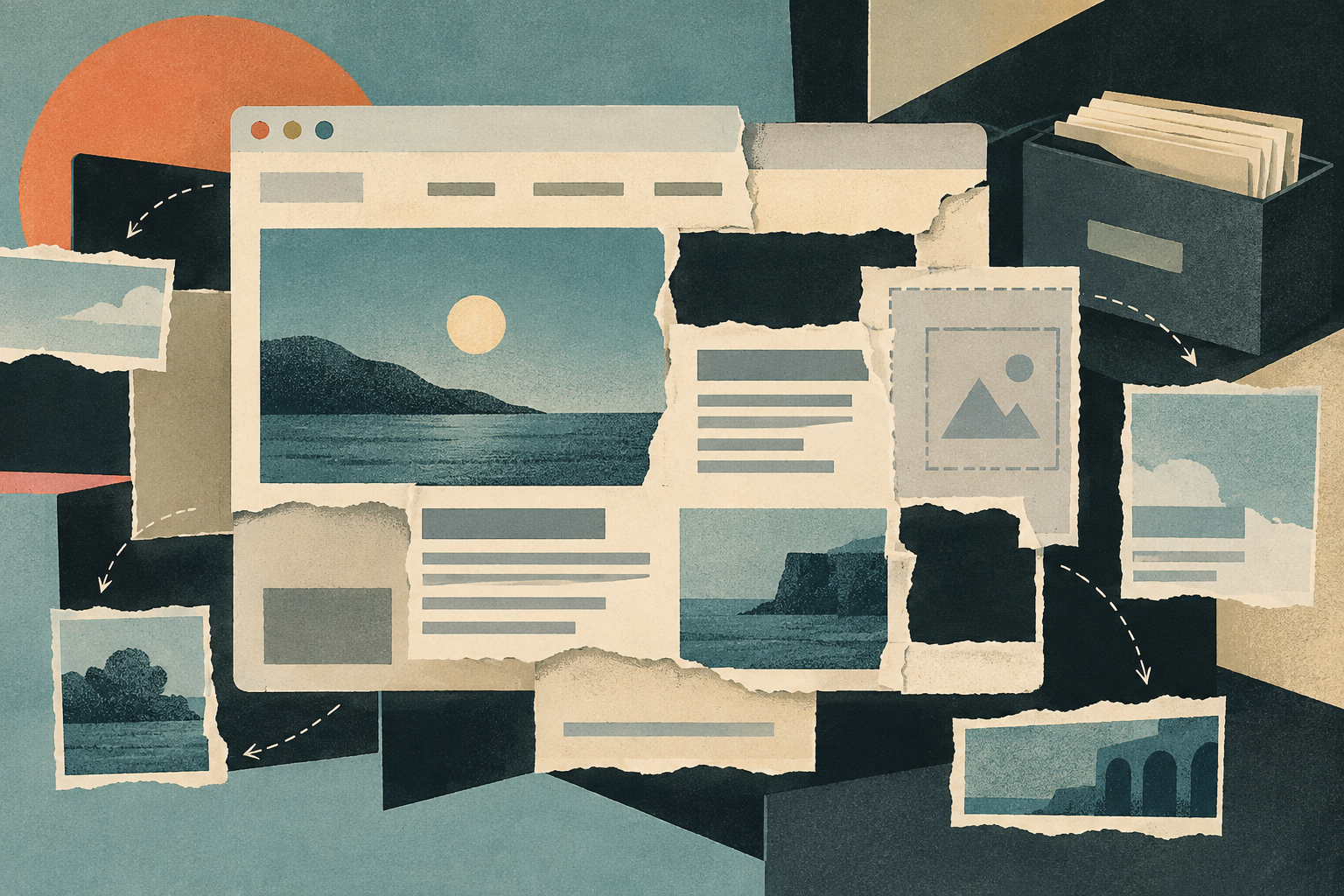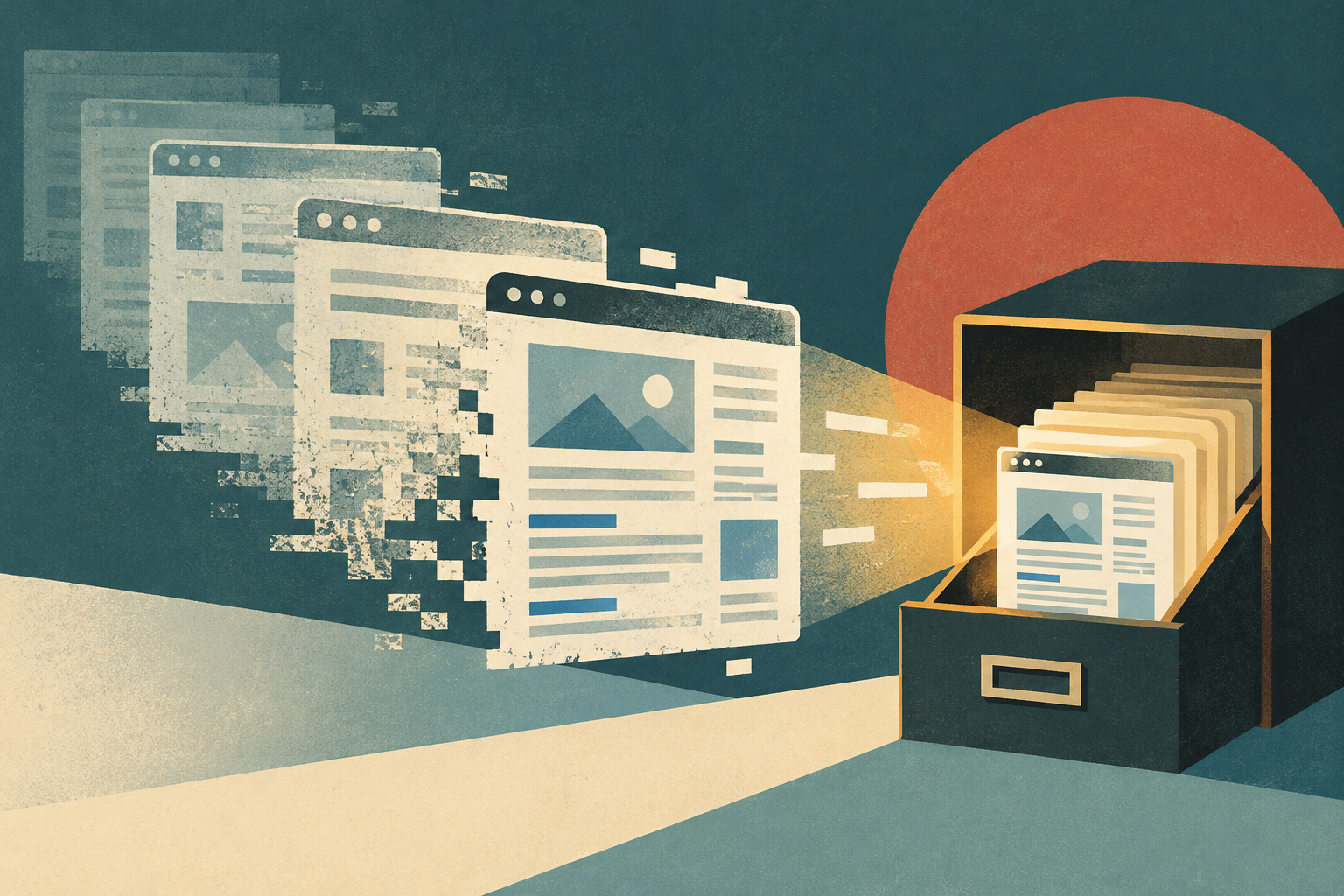
A vanished website invites us to fill in what is missing: to imagine how it worked, what it offered, and what it meant to the people who visited it. But a capture or archived page does not, by itself, prove all of that. To reconstruct internet services carefully, the first question is not what memory the page evokes, but what kind of evidence has survived and what its limits are.
An archive preserves a selection, not the whole past
The National Library of Spain describes the Spanish Web Archive as a collection of websites gathered to preserve Spain’s documentary heritage on the internet. That stated purpose gives us a verifiable starting point: the archive brings websites together as documentary heritage. Without consulting specific records, however, it does not tell us which pages from a particular service are available, how often they were captured, or whether their interactive functions can still be reproduced.
This distinction matters because a visible page is only part of a service. It may show text, links, or a visual arrangement, but it does not necessarily show how a person registered, sent messages, or what happened after logging in. The supplied documentation does not specify which technical elements accompany each capture in the Spanish Web Archive. We should therefore avoid presenting the collection as an operational replica or a complete sequence of changes.
Three questions before telling the story
For each trace, separate three questions. First, what object are we looking at: a page, a group of pages, an institutional description, or a later interpretation? Second, what does the source state literally? Third, what conclusion are we adding?
The distinction may seem small, but it prevents familiar errors. A date associated with a memory does not establish when a service began. Nor does a capture prove that every user saw that version or accessed it in the same context. The date and content of each document should be considered separately; the evidence supplied here includes no specific captures or dates for an individual service.
General history helps, but cannot replace the case
The Universidad Politécnica de Madrid thesis is described as an overview of internet history and its beginnings in Spain, including data networks and deployments. That broad scale can help frame questions: it allows service histories to be considered in the context of networks and access. It cannot, on its own, establish how a particular page worked or what its users experienced.
Telefónica’s overview and the ACTA article also offer general frameworks for the origins and evolution of the internet. They can help organize topics and identify possible research paths, but a general chronology is not a substitute for evidence about a specific service. A claim about an interface, feature, or practice needs a source that documents it directly.
What a capture can and cannot tell us
A preserved capture can help us study visible elements: wording, structure, links, or the way a page presents information. It is reasonable to read those elements as choices documented in the object being consulted. But describing the complete experience requires caution. A single capture does not, by itself, establish a navigation path, frequency of use, user profile, or the service’s success.
Nor should absence be turned into certainty. If a feature does not appear in one capture, that does not necessarily prove it never existed: it may have appeared on another page, may not have been preserved, or may have depended on an interaction the document does not represent. An absence is an observation about the available evidence, not automatic proof about the original service.
Cross-reference sources without erasing their differences
The BNE page describes a preservation initiative; the UPM thesis provides a historical overview; Telefónica and ACTA offer broader accounts of internet history. These materials have different scopes. Bringing them together can guide research, but it does not make them interchangeable testimony. An institutional source explains the purpose of a collection; a historical overview supplies context; a specific capture would allow us to examine a page’s appearance at a particular moment.
RetroPause’s article about museums on the internet also raises the questions of archival access and context. Here it serves as an editorial reference for that issue, not as proof of technical details absent from the supplied evidence. Keeping the provenance of each claim visible helps readers distinguish document, context, and interpretation.
A reconstruction with explicit limits
The sources consulted support the existence of the Spanish Web Archive and its stated aim of preserving websites as documentary heritage, as well as the existence of works and overviews that contextualize internet history and its beginnings in Spain. They do not identify a particular vanished service or describe its features, users, dates, or evolution through verifiable captures.
That limit does not make the archive useless; it defines the next step. Reconstructing a service would require specific records and related sources that allow each one to be compared. Until then, the responsible approach is to describe the kind of trace that can be studied, attribute each claim to its source, and leave unconfirmed details open. The archive then becomes more than an invitation to nostalgia: it becomes a basis for precise research.
- Decade
- 2000s
- Region
- Spain
- Level
- Enthusiast
- Entities
- Archivo de la Web Española, Internet
Sources and references
- Historia de Internet: ¿cómo nació y cuál ha sido su evolución? -www.telefonica.com · 2026-10-11
- Historia de Internet y de sus inicios en Españaoa.upm.es · 2026-10-11
- Archivo de la Web Española | Biblioteca Nacional de Españawww.bne.es · 2026-10-11
- Cuando el museo llegó a Internet: acceso, archivo y el ...www.retropause.com · 2026-10-11
- Historia y evolución de Internetwww.acta.es · 2026-10-11