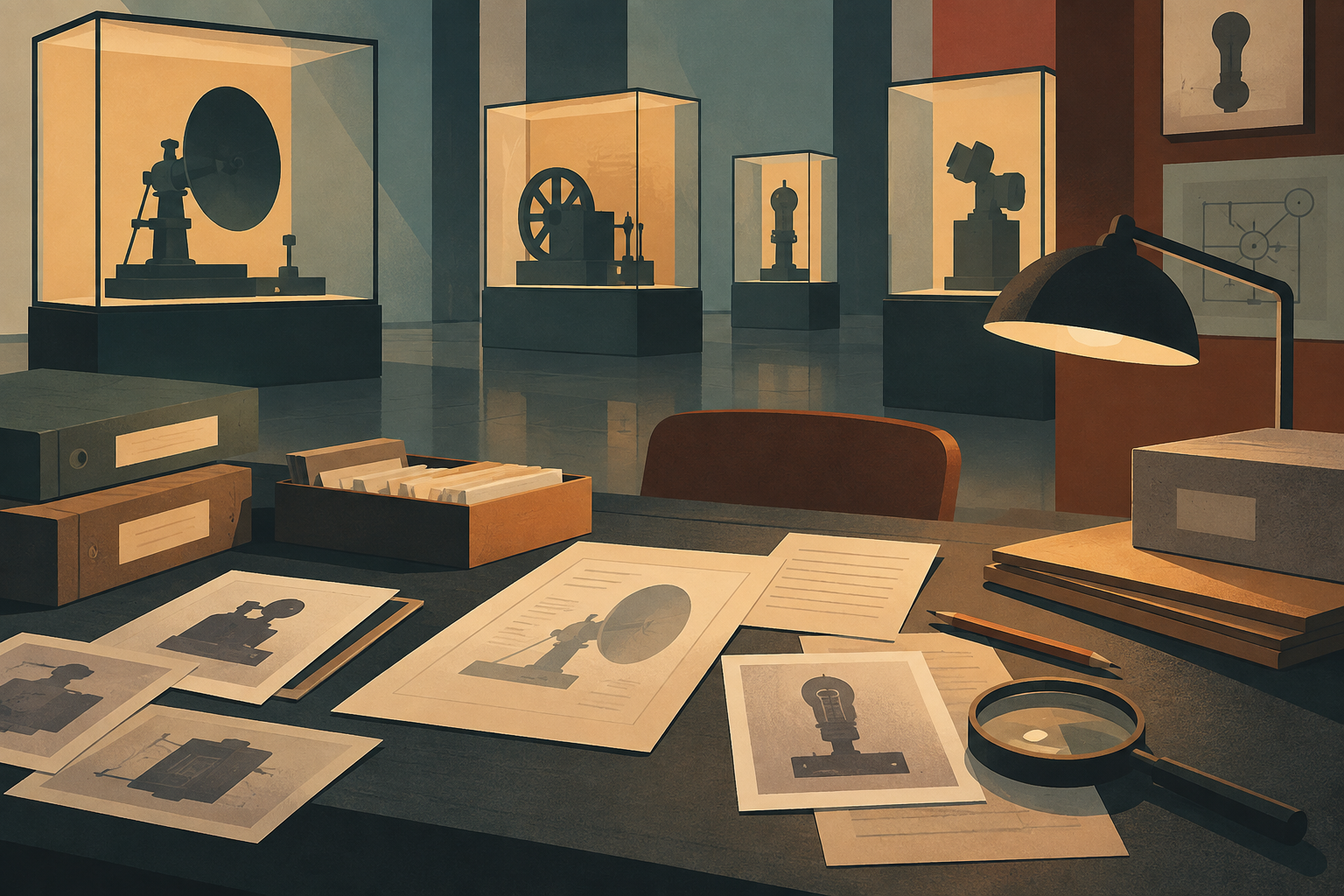
The image and the archive are not the same thing
A photograph can seem like a direct window onto a place, a person or a period. But an image preserved in a collection arrives with—or without—information about its provenance, use and physical support. Those differences determine which questions can be asked rigorously. The image shows something; the archive organizes and preserves materials, and may add information that helps describe them. None of these layers, by itself, amounts to a complete explanation.
The visual documentation protocol for museums presented by Ibermuseos says that photographing heritage objects is an indispensable part of inventory, registration and documentation processes. This matters because it places photography within a specific practice: besides being an image for someone to look at, it can serve as a record of an object. It does not, however, prove that every heritage photograph was made for that purpose, or that an image alone can identify how it was produced.
What knowing a collection can tell us
The Photographic Archive of Spain’s Institute of Cultural Heritage reports that it preserves almost half a million images, spanning a chronology from 1844 to the present. This description conveys the collection’s temporal breadth; it is not enough to infer that all its images share a technique, function or conservation history. The figure points research towards the collection and its finding aids, not towards a uniform reading of every image.
The National Archaeological Museum describes its photographic holdings as valuable for their subjects, chronology and typology. Information about the museum’s photographic archive adds that it includes material produced in-house since the museum’s establishment in 1867, as well as donations and purchases. These facts show that a collection may bring together materials of different origins. They do not, on their own, explain who made each photograph, with what equipment, on which support or for what specific use.
The support is a question, not a guess
Asking about a photograph’s support is essential, but it does not justify guessing from a digital reproduction or a brief catalogue entry. The supplied sources describe collections and the importance of documenting objects; they do not identify the processes used for each photograph or detail the supports of the images mentioned. A technical attribution would require piece-specific evidence: for example, a catalogue description or conservation documentation that unambiguously identifies the object.
This caution also helps distinguish two objects that are often conflated: the photograph preserved in a collection and the digital image viewed on a screen. A reproduction makes visual access easier, but the information available here does not establish what operations were used to digitize it or whether its characteristics faithfully represent the original object. The responsible editorial question is not to fill those gaps with a likely technique, but to identify them and seek documentation that can resolve them.
Archives, interpretation and visual culture
The cited academic publication on photography and archives, and the study of amateur photography in Spain, offer avenues for examining images in relation to archival practices and historiographical frameworks. Their bibliographic records identify those subjects, but the supplied information does not summarize their arguments or support attributing specific conclusions to them. They do show that a photographic archive can be studied as more than a set of images: it is also a way of organizing materials and making certain historical questions possible.
The study of the fanzine Rockocó and the Miguel Trillo Archive at the Reina Sofía Museum provides another research case involving documentary photography, publication and archives. Its title identifies those elements as the article’s subject; without further content, it would be unwise to elaborate on its findings. This distinction between a documented topic and an interpretation matters especially when a photograph is used to discuss a community, a subculture or everyday life. An image may be relevant evidence, but it does not automatically substantiate everything narrated around it.
What we can say—and what remains open
The available information supports a specific conclusion: heritage institutions preserve photographic collections of considerable breadth and diversity, and visual documentation has a recognized role in museum registration. Academic work also places photography in relation to archives, amateur practices and publications. These sources, however, cannot establish the process or support of an individual photograph without documentation specific to that object.
Reading a photograph carefully means holding two approaches together: attending to what it shows and not demanding that it prove what it does not show. An inventory, provenance, material description and context of use can help us understand an image as a source. When these are absent, that gap is part of the documentary history too. It should not be filled in; it should remain visible until evidence allows us to do so.
- Decade
- Contemporary
- Region
- Spain
- Level
- Enthusiast
- Entities
- Museum, Museo Arqueológico Nacional, Museo Reina Sofía
Sources and references
- Fotografía y archivodoi.org · 2026-10-04
- Una mirada documental de la fotografía underground a través del fanzine Rockocó. Análisis del Archivo Miguel Trillo en el Museo Nacional Centro de Arte Reina Sofía (MNCARS)doi.org · 2026-10-04
- Fotografía amateur en España: conceptos, historiografía y métodosopenalex.org · 2026-10-04
- protocolo-documentacion-visual.pdfwww.ibermuseos.org · 2026-10-04
- Fototeca - Instituto del Patrimonio Cultural de Españaipce.cultura.gob.es · 2026-10-04
- Archivo fotográfico del Museo Arqueológico Nacionalportalvirtualfotografico.es · 2026-10-04
- La conservación de la fotografía en el Museo de Zaragozawww.museodezaragoza.es · 2026-10-04
- Archivo fotográfico - | Ministerio de Culturawww.man.es · 2026-10-04