The question behind the catalogue entry
Which catalogue identifies series and variants? A careful answer begins by separating those two tasks. A record can help recognise an object and offer clues about its provenance or attribution; it does not necessarily prove that an item belongs to a particular variant. In the CER.es entry supplied for this research, the object is listed as «Álbum de cromos», with Rosés (Barcelona), Ediciones Ada (Barcelona) and Archivo de Arte named in the search result. This lets us identify names associated with the record, but the available extract does not explain each name’s relationship to the album or list variants.
That distinction matters because identifying an object is not the same as completing its history. The catalogue provides a verifiable starting point. Interpretation begins when someone tries to connect a mention with an edition, a series or an exchange practice. If the source does not document that connection, it should remain a question rather than become a fact.
What a record can contribute
The CER.es result makes it possible to recognise that a record for a sticker album exists within a state cultural institution: it associates the entry with the Museo del Traje, Centro de Investigación del Patrimonio Etnológico, and displays the code CE086124. It also gives the names noted above. These details are useful for locating the record and guiding further enquiries. On their own, they are not enough to reconstruct the album’s contents, establish a publication date or assert a variant.
A catalogue is not a complete biography of an object. The information visible in a search result may be briefer than the documentation held by the institution. A short description should not therefore be mistaken for a complete catalogue record or a material examination of the item. In this case, the supplied extract says nothing about the number of stickers, differences between copies, condition or attribution criteria. Any conclusion on those matters would require further documentation.
The image as an identification tool
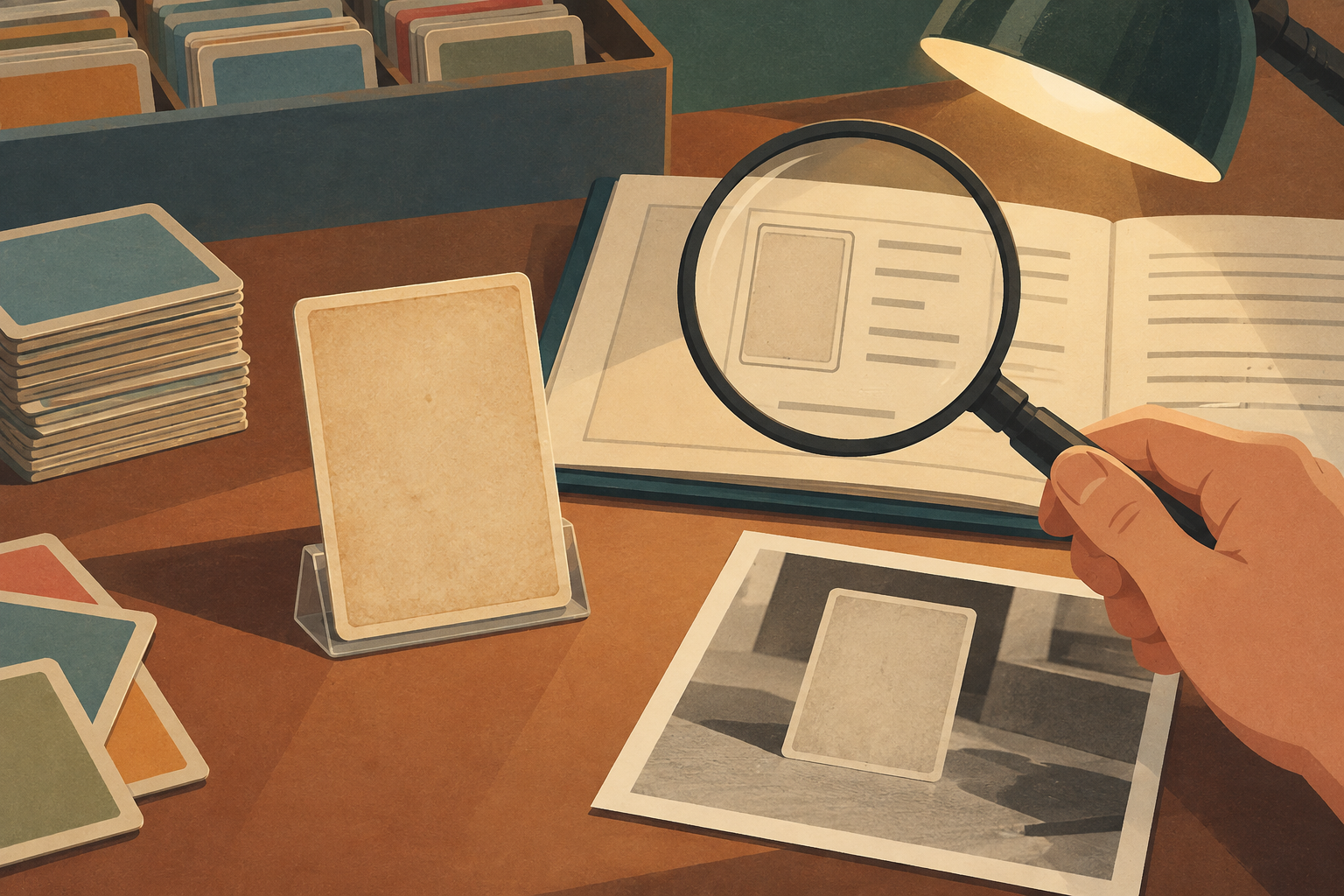
Ibermuseos’ visual-documentation protocol describes collection photography as a record intended to identify objects. This helps explain why image and text complement one another: a photograph can assist visual comparison, while the record organises written data. The protocol provided does not show that images of this particular album are published or that they make its variants recognisable; it offers a general framework for considering the role of visual documentation.
For a collector, an isolated image can seem conclusive because it shows visible differences. But an observed difference does not automatically explain its cause. It could be an edition feature, a later alteration, deterioration or a limitation of the photographic reproduction. Without a description that can be checked and access to relevant evidence, it is more rigorous to record what is visible than to assign it an explanation.
Archives and an object’s history
The Spanish Ministry of Culture’s information on state museum archives says that they hold documentation relating to the objects in their care from the time of deposit. This suggests a research route: beyond the public catalogue, institutional documentation relating to an object’s custodial history may exist. The page does not guarantee that a specific file for the album cited is available for consultation, or that such a file would settle questions about edition or variant.
The National Archaeological Museum’s Historical Archive describes itself as a research resource for the museum’s departments and external researchers. It is an example of the research role of an institutional archive, but it should not be confused with a source specifically about the Museo del Traje album. Keeping repositories distinct avoids attributing documents to an object when the available evidence does not connect them.
A century of albums is not one series
According to the information from Cultura de Aragón, the Museo del Álbum de Cromos Villa de Estadilla occupies rooms in the Espacio Cultural Buñero, made available by the town council, and aims to exhibit a century of albums, from 1900. This places an initiative devoted to albums within a broad time span. It does not prove that every period, series or variant is represented, nor does it provide a complete catalogue of the items on display.
That century-long horizon is a reason to avoid an overly simple idea of «the sticker album». The label brings together objects from different periods; comparisons between examples should therefore specify what is being compared and what documentation supports it. A broad chronological exhibition can help provide context, but it cannot replace comparing objects or identifying their editions.
Exchange leaves questions too
Exchange networks are part of a collection’s archive, although the sources supplied here document neither a specific network nor a particular local practice. As an editorial approach, this means that the album is not the whole subject: annotations, loose stickers and documented testimony could matter if preserved and clearly attributable. There is no basis for filling that gap with generalised memories or assuming how all collectors exchanged stickers.
An OpenAlex record for a study of comic collecting and preservation in the United States offers a thematic point of comparison between the private market and libraries. Its title does not prove that the histories of comics and stickers are equivalent. It does, however, prompt a useful question about collections moving between different contexts of preservation; any parallel should be presented as a comparison to investigate, not as an established shared history.
Identify first, attribute afterwards
The initial question has no single answer if «identify» is taken to mean recognising an item, establishing its edition and reconstructing how it circulated. The CER.es record provides a concrete anchor: an album with an institutional reference number and names associated in the search result. Sources on archives and visual documentation explain why complementary evidence is worth seeking, while Cultura de Aragón’s information places a museum initiative devoted to albums within a frame extending from 1900.
What can be verified ends where the supplied documentation ends. We cannot infer a variant, a precise date, the album’s complete contents or the circulation history of its stickers. Rigorous cataloguing means recording separately the object’s name, attributions as they appear, institutional reference and observed differences, while distinguishing observation from conclusion. A record need not promise to resolve what still needs checking: it can make the question visible and provide a route for investigating it.
- Decade
- Contemporary
- Region
- Spain
- Level
- Enthusiast
- Entities
- Museum, Museo del Traje, Museo Arqueológico Nacional
Sources and references
- Coleccionismo y conservación del cómic en Estados Unidos. Del mercado privado a las bibliotecas /openalex.org · 2026-10-04
- Álbum de cromos - CER.es - Ministerio de Culturaceres.mcu.es · 2026-10-04
- Archivo histórico - | Ministerio de Culturawww.man.es · 2026-10-04
- ARCHIVOS DE LOS MUSEOS ESTATALESwww.cultura.gob.es · 2026-10-04
- protocolo-documentacion-visual.pdfwww.ibermuseos.org · 2026-10-04
- MACVE. Museo del Álbum de Cromos Villa de Estadillaculturadearagon.es · 2026-10-04