The history is not only in the object
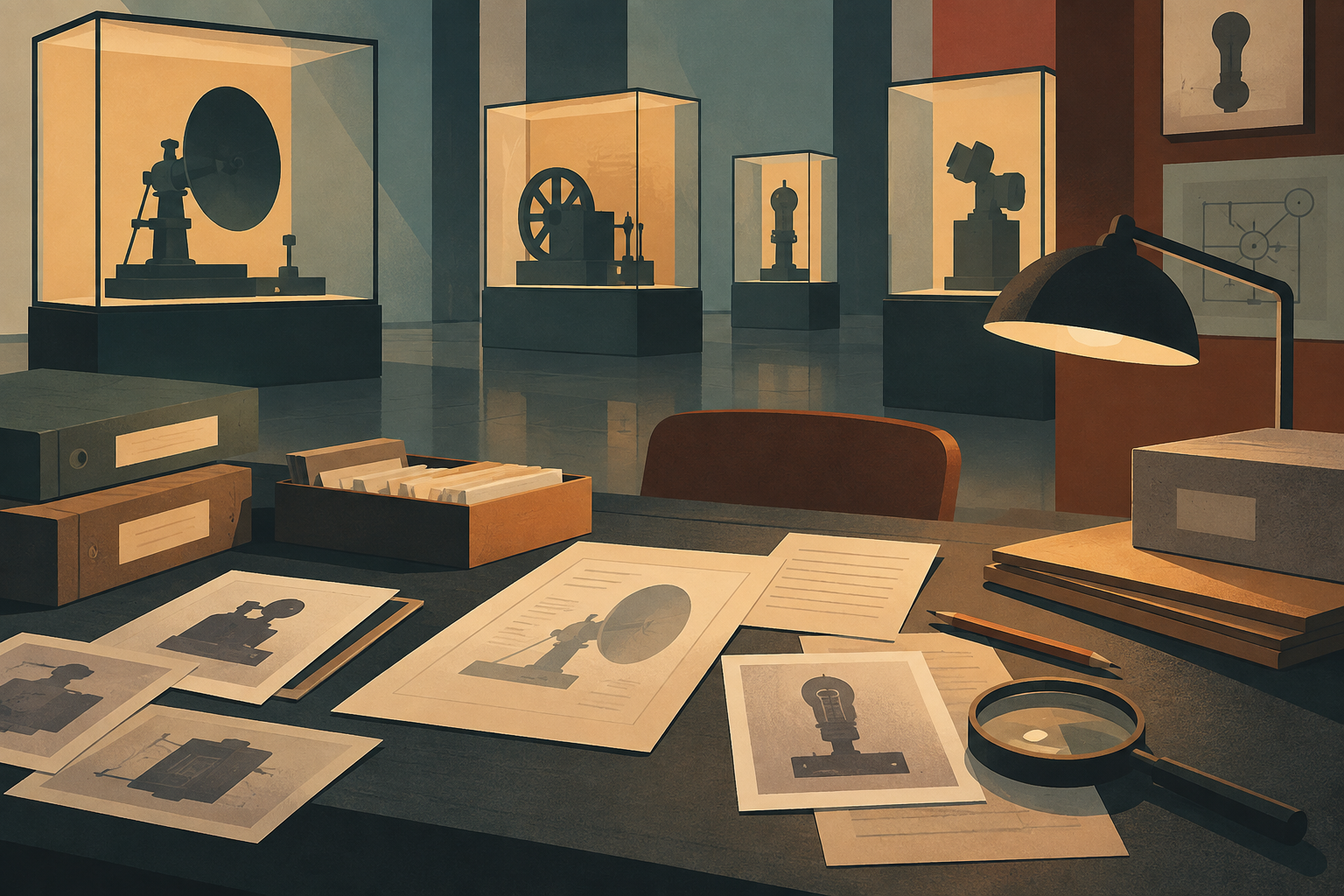
A displayed device can seem to offer a compact history: a form, some materials and a function. But the object alone cannot explain why it entered a collection, how a museum identified it, or what interpretation accompanied its display. Archival documentation may provide clues to those questions, but it does not answer them automatically.
An article in Tábula describes the fundamental role of archives in science and technology museums and emphasizes preservation and dissemination. That framing shifts the focus: an archive is not a bureaucratic appendage to a display case, but part of the infrastructure that makes research and communication about heritage possible. This is an interpretation of the scope of that function, not a claim that every museum keeps the same kinds of records.
What a document can establish
The archive page of Spain’s National Museum of Science and Technology (MUNCYT) describes work involving the organization, documentary processing and storage of historical and administrative records. Those terms establish a specific field of activity: the institution manages documents relating to its own history. They do not, by themselves, tell us which files are available or what information any particular file contains.
It helps to distinguish three levels. A record may confirm that a document exists; the document may describe an object or an administrative process; and an interpretation may connect that information to a technical or social use. Each step requires its own evidence. An inventory record, for instance, might identify an object if it contains sufficient details, but the existence of such a record alone would not prove how the object was used in everyday life.
Institutional archives and devices
The Historical Archive of the National Archaeological Museum is presented as a space intended to enable public access, provide finding aids that are subject to review and updating, and encourage consultation. The page documents that institutional purpose; it should not be taken as proof that every collection is accessible in the same way or that all finding aids are complete.
The contrast with MUNCYT’s archive description is useful, without erasing their differences. One institution explicitly describes access and its finding aids; another describes the organization and storage of historical and administrative records. Taken together, the pages show that an archive involves not only documents but also the conditions that help people find them. They are not enough, however, to reconstruct the history of a particular device: that would require locating and verifying records connected to that object.
Collections have documentary histories too
The research discussed in Tábula emphasizes archives’ contribution to preservation and dissemination in science and technology museums. A separate work recorded by Crossref is titled “Las revistas como aparatos de sensibilidad” (“Magazines as apparatuses of sensibility”) and is identified as a book chapter. From the supplied record, we can state its title and bibliographic classification, but we cannot summarize its arguments. Its presence is a useful reminder: “apparatus” can function as a concept in academic writing, not necessarily as a reference to a physical device.
An OpenAlex record describes a 2020 book on preventive conservation of documents in archives and libraries, while another identifies a 2015 article on digital technology and the conservation of architectural heritage. Their titles situate research topics, but they do not allow us to attribute specific recommendations to their authors. Responsibly used, they indicate that documentary conservation and digital technologies in heritage conservation are subjects addressed in publications—not that we know the conclusions of those works from the supplied information.
Reading promises and limits
If the question is what real-world use distinguished one device from another, the archive can be one part of a larger investigation. A manual or advertisement, if preserved and consulted, could document the instructions or promises made by its producer. An institutional file could clarify how an object was acquired, registered or displayed. But we should not assume that any of these record types is present in a particular collection without checking.
A careful reading asks who created the document, when, for what purpose and how it relates to the object under study. It also distinguishes statements made at the time of the device from later museum descriptions. An advertising claim documents a promise, not proof that the product delivered everything promised in practice. A museum classification documents a cataloguing decision, not necessarily an object’s everyday use.
A history built from verifiable relationships
A history of technology built from archives does not come from accumulating papers around a display case. It depends on establishing verifiable links between documents, objects and institutions, while keeping gaps visible. The MUNCYT and National Archaeological Museum pages describe archive functions and aims; Tábula stresses their significance for science and technology museums. These are institutional starting points, not substitutes for consulting specific records.
The editorial conclusion is deliberately limited: a device has a design history and a history of use, but the evidence supplied here does not allow us to tell the story of a particular model. It does support a broader, useful question: which documents are needed to move from an exhibited object to a historical explanation, and which claims must remain open until those documents are found. A display case shows an object; an archive can help reconstruct the relationships around it, provided each step is attributed and verified.
- Decade
- Contemporary
- Region
- Spain
- Level
- Enthusiast
- Entities
- Museum, Museo Arqueológico Nacional
Sources and references
- Las revistas como aparatos de sensibilidaddoi.org · 2026-10-04
- Conservación preventiva de documentos en archivos y bibliotecas. Experiencias, metodologías y políticasopenalex.org · 2026-10-04
- Tecnología digital una posible herramienta para la conservación del patrimonio arquitectónicoopenalex.org · 2026-10-04
- El archivo en los museos de ciencias y tecnologías | Tábulapublicaciones.acal.es · 2026-10-04
- Archivo histórico - | Ministerio de Culturawww.man.es · 2026-10-04
- Archivomuncyt.es · 2026-10-04