A scene cannot fit inside a single document
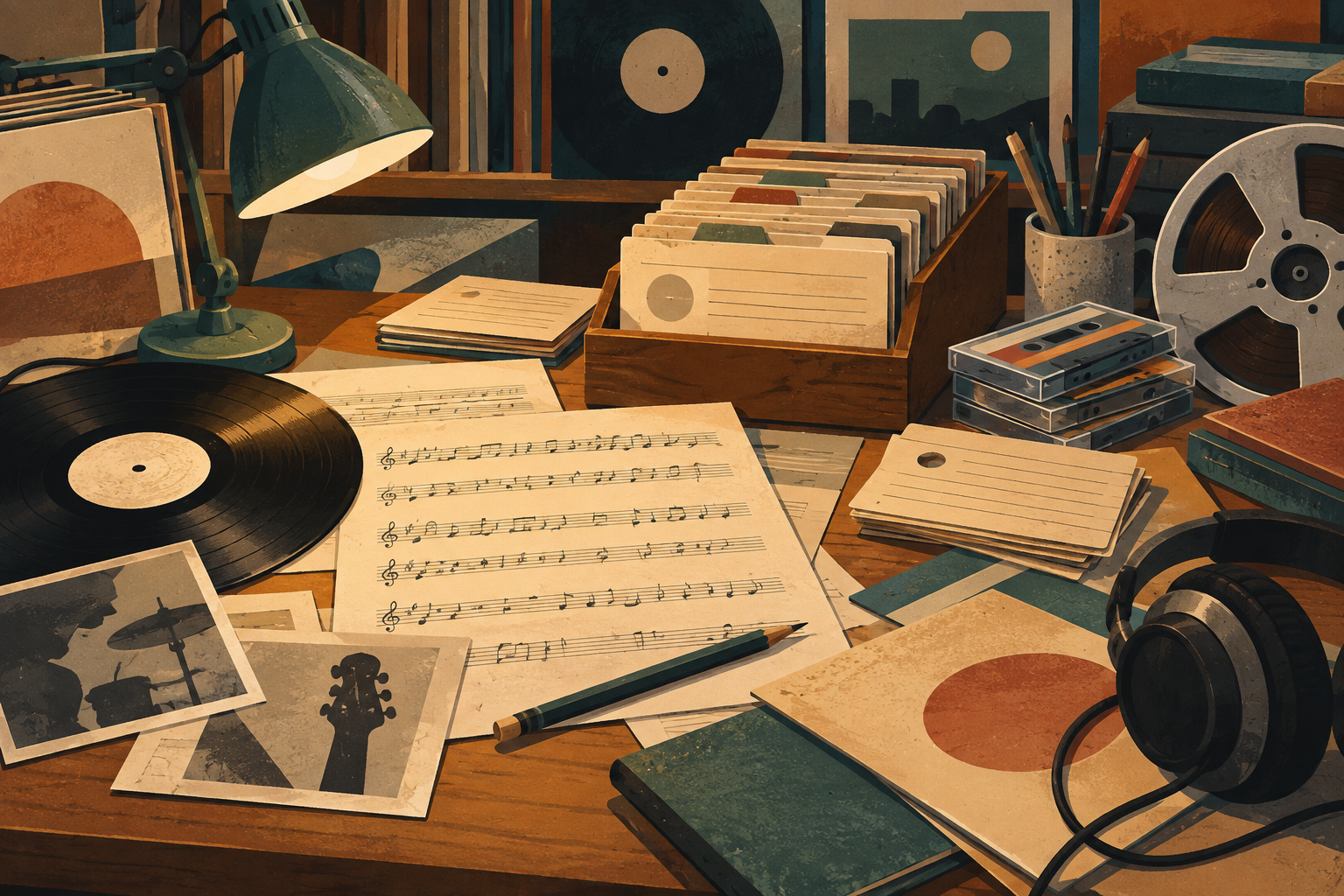
A music scene often brings to mind encounters: people making music, places where it circulates, and audiences who recognize themselves in it. Yet the available documentation rarely provides a complete view of those relationships. Sources on music may include scores, recordings, documents and objects; each kind records different aspects and leaves others out. The first decision in research, then, is not to treat an archive as if it were the entire scene, but to ask which part of musical activity each trace allows us to observe.
Musical documentation is presented as a field of sources for study. Other materials supplied describe collections arranged into categories and stress that identifying contexts requires consulting documentary sources. A cautious reading follows: gathering materials does not, by itself, reconstruct the connections among those involved in musical life.
The score: a trace, not the event
A score makes it possible to study a written work and its musical organization. On its own, however, it does not prove where, when or before whom it was performed, or what a particular performance sounded like. This is a basic distinction between the documented work and the act of listening to it. Other traces, and verifiable links between them, are needed to approach that second dimension.
The university source on Music History and Sciences lists among its areas of study the function of a musical scene or an instrument within an artistic work. That framing encourages us to look beyond an isolated piece and ask what role an element may have had in a context. But an academic question is not evidence for a particular case. Unless specific documentation connects a score with a use, place or group, those relationships must remain open questions.
Recordings and publications: identify what survives
A sound recording preserves a recorded performance; a publication may add other elements and appear in a particular edition. These are not interchangeable categories. Distinguishing work, edition and medium helps clarify which object is being consulted and what claim is being made about it. A catalogue record, for instance, may identify an item in a collection without explaining how it was heard or what it meant to its users.
Documentation of a scene may bring sound media together with other materials. The announcement of the Miguel Ríos Foundation archive describes it as a growing, living archive intended to reflect the richness and diversity of the city’s musical scene. That news item supports a statement about the archive’s institutional aim; it does not establish that the archive comprehensively documents every encounter, audience or circuit in that scene. The scope of each claim should match the scope of the evidence consulted.
Catalogues and collections: organizing is also interpreting
Catalogues make materials discoverable and offer ways of describing them. Research on the valuation of music collections mentions categories such as vocal or choral music, music for the stage and incidental music, and notes the need to consult other sources to identify context. Classification is useful, but its labels do not replace the history of use or explain relationships among people on their own.
It is therefore worth recording what a catalogue states literally and what is inferred from that description. If a collection is arranged into groups, that structure can suggest new questions; it does not automatically prove that the materials belonged to the same community or circulated together. An inventory is a research tool, not a complete story already settled.
Correspondence, archives and encounters
Personal or institutional documents can raise questions about relationships and processes that do not appear in a recording or score. A bibliographic record for a work on the musical archives of an experimental music centre mentions correspondence kept in an archive. This points to a type of material that may be relevant to studying connections, but the information available here does not allow us to describe the letters’ contents or assign them a specific meaning.
An announcement from Chile’s National Library, in turn, reports approved nominations for inclusion in the National Register and mentions documentation of an artistic scene. This is a lead concerning institutional recognition and preservation; it is not enough to reconstruct the scene’s encounters. In both cases the limit matters: an archival description guides research, but it does not replace consulting the documents and comparing them with other evidence.
A method for telling the story without filling the gaps
A route through a scene can begin with modest questions: which objects survive, who describes them, which dates or relationships are stated explicitly, and what materials might corroborate them? It is then useful to separate three levels: the information visible in the source, the interpretation it makes possible, and the information still missing. This prevents a catalogue, news item or bibliographic reference from becoming a total memory of the past.
The sources gathered here support a general point: music research draws on varied documents and objects, and understanding contexts requires bringing materials together. They do not support a detailed history of a particular scene, a chronology of its encounters or a description of its listening practices. Acknowledging that limit does not impoverish the account. It sharpens the distinction between a work, its publication, the medium that has survived and the relationships that still need evidence.
- Decade
- Contemporary
- Region
- Global
- Level
- Enthusiast
- Entities
- No linked entities
Sources and references
- (PDF) La documentación musical: fuentes para su estudiowww.academia.edu · 2026-10-04
- La valoración de colecciones como herramienta para la ...revistas.javeriana.edu.co · 2026-10-04
- El Archivo de la Fundación Miguel Ríos avanza hacia un ...cajagranadafundacion.es · 2026-10-04
- Grado en Historia y Ciencias de la Músicawww.uniovi.es · 2026-10-04
- (PDF) Escuchando archivos musicales : esto no es una ...www.researchgate.net · 2026-10-04
- Diecinueve candidaturas fueron aprobadas para ser ...www.bibliotecanacional.gob.cl · 2026-10-04