A package is a source, not a portrait of the table
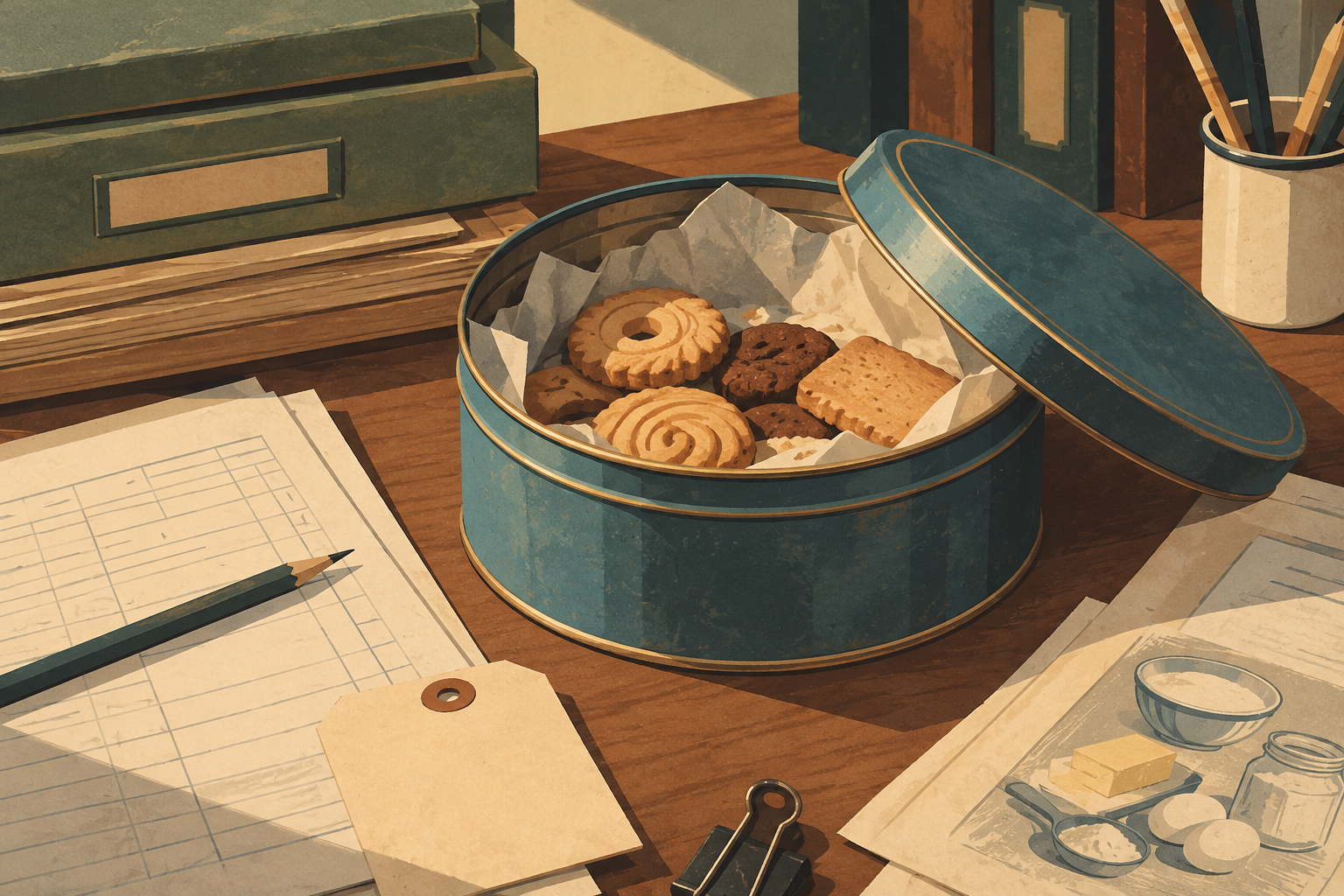
A biscuit tin can outlast its contents and become a collectible object. That makes it valuable for studying how a product was presented, but it does not make it direct evidence of who bought it, who ate what it contained, or how often it appeared in a home. The distinction seems obvious until an attractive image starts to stand, unintentionally, for a general memory of everyday custom.
The Museum of History of Madrid describes a collection of tins for biscuits, sweets and other products, and notes that several chromolithographed boxes used as containers for goods sold to the public entered its collections in recent years. That description documents objects and their stated commercial function. The available summary does not identify every box, detail its original contents or specify who used it. Those gaps should remain visible rather than being filled with imagined scenes.
Advertising documents intention
A package sold to the public was also a surface for presentation. Its survival allows us to examine design choices and ask what appearance was considered suitable for showing the product. But the image communicates a commercial proposition; on its own, it does not prove that domestic experience matched it.
Moving from presentation to everyday practice would require other kinds of evidence: for example, records linking particular packages to households, purchases or consumption, or attributable testimony describing their use. The supplied evidence does not provide that link for the tins mentioned by the museum. We can therefore ask what was offered for sale and how it was presented, but we cannot infer from an isolated tin who bought it or what it meant to that person.
This caution does not diminish the object’s value. It defines precisely which question it can answer. It also prevents us from treating advertising as a neutral record of taste: its images belong to commercial communication, while habits must be investigated through other evidence.
Archives widen the field, but they do not all do the same work
The Archives of Castilla y León website presents documentary and bibliographic sources for learning about gastronomy. Its value for a study of the table lies in pointing toward a field of inquiry wider than packaging. The general description supplied here, however, does not list specific documents or allow us to attribute a conclusion about a particular recipe, ingredient or habit to them.
The differences between source types matter. An archive may preserve documents useful for framing historical questions; a museum collection may preserve objects; a general history may provide context. These are not interchangeable, and they do not all prove the same things. Before drawing a conclusion, one must check which document was consulted, what period it covers and whom it represents. In this case, the institutional description opens a research path but does not replace consulting its specific materials.
From food history to the culture of the table
The Juan March Foundation presents a history of food in Spain and notes that the arrival of foods from the New World initiated an exchange between the Americas and Europe. This provides a broad historical frame, different from the one offered by a retail tin. It cannot by itself reconstruct a particular domestic practice; it does situate food within histories of circulation and exchange.
The Ministry of Culture’s «Edible Heritage: A History of Sweets and Their Women Confectioners» project begins from observations and a need that its presentation describes as the initiative’s starting point. Its framing invites us to look not only at sweets as products but also at the confectioners and forms of cultural transmission that the project chooses to study. We should not attribute specific findings absent from the supplied description, but its title and presentation make clear that the subject can extend beyond merchandise.
Mercasa describes its book «Alimentos con historia» as a popular work containing abundant information. The summary available here does not specify its contents, so it is reasonable to treat it as a possible contextual source, not to cite it for a particular detail that the supplied record does not include.
What a preserved image can tell us
The Museo Reina Sofía presents «Sobre la mesa» as an exhibition addressing the cycles food passes through, from processes such as seed germination and fermentation to consumption. This shifts attention from the finished package to the processes and time that make eating possible. It is not a description of specific household habits: the exhibition summary supplies a conceptual frame, not a survey of how one family ate.
Read together, these sources suggest a method rather than a completed narrative. Packaging tells us about a presentation for sale; archival resources point toward documents; general histories offer frameworks of circulation; a heritage project selects people and practices for attention; an exhibition can make food cycles visible. Each illuminates a different question.
A conclusion proportionate to the evidence
The useful question is not whether a tin «tells us about everyday life» in the abstract, but which part of that life it can document alongside other sources. The material consulted clearly indicates that collections of packaging and institutional resources for studying gastronomy, food history and table culture exist. It does not, however, provide enough information to infer specific household habits from an isolated package.
Separating advertising from domestic practice means maintaining that distinction throughout the research. A tin can document that a kind of container existed and was used to sell food; other documents might clarify who bought, prepared or shared that food, if they can be located and verified. Until then, the tin is an important material trace, but not a complete scene of the table.
- Decade
- Contemporary
- Region
- Spain
- Level
- Enthusiast
- Entities
- Museum, Museo de Historia de Madrid, Sobre la mesa, Museo Reina Sofía
Sources and references
- Archivos y Gastronomía | Archivos | Junta de Castilla y Leónarchivoscastillayleon.jcyl.es · 2026-10-11
- LA COLECCIÓN DE CAJAS DE GALLETAS, DULCES Y ...www.madrid.es · 2026-10-11
- Alimentos con historiawww.mercasa.es · 2026-10-11
- Patrimonio Comestible: Una historia de dulces y de sus ...www.cultura.gob.es · 2026-10-11
- Sobre la mesawww.museoreinasofia.es · 2026-10-11
- Historia de la comida en Españawww.march.es · 2026-10-11