An image is not enough to describe its document
A photograph may show a scene clearly and still leave basic questions about the object before us unresolved: what support it comes from, how it was made, or what circumstances accompanied its creation. Looking at the image is not the same as knowing those facts. Addressing them requires documentation—and a distinction between what a record states and what the image itself lets us observe.
This distinction matters both for a historical collection and for photographs of heritage objects. Ibermuseos’ visual documentation protocol describes photographing heritage objects as an indispensable part of museums’ inventory, registration and documentation processes. That documentary role does not automatically make an image a complete description of the object photographed. It explains why the image is included in a record, not what it can prove on its own about every attribute.
Recording is a way of organising information
Ibermuseos’ description places photography within a broader institutional task. Inventorying, registering and documenting are related activities, but the source does not say they are interchangeable or set out a material procedure that applies to every image. The cautious conclusion is narrower: an image may form part of an object’s documentation, and its usefulness depends on the information associated with it in the record.
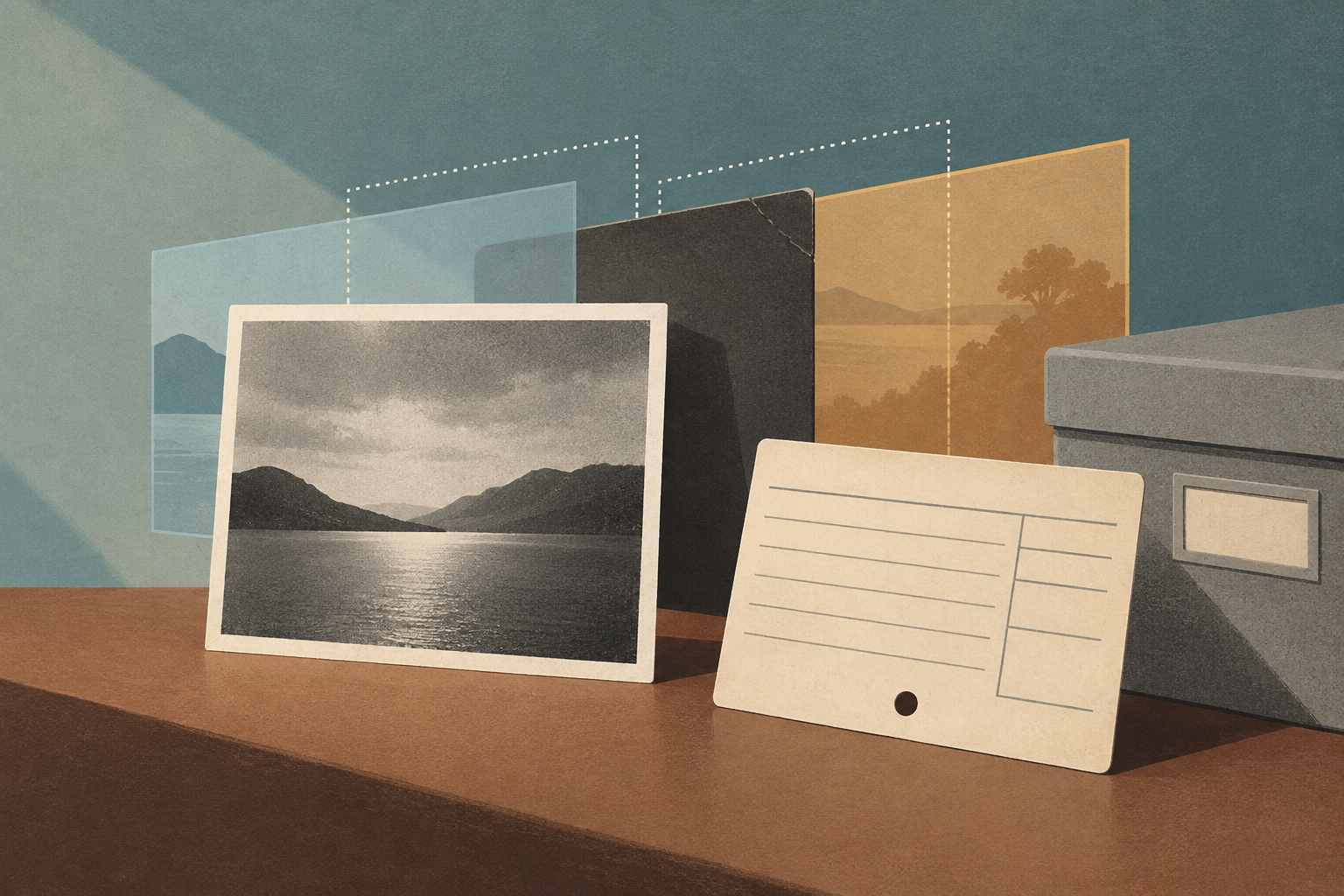
This helps separate three planes that are often conflated. The first is what appears in the image. The second is the photographic object—the photograph as a document, with a support that should not be taken for granted. The third is the archival context: the collection, its arrangement and the descriptive information through which the photograph can be found and understood. A visible image does not automatically answer questions belonging to the other two planes.
An archive provides context, not omniscience
The description of the National Archaeological Museum’s photographic archive says its holdings have documentary value because of their subject matter, chronology and typology. That list shows why a collection’s context matters: it is not limited to what a single photograph depicts, but includes the criteria through which holdings are described and situated.
The portal devoted to the MAN photographic archive adds that it comprises the museum’s own holdings, generated since the museum’s foundation in 1867, as well as donations and purchases. These details support the statement that the archive brings together material described as having more than one kind of origin. They do not establish the provenance of any individual image without information about that item. Nor does the museum’s foundation date allow us to infer the date, support or process of every photograph it holds.
What research records say—and what we cannot infer
The available bibliographic titles and records point to other lines of research. “Photography and Archive” is listed as an article by Isabel Argerich in Fotocinema. Another study examines underground photography through the fanzine Rockocó and the Miguel Trillo Archive at the Reina Sofía Museum. A further article addresses concepts, historiography and methods in amateur photography in Spain. These references show that archives, publications and photographic practices are subjects of research; their bibliographic records alone do not justify attributing specific findings to them when those findings have not been supplied.
A reference on historic photographic holdings related to Aragonese art mentions the National Library, the Prado Museum and the National Historical Archive. Its title identifies areas of study, but does not allow us to summarise the article’s arguments. Such caution is not an editorial obstacle: it sets the boundaries of what can be claimed without access to content not present in the assembled evidence.
Support and process: questions that require evidence
Asking about a photograph’s support and process is necessary, but the supplied documentation identifies no photographic processes, materials, formats or physical characteristics for any specific item. This analysis therefore assigns no techniques to the collections cited, and does not suggest that chronology, subject matter or institutional provenance is enough to determine how an image was made.
The proper response begins by acknowledging that absence. Describing a particular item would require evidence linked to that item: an identifiable catalogue record, examination of the object, or a source explicitly documenting its characteristics. Without such evidence, presenting a process as certain would turn a possibility into a fact. A generic illustration of an archive should likewise not be mistaken for a historical photograph or for material evidence.
Reading the limits of a record precisely
Documentation can help identify and consult photographs; the MAN example illustrates the relevance of subjects, chronologies, typologies and ways material enters a collection. But a general statement about holdings does not automatically describe each item, and an image of an object does not replace information about the photographic object itself.
The lesson is simple, though it requires discipline: state what is documented, attribute it to its source, and leave open the questions the evidence does not resolve. This makes it possible to explain why a photograph is useful for inventory or archival research without overstating what it proves. Before claiming which process and support explain an image, we need evidence that refers to that image. If none is available, that limit is part of its documented history too.
- Decade
- Contemporary
- Region
- Spain
- Level
- Enthusiast
- Entities
- Museum, Archivo Histórico Nacional, Museo Arqueológico Nacional, Museo Reina Sofía
Sources and references
- Fotografía y archivodoi.org · 2026-10-12
- Fondos de fotografía antigua sobre el arte aragonés en la Biblioteca Nacional y unas notas sobre el Museo del Prado y el Archivo Histórico Nacionaldoi.org · 2026-10-12
- Una mirada documental de la fotografía underground a través del fanzine Rockocó. Análisis del Archivo Miguel Trillo en el Museo Nacional Centro de Arte Reina Sofía (MNCARS)doi.org · 2026-10-12
- Fotografía amateur en España: conceptos, historiografía y métodosopenalex.org · 2026-10-12
- protocolo-documentacion-visual.pdfwww.ibermuseos.org · 2026-10-12
- Archivo fotográfico - | Ministerio de Culturawww.man.es · 2026-10-12
- Archivo fotográfico del Museo Arqueológico Nacionalportalvirtualfotografico.es · 2026-10-12