Music can also be studied through its traces
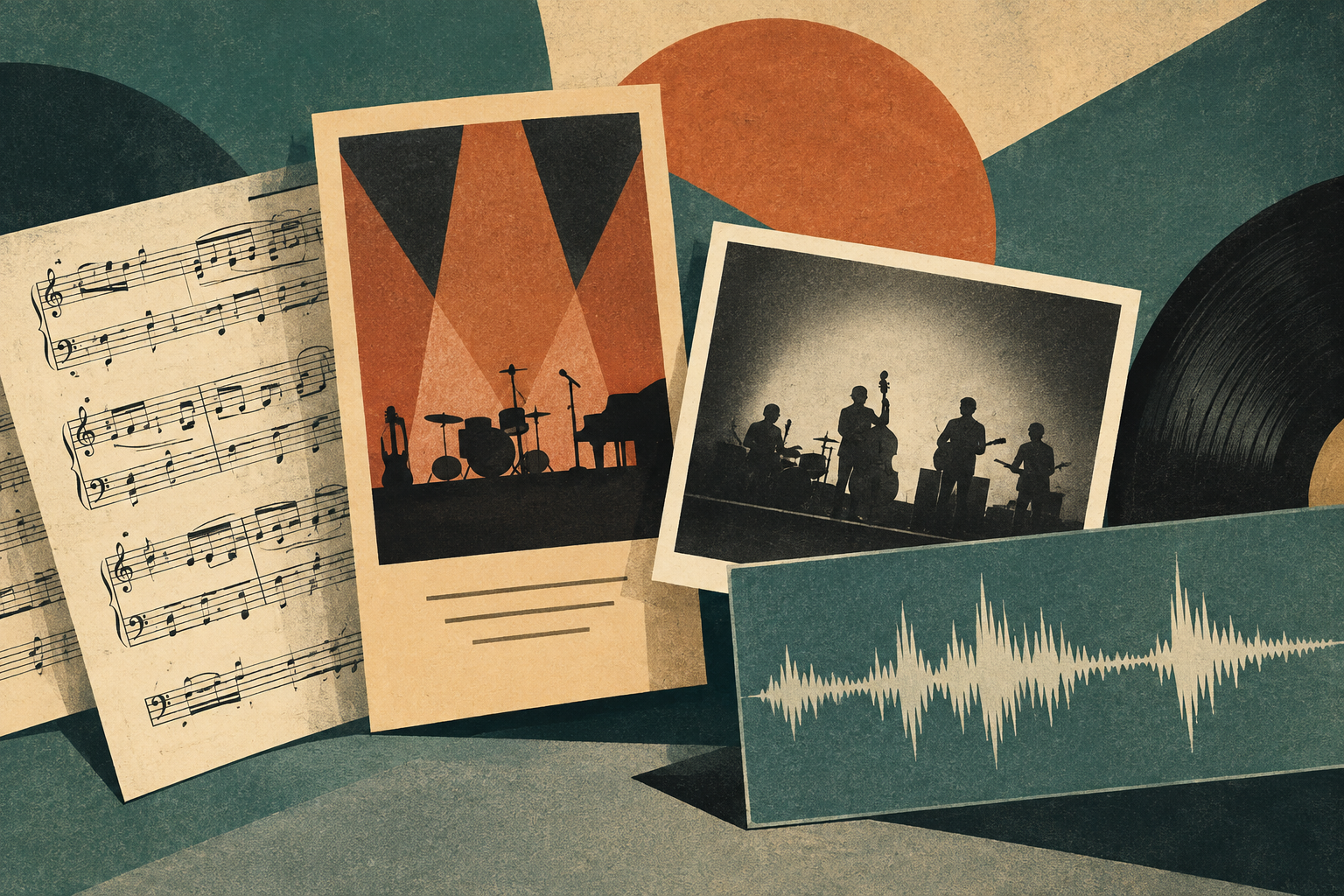
A recording preserves a sonic experience, but it cannot by itself stand for the complete history of an ensemble. Scores, programmes, photographs and sound recordings may coexist in an archive, each bearing on a different dimension of musical life. A paper on the musical archive of a symphonic band describes just such a combination of documents, associated with different seasons and venues. The point is not that each item explains everything, but that each supplies a particular kind of evidence.
This distinction helps prevent us from treating an archive as a mere storehouse of songs. It also lets us distinguish a musical work from its editions, performances and documentary contexts. A score represents a written form of music; a programme preserves information about a presentation; a photograph records an image of people or places; a recording makes a sonic result available for listening again. The sources available here do not support more detailed claims about what each format contains, but they do show that these materials occur together in ensemble archives.
A collection is not a single kind of object
Musical archives include materials related to music, not just audio. A general definition of a music archive encompasses scores and documents such as chronologies, recordings and biographies. Research on ensemble archives, in turn, mentions scores, programmes, recordings and photographs of seasons and venues. Taken together, these references describe a heterogeneous documentary landscape.
That heterogeneity matters because a medium shapes which traces remain available for consultation. Studying a musical text is not the same as studying a photograph or a recorded performance. This is an analytical reading of the types of material listed, not a claim that one medium is superior or more complete than another. Each item has limits: a programme cannot let us hear a performance; a recording does not automatically replace documents that situate a presentation; a photograph alone cannot explain an entire season.
From documents to cultural identity
The organization of these materials has consequences for collective memory. A conceptual study of musical archives connects the gathering and preservation of musical heritage with a society’s cultural identity. Another paper, focused on the documentary archive of a symphonic band, emphasizes the archive’s cultural value and its connection to the collective subject from which it originates. These ideas invite us to see an archive not simply as an accumulation of objects, but as a way of making visible the practices and communities that produced them.
That does not mean a body of documents fully represents a community. Preserved material is one part of a history, and its interpretation requires attention to what each document can establish. The existence of photographs from particular seasons, for example, does not by itself show which experiences were left undocumented. Likewise, the presence of scores or recordings does not justify unsupported assumptions about how they were heard, distributed or valued at the time.
Bringing materials together, describing and preserving them
Archival organization is essential if materials are to be connected and studied. Writing on the organization of musical archives presents the gathering and preservation of this heritage as work requiring archival methodology. The formulation matters: preservation is not only keeping an object in good condition, but also being able to identify what it is, where it came from and how it relates to other documents. The sources considered here emphasize the general importance of methodology, although they do not set out specific technical procedures for every medium.
A publication by the International Council of Museums, devoted to the conservation of musical heritage in institutions in Latin America and the Caribbean, raises the question of whether the music museum is the only way to understand that heritage as a whole. The question broadens the debate: a museum can provide a framework for interpretation, but the cited question does not establish that it is the only one. Archives, institutions and collections can offer complementary perspectives; the available extracts, however, do not support descriptions of particular institutional cases.
Reading differences without confusing them
When studying musical history, it is useful to identify first what kind of evidence each item offers and what it cannot prove. A recording, score, photograph and programme are not interchangeable substitutes: they are different traces of a practice. Bringing them into relation can enrich interpretation, provided the relationship is documented rather than imagined.
The scope of what can be verified here is deliberately limited. The sources support the diversity of materials found in musical archives, their relevance to memory and cultural identity, and the need for methods to organize and preserve them. They do not provide a detailed history of playback technologies, changes in listening habits or commercial trajectories. Even so, they offer a useful basis for one conclusion: distinguishing work, edition, performance and medium does not fragment music history; it helps tell that history more precisely.
- Decade
- Contemporary
- Region
- Global
- Level
- Enthusiast
- Entities
- Museum
Sources and references
- La Conservación de patrimonio musical en museos e ...icom.museum · 2026-10-05
- Música y su Impacto en Archivísticaes.scribd.com · 2026-10-05
- Archivos (música) - Wikipedia, la enciclopedia librees.wikipedia.org · 2026-10-05
- (PDF) El archivo musical documental: subjetividades y ...www.researchgate.net · 2026-10-05
- El archivo musical documental: subjetividades y aportaciones ...www.scielo.org.co · 2026-10-05
- La organización de archivos musicales: marco conceptualwww.scielo.org.ar · 2026-10-05