A game is more than its code
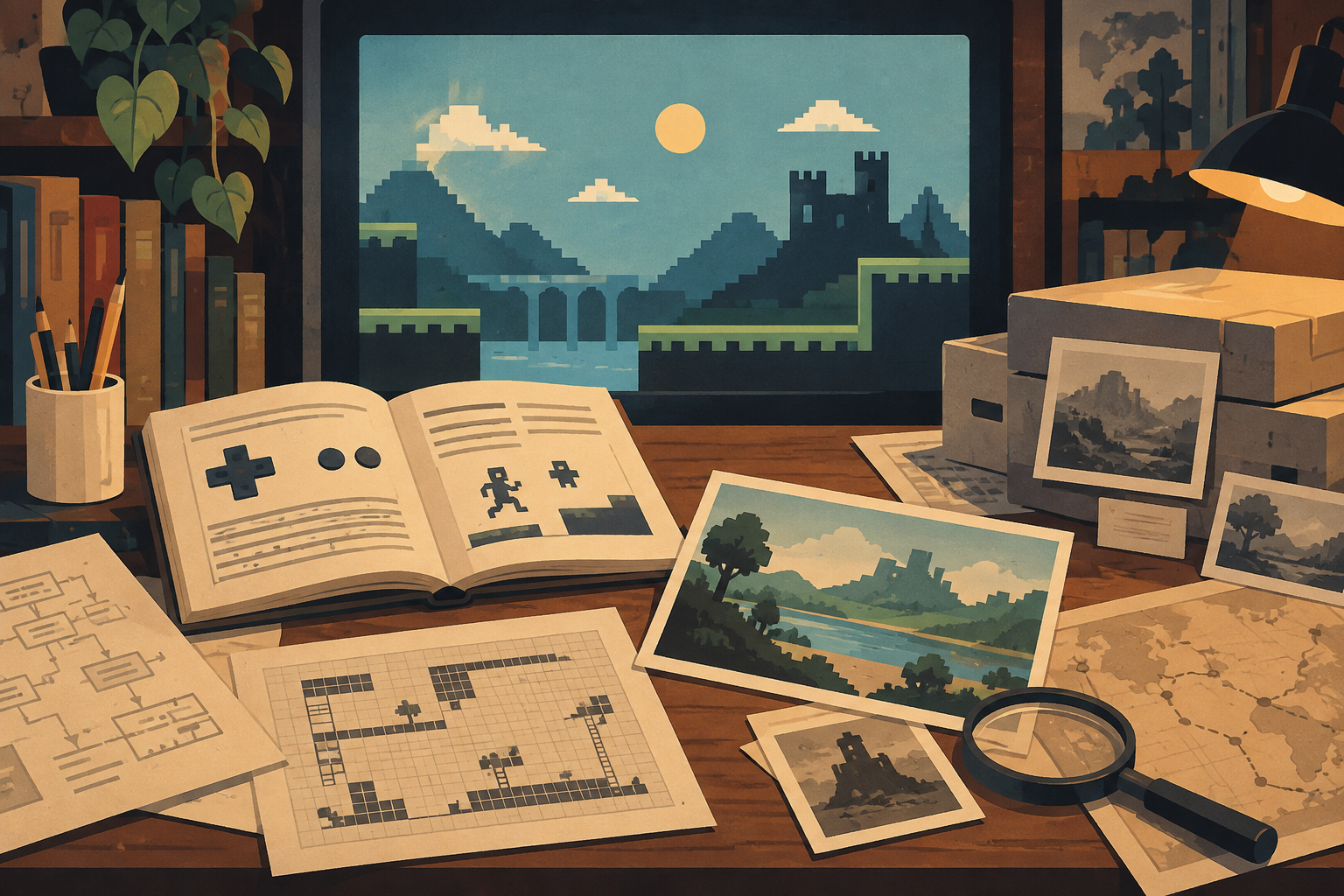
A video game may be remembered as an image, a melody or a rule learned by heart. None of these, on its own, fully explains a work. Studying it requires distinguishing what the game offers from what a player remembers experiencing, then relating that experience to the materials around it. Manuals, publications and audiovisual documents can provide clues about presentation and use. The Digital Archive of the Video Game Museum is described as bringing together documentation, publications and audiovisual materials related to the medium’s history. That range encourages us to understand preservation as work with context, not merely the conservation of an isolated object.
Documentation cannot replace play
Documents help pose questions that a play session alone cannot answer: what guidance players received, what features were emphasized, and what falls outside the screen. They do not automatically prove how a game was played in every home, venue or group. This boundary matters. A manual can record instructions; it is not a personal testimony and does not prove that every player followed them. A publication can show how a title was presented, but it cannot reconstruct every condition of access or use.
The event titled “The Video Game: A Cultural Product to Preserve” includes references to video games, libraries, museums and conservation in the information supplied. Its framing raises a central question: preserving a cultural product requires asking which materials make it possible to study. It is not enough to project nostalgia onto fragmentary documents; nor should those documents be dismissed because they cannot reproduce the complete experience.
The museum as a place of interpretation
Museums do more than store objects: they also organize them and make them legible to particular audiences. A 2023 academic article on museums and video games describes initiatives in which cultural institutions use games to present their collections. This suggests a two-way relationship: a video game can be a cultural object and, at the same time, a means of interpreting other collections. These functions are related, but not identical.
MUVIC is described as a cultural and museum project devoted to preserving, studying and sharing the history of video games through temporary and touring exhibitions. That description foregrounds three distinct verbs. Preservation concerns sustaining materials; study involves analysis; public engagement means creating ways to access them. An exhibition can connect these aims, provided its selection is not mistaken for the entirety of a history.
Learning through games raises questions too
The Thyssen Museum’s educational programme addresses education in museums through video games and notes that the game’s status as a museological element remains an academic debate. This observation does not settle the issue; it makes it visible. What can be learned through an interactive work? What role do its rules play, and what changes when it becomes an educational tool? Answers depend on each project and cannot be inferred from the word “video game” alone.
An ICOM article describes two Argentine projects that produced video games from heritage. This expands the discussion: a game appears not only as something a museum preserves or exhibits, but also as a format used to connect heritage content with participation. The information available here does not allow us to detail how those projects worked, so it is more responsible to identify the kind of initiative than to assign results or effects that have not been documented in the supplied evidence.
Archives, preservation and limits
A Microsiervos article presents the Embracer Games Archive as an initiative devoted to preserving the cultural legacy of video games. The existence of archival projects and documentary collections shows institutional and cultural interest in preservation, but each initiative must be examined in terms of its actual scope and holdings. The evidence gathered here does not specify inventories, access policies or technical conditions; these should not be invented.
The title of a 2022 academic work also identifies the abandonware movement as a tool for preserving video-game cultural heritage. Its title is enough to recognize a research topic, but not to conclude that every practice associated with abandonware guarantees preservation or lawful access. The distinction between a research question and a demonstrated conclusion is essential.
Reading the past without filling its gaps
The available sources point towards a method: relate rules, presentation, documentation and contexts without treating one person’s memory as universal description. Museums and archives can provide places to preserve and study materials; educational projects can test other forms of interpretation. None of these approaches, by itself, reconstructs every past experience.
A video game does not end at the screen because its history also depends on the documents around it and the questions asked about its use. But documents are not the game session either. The editorial task is to hold this evidence together without erasing its differences: explain what we know, say where it comes from, and leave visible what cannot yet be claimed.
- Decade
- Contemporary
- Region
- Global
- Level
- Enthusiast
- Entities
- Museum, Museo del Videojuego
Sources and references
- Museos & videojuegos: dos proyectos desarrollados en ...icom.museum · 2026-10-07
- Vista de Museos y videojuegos. La renovación de los ...revistas.uma.es · 2026-10-07
- Jornada "El videojuego un producto cultural a conservar"www.youtube.com · 2026-10-07
- MUVIC – Museu del Videojoc de Catalunya | Castellanomuvic.cat · 2026-10-07
- Educación en museos a través del videojuego (I)www.educathyssen.org · 2026-10-07
- La conservación de la historia de los videojuegos en el ...www.microsiervos.com · 2026-10-07
- Descargas - Museo del Videojuegowww.museodelvideojuego.com · 2026-10-07