An interior is more than a single image
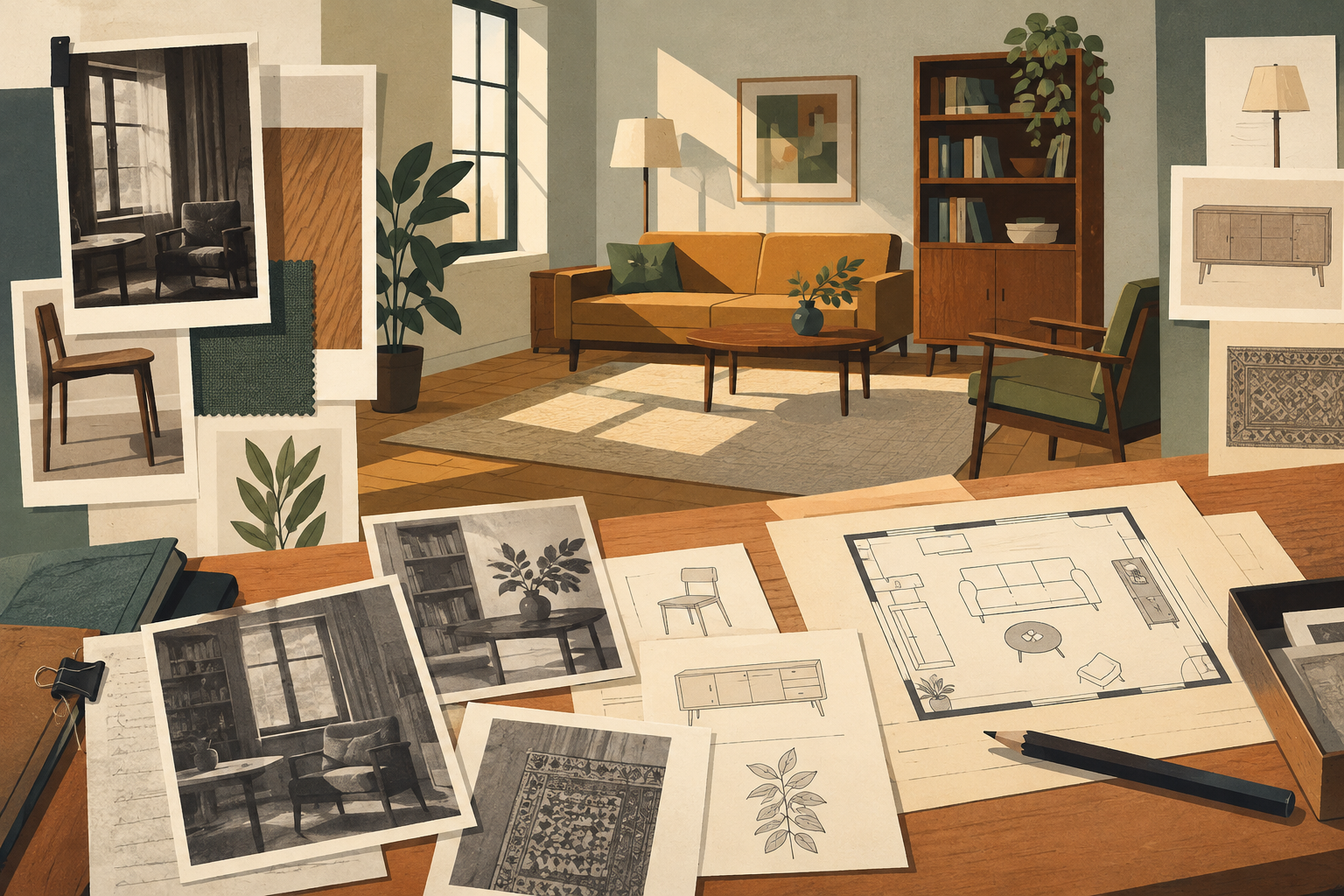
A photograph of a room lets us observe an arrangement, some objects and the visible relationships between them. On its own, it does not explain who used the space, how long its objects remained there, or whether the scene was ordinary or staged for the camera. The frame selects and excludes: walls beyond the image, everyday activities and later changes may remain invisible.
Reconstructing an interior is therefore not a matter of turning one image into a complete description. It means bringing clues together while keeping observations separate from hypotheses. Research on the Museo Nacional de Artes Decorativas and its collections offers a starting point for considering decoration as a history of objects, production and design, not simply appearance.
Catalogues: names and categories, not the whole room
A catalogue can help identify how furniture or objects were classified and what vocabulary was used to describe them. A bulletin of the Museo Nacional de Artes Decorativas, for example, mentions a room devoted to the history of furniture design and to chairs considered representative of that history. This reference identifies an exhibition framework and a thematic selection; on its own, it cannot recreate an entire home or the practices of its occupants.
Categories are also institutional and editorial decisions. Classifying an object under a particular term makes it easier to locate, but does not automatically prove how it was used in a home. Researchers should record what a source says literally, what it clearly identifies and what interpretation they themselves add.
Archives and collections: tracing relationships without assuming them
Institutional history and the formation of collections matter because they help explain which materials have been preserved and within what frameworks they are studied. Academic research on the context in which the Museo Nacional de Artes Decorativas was created examines correspondences and parallels connected with its foundation. This kind of work can help situate collections, though it cannot replace documentation for an individual object or room.
Information about the museum’s library and archives also points to the value of consulting more than one kind of document. A corporate archive, such as the one described in the case of Alessi, may bring together material on a brand’s history and on design. This illustrates how an archive can broaden the context of objects; it does not, by itself, establish a connection to a particular domestic interior.
Use, aesthetics and the limits of reconstruction
Decoration combines appearance with practical needs, but sources do not always document both equally. An image may record where a piece of furniture stood without explaining who could use it, how it was maintained or whether it formed part of everyday routine. A catalogue may name an object without documenting its use. Missing information should not be filled in with a plausible scene presented as fact.
The document’s provenance matters too. An exhibition photograph, an archival image and a photograph of a home do not answer the same question. Before interpreting them, researchers should establish what was photographed, who made the record and what contextual information accompanies it. If the consulted sources do not provide those details, the reconstruction should state that limitation.
A reconstruction that keeps its uncertainties visible
Sources on decorative arts, collections, archives and design offer methods and context, but the materials available here do not reconstruct a specific historical room. They do support a cautious approach: compare different kinds of documents, state what each contributes and do not mistake a preserved object for the complete experience of a home.
The most reliable result may be a partial reconstruction: what can be observed, which categories an institution used and which questions remain open. Making those limits visible does not weaken the history of an interior. It prevents editorial imagination from replacing evidence and clarifies what documents would be needed to go further.
- Decade
- Contemporary
- Region
- Spain
- Level
- Enthusiast
- Entities
- Museum, Museo Nacional de Artes Decorativas
Sources and references
- Los Museos de Empresasevemuseografia.com · 2026-10-07
- Cuando la decoración también fue industria - RetroPausewww.retropause.com · 2026-10-07
- boletín del museo nacional de artes decorativaswww.cultura.gob.es · 2026-10-07
- TEXTO Y CONTEXTO. EL MUSEO NACIONAL DE ARTES ...revistas.uned.es · 2026-10-07
- La biblioteca y el archivo del Museo Nacional de Artes ...artstatementmagazine.com · 2026-10-07