A description is a tool, not a film
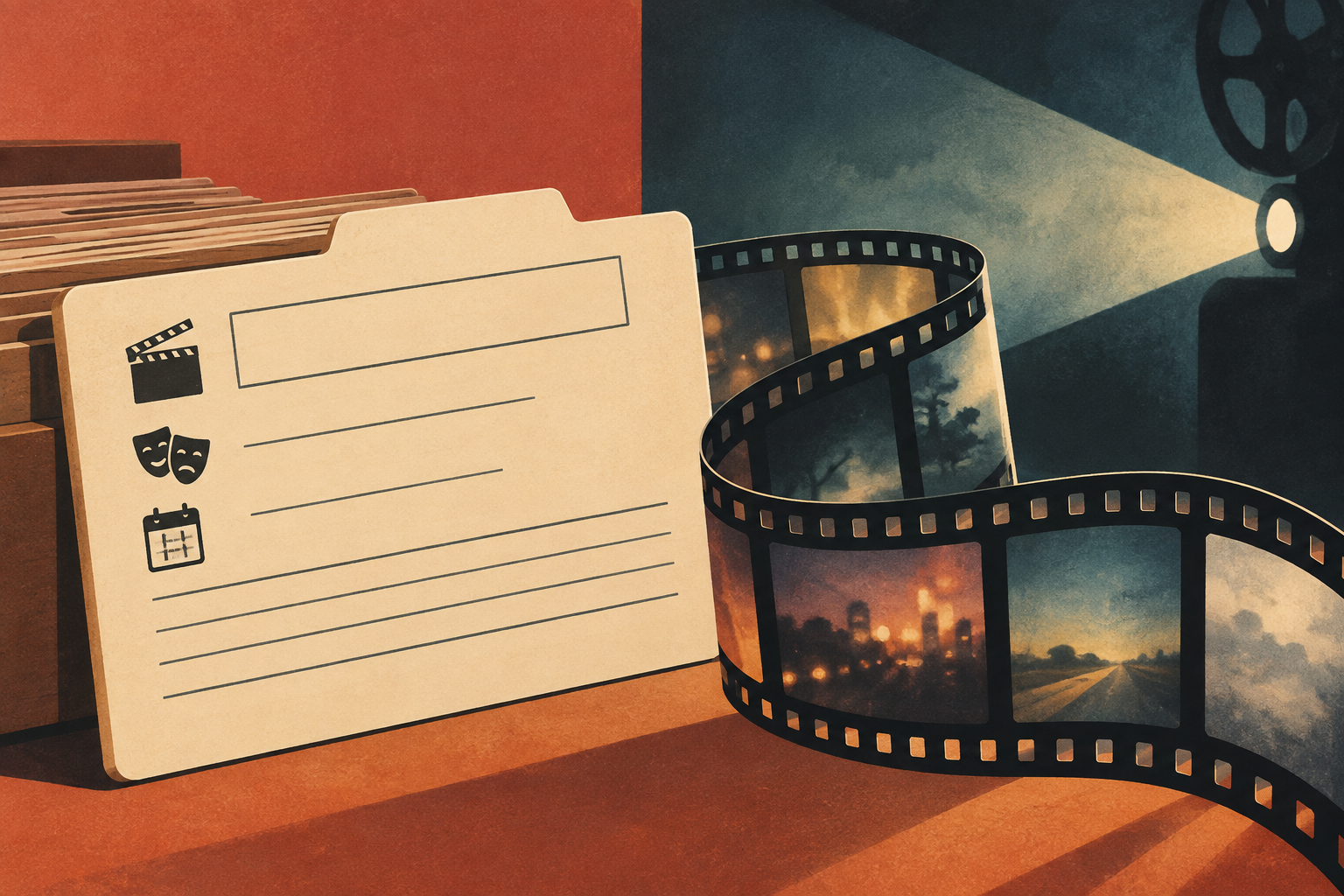
An archival record does not present the work itself; it organizes information about it. Domínguez-Delgado’s study lists the entry number, title, filmmakers, genre and filming dates as descriptive data. These fields help identify and arrange materials. They are not an assessment of the film and cannot, by themselves, reconstruct what it was like to see it.
This distinction matters when writing film history from documents. A record makes some information accessible, but it also establishes a frame: what is named, what is classified and what remains undescribed.
Genre as data and as a decision
The fact that a record includes genre does not make genre a neutral or sufficient property for summing up a work. The field helps classify, compare and retrieve records. Yet a label cannot explain how a film uses conventions or how different audiences may have interpreted it.
The supplied evidence supports the claim that genre appears among the descriptive fields discussed in the study of film documentation. It does not establish which vocabulary a particular archive used, how a classification changed over time, or whether its label matched a film’s promotional categories. Those questions require identifiable records, catalogues and period materials.
From archive to history
The volume Historia y cine. La construcción del pasado a través de… places cinema in relation to the construction of the past. The article on film documentation, in turn, offers a framework for thinking about how information about cinema is organized. Read together, they invite us to distinguish two activities: studying a film and studying the documents that make it possible to locate and describe it.
A record can guide research, but it cannot by itself prove a historical interpretation. That would require sources connected to the work and an account of how they were compared. The record is a verifiable starting point, not a substitute for that work.
Preservation also means description
The study of the musealisation and valorisation of film heritage relates cinema to its heritage status. From this perspective, description is not an administrative task detached from preservation: it helps make material locatable and communicates what is known about it. But description and work remain distinct. Catalogued information is not the copy itself, nor does it necessarily record every circumstance of circulation.
The same caution applies to reception. The supplied sources do not document a concrete comparison between watching a particular film in a cinema and watching it on video. They therefore cannot establish how its audience or evaluation changed between those settings. A record may help identify the object of study; answering that question would require specific testimonies, press coverage, distribution materials or other evidence.
When archival images enter fiction
The OpenAlex record titled “Archival images in fiction film: cinema based on a true story” identifies a study of archival images in fiction films based on true stories. Its title is enough to define a possible research area, but the supplied metadata does not give the study’s conclusions. It would be unwise to attribute a more specific argument to it.
This limit is instructive: even a highly relevant bibliographic record does not replace reading the text. Records help locate works and identify their declared subject; they do not justify filling in details absent from the information provided.
Reading a record without asking too much of it
A record can answer practical questions: which title is listed, which filmmakers are recorded, what genre is assigned and which filming dates are given. It can also prompt broader questions about descriptive criteria. By itself, it does not show how a film was advertised, how it was received in cinema or video, or how different viewers interpreted it.
Critical reading begins by recognizing both sides. A record makes a film visible within a documentary system while leaving out whatever its fields do not capture. Attending to that boundary allows us to use the archive without confusing description with the work or classification with the complete history of its reception.
- Decade
- Contemporary
- Region
- Spain
- Level
- Enthusiast
- Entities
- No linked entities
Sources and references
- Imágenes de archivo en cine de ficción: cine basado en una historia realopenalex.org · 2026-10-07
- Historia y cine. La construcción del pasado a través de ...ifc.dpz.es · 2026-10-07
- La Documentación Fílmica: marco contextual históricorevistas.ucm.es · 2026-10-07
- archivo y memoriawww.docutren.com · 2026-10-07
- musealización y puesta en valor del patrimonio cinematográficodigibug.ugr.es · 2026-10-07