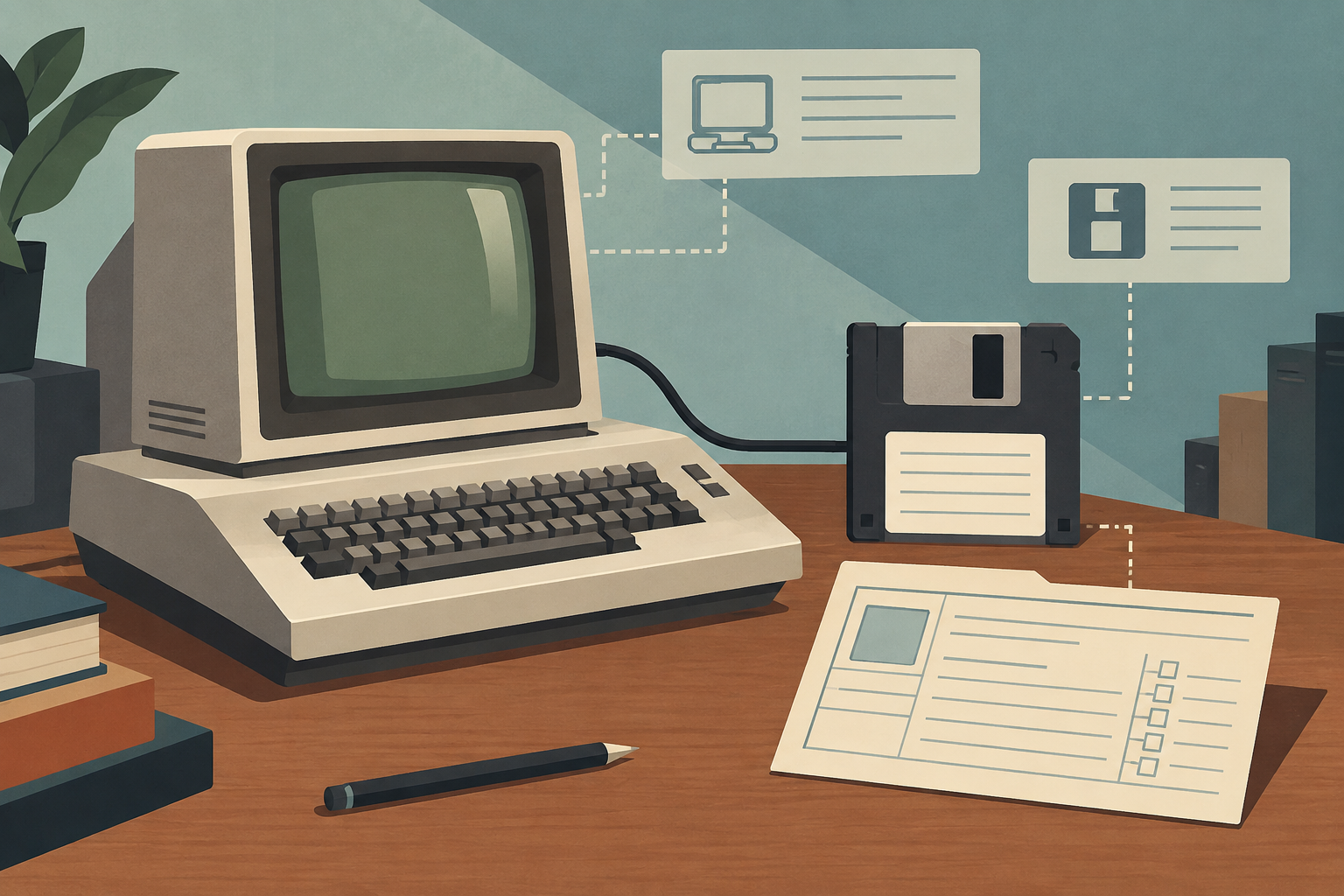
A home computer is often remembered through its case, screen or keyboard. But understanding what a machine did also means looking at its connections, the media it could read and the documentation that survived alongside it. These traces do not all tell the same story. A reference to a floppy disk may identify a storage medium; on its own, it does not show which computer used it, what it contained or how often it was consulted.
Three things worth keeping distinct
An inventory may mention a computer, a drive or a storage medium, as well as a document stored on that medium. These levels are related, but they are not interchangeable. Catalonia’s archival description standard lists physical media and units—including floppy disks, hard disks and ZIP drives—in its discussion of electronic documents. Identifying a physical unit can help describe where a document is held; it is not a complete history of the equipment or its owner.
The supplied literature on historical databases also includes floppy disks and other media among electronic document forms. This distinction is useful for historical writing: an object can offer evidence of a technical possibility, while a record describes an object or a content. Moving from one to the other requires further evidence.
What a catalogue record can tell us
Archival documentation provides vocabulary for recording material and medium. A Ministry of Culture bulletin includes bibliographic examples of publications accompanied by a floppy disk. That wording supports the claim that the publication described was distributed with that supplement. It does not establish which computer read it, how it was used in a home or whether a surviving disk is the original.
The archival guide available through the UOC also notes that, when describing electronic records, it may be relevant to record the software application used to create them. It is a reminder that a medium is not interpreted in isolation: physical format, software and documentary context are separate questions. The supplied excerpt, however, does not justify assigning a particular application to a specific home-computer medium.
The peripheral as part of a system
The Apple IIc offers a limited example of how a drive could be integrated into a computer: the supplied encyclopaedia entry describes a 5¼-inch floppy drive built into its side. This supports a statement about one hardware configuration, but not about how households organized disks or what tasks they performed with them. The contrast between an integrated drive and a removable medium can guide research; it is not a description of usage habits.
Reconstructing an actual path would require linking evidence: the computer and its connections, the drive, the medium, its labels or notes, and any associated documentation. An ANABAD information sheet mentions a sequence of changes in institutional storage media. It offers broad context about media, not direct evidence of a sequence followed by home users.
The line between description and imagination
The archival standards and texts consulted here help frame verifiable questions: which physical unit survives? Which medium is recorded? Is there a document identifying its contents? Is the software needed to interpret it known? The answers may be incomplete. The supplied evidence contains no household records, attributable testimony or usage studies that would establish how often files were saved, disks exchanged or peripherals connected.
A rigorous description should therefore separate observation from inference. A documented floppy disk does not establish its contents; a computer’s ability to support external storage does not mean every user had the same setup. Nor does the mention of a medium in a catalogue prove that it remains readable today.
One object, several layers of history
Hardware, storage media and documentary records are related layers in the history of home computing. Keeping them distinct does not weaken the account: it prevents a specification from turning into a domestic scene unsupported by evidence. An inventory can establish which object is described and where it is held; other sources must explain what people did with it.
The most useful conclusion for future research is a cautious one: catalogue the machine, peripheral, medium and content separately, and connect them only when a source allows it. Material traces can then help us ask how home computers were used without pretending that they have already answered the question.
- Decade
- 1980s
- Region
- Global
- Level
- Enthusiast
- Entities
- No linked entities
Sources and references
- LAS BASES DE DATOS HISTÓRICASagora.edu.es · 2026-10-04
- Los archivos, entre la memoria histórica y la sociedad del ...openaccess.uoc.edu · 2026-10-04
- 01 ARCHIVÍSTICA Y GESTIÓN DE DOCUMENTOSwww.cultura.gob.es · 2026-10-04
- Norma de Descripción Archivística de Cataluña (NODAC) ...cultura.gencat.cat · 2026-10-04
- Hoja Informativawww.anabad.org · 2026-10-04
- Apple IIces.wikipedia.org · 2026-10-04