A magazine is more than what gets read
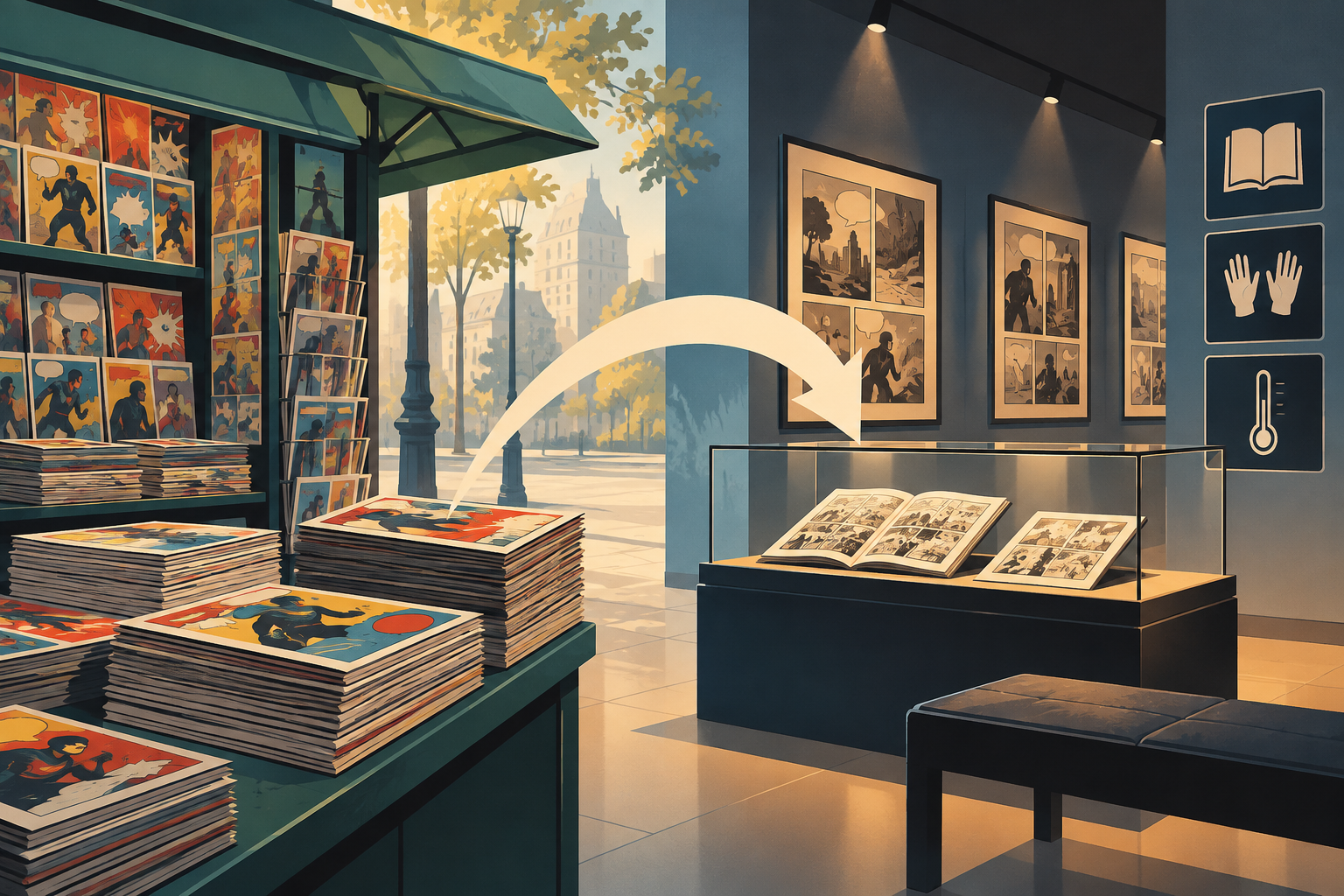
A comic magazine can be viewed as a sequence of stories, but also as an object that circulates, is sold, preserved and later exhibited. The evidence gathered for this proposal supports that change of perspective in Spain: a piece about Spanish comic magazines of the 1970s and 1980s describes a shift in the places from which comics are seen, read and remembered. Its title sums up the movement as a journey “from newsstand to museum.”
The idea is useful, but its limits matter. The material available does not specify which magazines made that journey, when they stopped being sold at newsstands, or how their readership changed. This analysis therefore focuses on what the evidence does support: the places and frames through which magazines can be interpreted.
The newsstand: circulation before canon
The newsstand is a point of departure here, not a complete reconstruction of magazine sales. The RetroPause article identifies it as one of the settings from which comics were seen and read, and connects that setting with Spanish magazines of the 1970s and 1980s. The supplied source gives no distribution figures, publication frequency or masthead names, so it would be inappropriate to turn the reference into a detailed account of the market.
Even so, “newsstand” helps distinguish a reading experience associated with everyday circulation from a later one shaped by selection and preservation. That is an interpretation of the frame proposed by the source, not independent evidence about every reader’s habits. The publication is linked to a place of access; it is not established that all readers obtained it there or that the newsstand was the only channel.
An exhibition changes the distance
An exhibition introduces another way of encountering comics. An academic article on the history and global context of comic exhibitions notes that they have a history that may seem more recent than it is. Its abstract also mentions the exhibition Bande Dessinée et Figuration Narrative. This reference supports the point that comic exhibitions should not automatically be treated as a new phenomenon, but the available excerpt is not enough to provide a broad chronology.
An exhibition also changes the reader’s position: the encounter is no longer only about following a printed story, but about observing how comics are presented as cultural objects. This is an editorial reading of the exhibition framework, not a description of a particular show. Other search results mention comic exhibitions and a show about twenty years of Injuve comics; their brief descriptions do not support claims about their installation or reception.
Format is part of the reading experience
The medium matters because it shapes how comics are arranged and encountered. An academic article by Rubén Varillas puts format at the centre of its subject and lists comic magazines, fanzines, mini-comics, albums and graphic novels. The supplied record identifies the article and its topic, but does not include its full argument; more specific conclusions should not be attributed to it.
At the basic level supported by the source, the list is enough to remind us that “comics” do not occupy a single publishing container. Comparing formats can help us ask what becomes visible when a collection is arranged, catalogued or exhibited. It does not, by itself, prove that one format is more important, more widely read or better preserved than another. The value of this perspective is that it brings the publication’s material form into the discussion without confusing a bibliographic category with every reader’s experience.
From archive to public memory
A museum or archive can bring a publication into view beyond its initial reading context. The RetroPause source specifically proposes a change in the places from which magazines are seen, read and remembered. The work on exhibitions offers a complementary frame: exhibiting comics has a history and context and is not necessarily a newly invented practice.
But, on the information available, “going to the museum” does not mean that a particular magazine was acquired, exhibited or preserved by a specific institution. Nor can we conclude that the transition erases its commercial or everyday past. An exhibition can open new questions about selection and memory; the supplied material does not document how those questions were resolved in individual cases.
What can be stated
The strongest conclusion is limited and, for that reason, useful: understanding Spanish comic magazines of the 1970s and 1980s requires more than attention to their printed stories. It also matters where they are encountered and under what frames they are remembered. Here, the newsstand, exhibition and archive are perspectives for analysis, not universal stages demonstrated for every publication.
The available sources point to a history of exhibitions and an academic discussion of format, as well as identifying the change in perspective proposed for Spanish magazines. They do not provide a masthead inventory, print-run figures, reader testimony or a detailed chronology. Keeping that boundary visible prevents nostalgia from being used to fill gaps as if it were fact. It also leaves a concrete research route open: tracing, magazine by magazine, which documents can establish circulation, preservation and successive forms of exhibition.
- Decade
- 1980s
- Region
- Spain
- Level
- Introduction
- Entities
- Museum
Sources and references
- El cómic, una cuestión de formatos (2): revistas de cómics, fanzines, mini-cómics, álbumes y novelas gráficasdoi.org · 2026-09-29
- Del quiosco al museo: qué cambió para las revistas de cómic ...www.retropause.com · 2026-09-29
- El cómic español: un recorrido por su historia por Gerardo ...www.youtube.com · 2026-09-29
- Las exposiciones de cómics. Historia y contexto globalerevistas.publicaciones.uah.es · 2026-09-29
- Catálogo de la historia de España a través del cómic (1940 ...www.comares.com · 2026-09-29
- Vista de La historieta española de 1951 a 1970arbor.revistas.csic.es · 2026-09-29