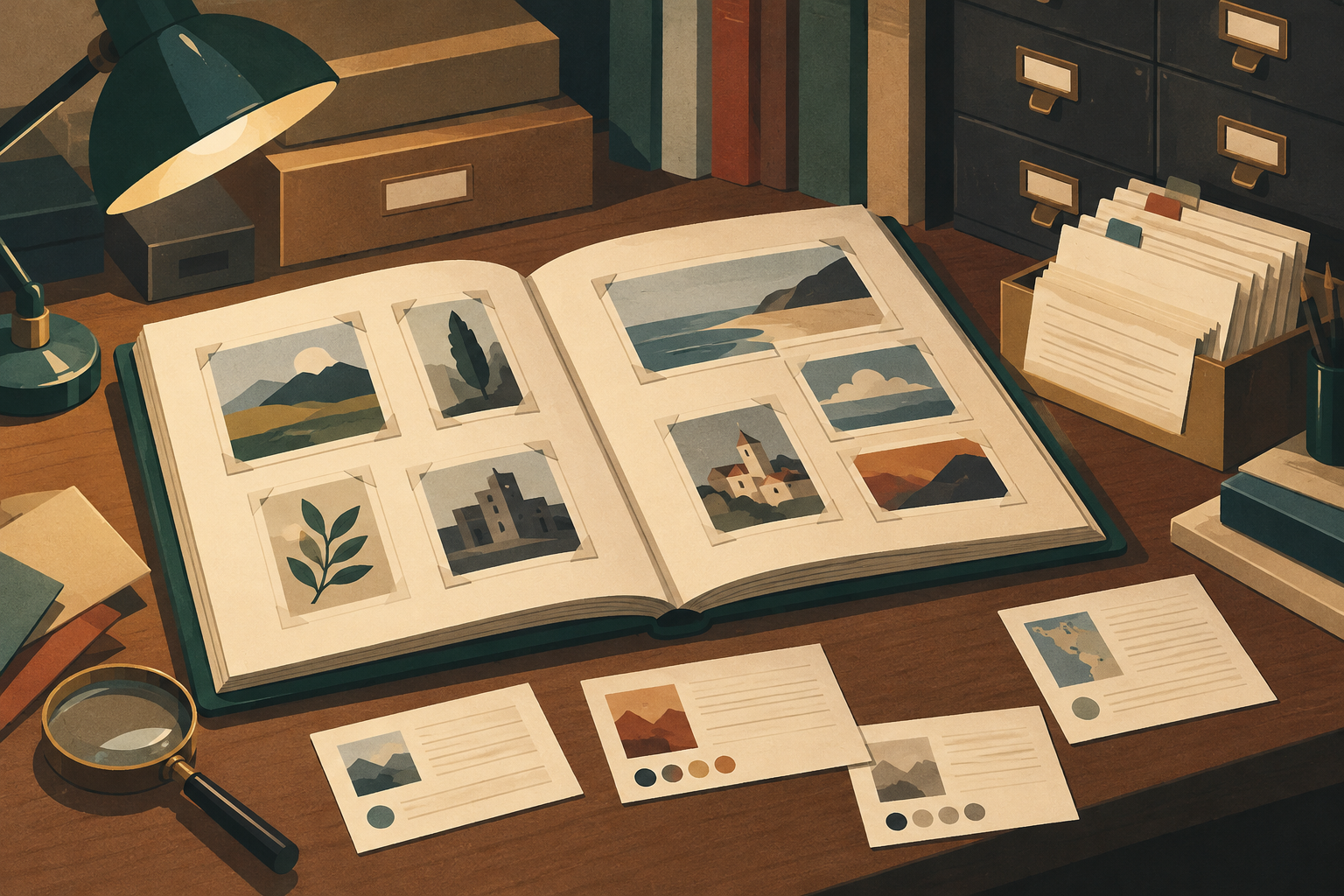
The CER.es record for Historia del Circo is brief, but it helps define what is known about the object and which questions remain open. It lists a sticker album, associates the entry with Rosés and Ediciones Ada, both linked to Barcelona, and places the item at the Museo del Traje in its Archivo de Arte. It also identifies it as “Documento nº 1”. These details help locate and recognize the catalogued object. They do not, however, amount to a complete history.
What the record actually says
The published information describes a specific catalogue entry, not an entire collection. The title given is Historia del Circo; the object type is a sticker album. The record supplies the names Rosés and Ediciones Ada, accompanied by references to Barcelona, and names the Archivo de Arte and Museo del Traje. “Documento nº 1” is another identifier included in the entry. Each detail provides a lead, but each should remain within the limits set by the source.
In particular, the record associates names with the object without explaining the precise role of each. It would therefore be unjustified to turn that association into a more specific attribution. Similarly, placing the item at the Museo del Traje does not explain how it arrived there or what its earlier history was. The catalogue locates the object within an institutional context; it does not provide an object biography.
A record is not an inventory
A catalogue entry organizes information about an object so that it can be identified and consulted. That work matters, but it differs from a comprehensive inventory of a collection, edition or series. The available entry does not specify a date, the total number of stickers, the contents of each page, or whether editions or variants exist. Nor does it describe the album’s physical condition.
The absence of these details does not prove that they cannot be found in other documents or on the object itself. It establishes only a verifiable limit: they are not included in the entry consulted here. This distinction prevents two opposite mistakes. One would be to treat the record as a complete description. The other would be to conclude that anything it omits can never be known. A catalogue is a route into research, not necessarily its final word.
Why names and provenance matter
The title, names associated with the item, city and holding institution can support more focused searches and comparisons if other records are found. That gives a concise entry practical value: it establishes recognizable reference points without claiming more than it documents. It also helps keep identification of the object separate from interpretations that might later be added.
Here, however, provenance has a limited scope. The available record names the institution holding the item; it does not give a sequence of owners, reasons for its acquisition or the circumstances of its arrival. Nor does it, by itself, establish the relationship between all the names it lists. Developing those questions would require additional sources and explicit comparison between them. Until then, the soundest description is also the most restrained: CER.es provides these names and this location as details associated with the entry.
What the entry cannot tell us about use
The record also cannot reconstruct how the stickers were obtained, whether they were traded, or what practices accompanied use of the album. Classifying the object as a sticker album is not, by itself, a description of those practices. Research into circulation and exchange would require further evidence, such as attributable testimony, distribution documents or related objects that could be compared. None of these appears in the information available here.
This limitation matters because a preserved and catalogued object can invite a story about shared experience that the entry does not document. Such experience could be a legitimate research question, but it is not a conclusion supported by this record. Keeping evidence and hypothesis distinct does not diminish the album’s cultural interest. It clarifies what further material would be needed to understand it better.
Identification is the beginning
The Historia del Circo entry offers neither a monetary valuation nor a general history of sticker albums. Its contribution is more specific: it identifies an item and preserves descriptive information that can guide further searches. Its title, associated names, references to Barcelona and institutional location are a starting point, not a complete account of production, circulation, reception or variants.
For researchers and collectors, that distinction is useful. It makes it possible to cite the record accurately, recognize which details are documented and avoid filling gaps with assumptions. An entry can be small and still matter: its value does not depend on answering every question, but on making certain information accessible and showing where further work begins. Here the concrete conclusion is straightforward: CER.es helps identify the album; understanding its history will require other evidence.
- Decade
- Contemporary
- Region
- Spain
- Level
- Introduction
- Entities
- Museo del Traje
Sources and references
- CER.es Colecciones en Red - Resultados de la búsquedaceres.mcu.es · 2026-10-10
- Una historia de cromos - Pixartprintingwww.pixartprinting.es · 2026-10-10
- Del envoltorio al álbum: cómo los cromos se hicieron ...www.retropause.com · 2026-10-10
- Cromos y coleccionables Paniniwww.panini.es · 2026-10-10
- Colecciones de cromos míticas de la historia de Españawww.imprentaonline.net · 2026-10-10