A record is not the whole collection
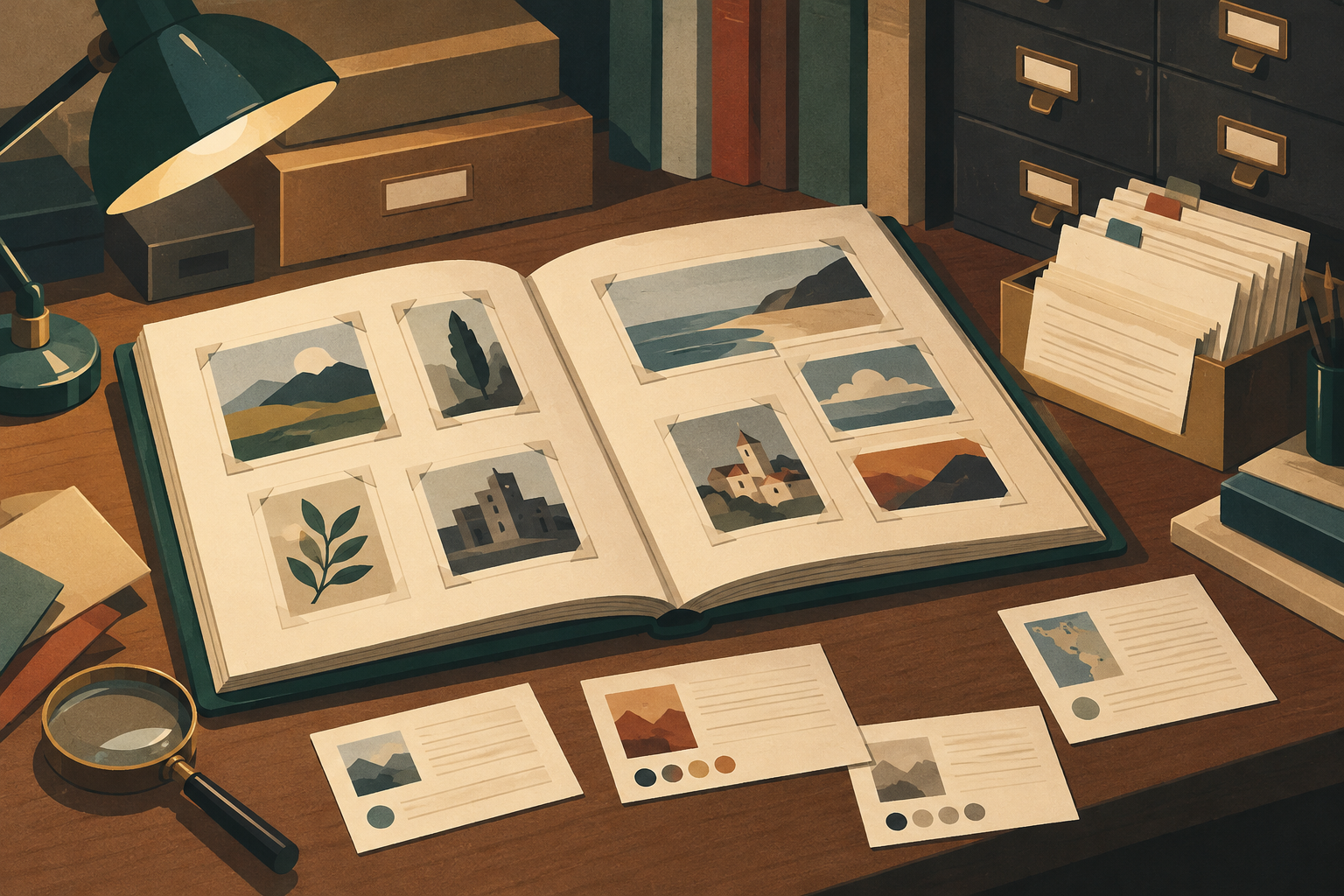
A sticker album can be read both as a physical object and as a structure for arranging images. But identifying a particular item requires separating what the album shows from what a catalogue states. CER.es describes itself as a collective online catalogue bringing together information and images for a selection of cultural objects. It is a research gateway, not a guarantee that every object or variant is represented.
That distinction matters. A record helps locate an object and compare information; on its own, it does not prove how many copies circulated, how a series was completed, or what exchanges accompanied its use. Further sources would be needed to support those claims, and they are not present in the material available here.
An identifiable CER.es record
A search for “Álbum de cromos” on CER.es returns a record titled “Colección Zoológica,” dated 1907 and associated with the reign of Alfonso XIII. The entry also gives “Documento nº 7” and names the Museo Pedagógico as the museum. This is a concrete basis for discussing that record: it identifies the title, the date as catalogued, and the institution specified.
Its scope should remain limited. The record does not establish that all sticker albums from that period were alike, nor can it reconstruct the experience of the people who collected them. It also provides no basis for inferring print runs, prices, or popularity. A catalogue description is evidence about a recorded object, not a complete history of the practice.
Archives alongside objects
Museum documentation can extend the reading, although it does not replace consulting the object itself. Spain’s Ministry of Culture describes state museum archives as holding documentation relating to the objects in their care from the time of deposit. The National Archaeological Museum’s Historical Archive, in turn, presents itself as a research source for the museum’s departments and for external researchers.
These references suggest a research path: consult an object record and, where relevant and available, look for associated documentation. They do not establish that a specific file exists for the 1907 album cited here, or that every museum preserves the same kinds of records. Availability must be checked case by case.
Images as an identification tool
Ibermuseos’ visual documentation protocol explains that photographic records of collections serve to identify their objects. When studying stickers and albums, images can help compare visible features of an item with its catalogue record. A photograph, however, does not automatically answer questions about variants, incomplete sequences, provenance, or exchange practices.
A sound comparison would require specifying which feature is being examined and which sources describe it. The available material supports the identification role of visual documentation in museums, but it does not provide a specialist method for classifying stickers or a list of variants for “Colección Zoológica.” Claiming otherwise would go beyond the evidence.
From an item to collecting context
The Museo del Álbum de Cromos Villa de Estadilla (MACVE) states that its aim is to exhibit a century of albums, beginning in 1900, and locates its space in premises at the Espacio Cultural Buñero, made available by Estadilla Town Council. This provides an institutional context for studying albums as a group rather than only as isolated examples.
A museum devoted to albums invites useful questions: how are items grouped, what identification criteria are used, and what documentation accompanies each one? The available source does not give those answers, so it would be inappropriate to attribute to the museum a specific catalogue of series or variants. Those questions remain open to direct enquiry and examination of its materials.
What a catalogue can establish
A useful starting point combines identification, images, and linked documentation where available. Here, CER.es supplies a specific 1907 record; museum archive pages explain that documentary holdings related to objects exist; and Ibermuseos identifies a role for collection photography. MACVE offers a context devoted to albums.
Together, these sources support a limited but useful conclusion: catalogues help identify and compare objects, while the history of a series and its exchange practices requires further evidence. A record should not be turned into a valuation, nor should a description be treated as proof of circulation. Keeping catalogue data distinct from interpretation does not diminish collecting; it makes its archive easier to read.
- Decade
- Contemporary
- Region
- Spain
- Level
- Introduction
- Entities
- Museum, Museo Arqueológico Nacional, Museo del Álbum de Cromos Villa de Estadilla
Sources and references
- CER.es Colecciones en Red - Ministerio de Culturaceres.mcu.es · 2026-10-09
- Archivo histórico - | Ministerio de Culturawww.man.es · 2026-10-09
- ARCHIVOS DE LOS MUSEOS ESTATALESwww.cultura.gob.es · 2026-10-09
- protocolo-documentacion-visual.pdfwww.ibermuseos.org · 2026-10-09
- MACVE. Museo del Álbum de Cromos Villa de Estadillaculturadearagon.es · 2026-10-09
- CER.es Colecciones en Red - Resultados de la búsquedaceres.mcu.es · 2026-10-09