Food does not arrive on its own
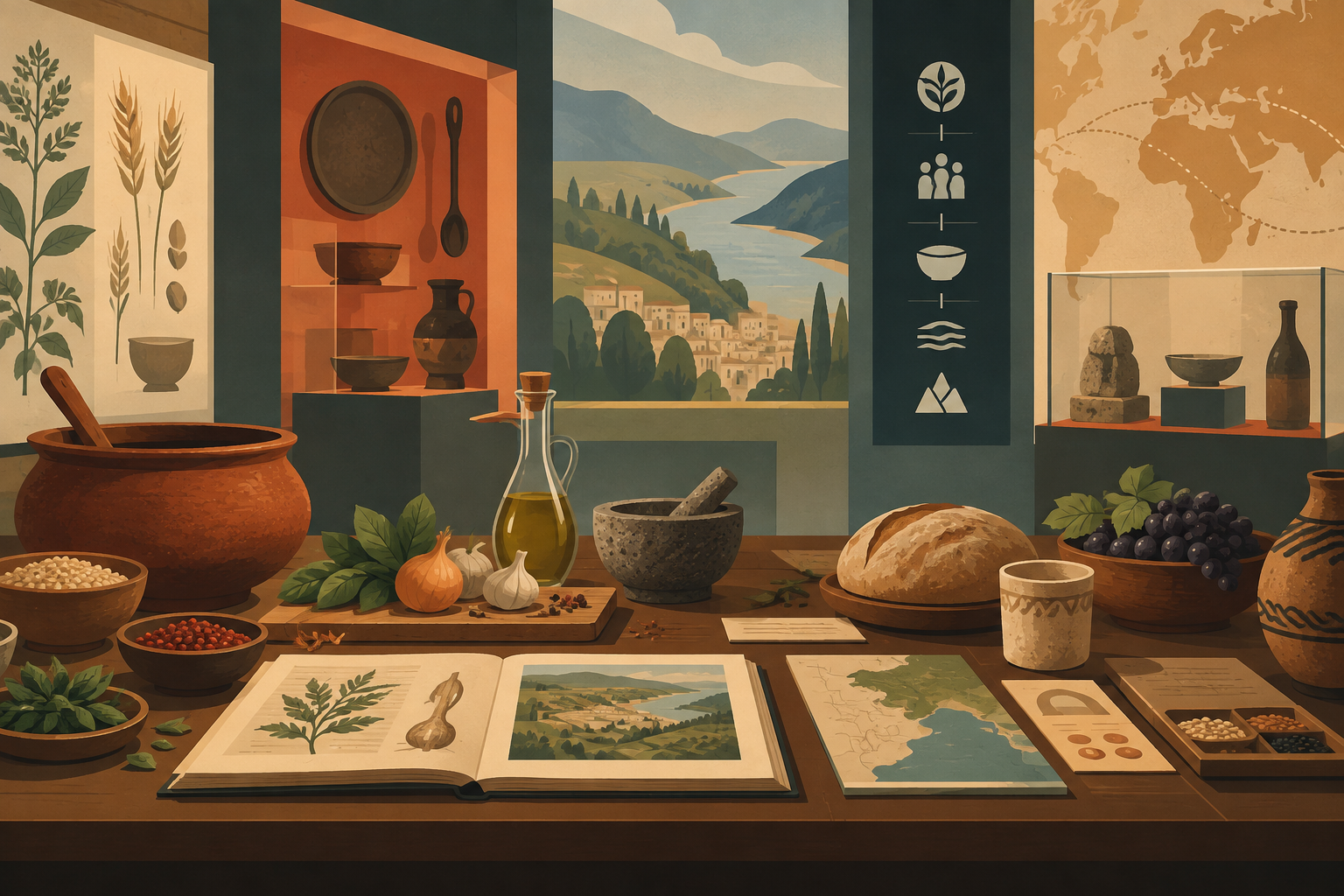
An exhibited food can seem self-contained: visible, removed from the kitchen and the moment of consumption. Yet Mexico’s Directorate General of the Agro-Food and Fisheries Information Service describes food heritage as including food, cooking and drink. That breadth changes the curatorial question. It is not enough to identify what people ate; how it was obtained, prepared and shared also matters, when there is evidence to document those practices.
An exhibition should therefore avoid turning a complex custom into an isolated object. An artefact, recipe or image can provide an entry point, but its meaning depends on cultural and territorial relationships. This is an interpretive principle, not a claim that every museum necessarily holds all those kinds of material.
From objects to practices
EVE’s discussion of museology and gastronomy emphasizes that food relates to cultural, social and personal norms. It also recommends beginning with a museum’s own collection and community before seeking broader contextual resources. That suggests a careful method: first establish what the institution actually holds and what its community can explain; then add context without presenting a general account as though it applied equally to everyone.
Food can connect individual experiences with collective identities, but that connection needs care. An exhibition should distinguish between a documented practice, a situated testimony and an editorial interpretation. Where information is missing, acknowledging the gap is more responsible than filling it with a persuasive nostalgic scene.
Museums and food heritage
A thesis from the Universitat Politècnica de València examines food museums in Spain. It says its study covers close to 85% of the museums it identified, numbering 209, while also noting that other places call themselves museums. That qualification matters: it describes the scope claimed by the study, not a definitive, universal census.
The Mexican government source describes museological interest in communicating the biocultural heritage of territories and countries. Read together, the sources suggest that food museums are not simply collections of culinary objects: they also raise questions about territory, representation and public communication. This is an interpretation of the evidence, not a complete taxonomy of institutions.
Preserving what does not fit in a display case
A catalogue for a 1987 exhibition at Spain’s National Museum of Ethnology concerns the conservation and restoration of ethnographic collections. Although the catalogue record is not specifically about food, it is a reminder that material conservation is part of museum work. In food heritage, the sources assembled here also allow us to discuss practices and knowledge as dimensions of heritage. They do not, however, provide a detailed technical protocol for preserving particular foods, packages or utensils.
The Food Cultura archive, belonging to an organization devoted to food culture through art and research, is another indication that the subject can be approached beyond a conventional gallery. The supplied information does not describe its holdings, individual projects or methods, so no specific practice should be attributed to it here. It does establish the existence of initiatives connecting food culture, art and research.
Communicating without pretending every question is settled
The National Archaeological Museum’s lecture series, “From the Neanderthal to the Supermarket: Diet and Cultural Evolution,” proposes a broad route from prehistory to present-day eating. Its description says eating nourishes the body and society. As a public programme, it illustrates one way to make food a subject of historical discussion; the listing alone cannot verify every claim that might be made about the programme’s subject matter.
A museum can help visitors examine how an account is built: which objects were chosen, whose voices are present, what context is supplied and what limits are acknowledged. The available sources do not establish one correct model for a food museum. They do, however, point to the value of relating collections, communities and context without confusing a compelling interpretation with a universal truth.
Everyday heritage needs context
Food seems familiar because it is part of daily life. That is precisely why exhibiting it requires more than evocation. Recipes, objects, drinks and practices gain meaning when their connections to people and places are explained, with sources and limits made clear.
The references available here cannot support a complete history of sweets, brands or specific habits, and inventing one would be misleading. They do support a narrower conclusion: food heritage is a museological field combining material elements and cultural dimensions, and its interpretation is more rigorous when it begins with what a collection and its community can demonstrate.
- Decade
- Contemporary
- Region
- Spain
- Level
- Enthusiast
- Entities
- Museum, Museo Arqueológico Nacional
Sources and references
- El patrimonio alimentario que incluye alimentos, cocina y bebidas se convirtió a partir de este siglo en una importante temática museológica | Dirección General del Servicio de Información Agroalimentaria y Pesquera | Gobierno | gob.mxwww.gob.mx · 2026-09-28
- Museos, Interpretación y Gastronomía – EVE Museos + Innovaciónevemuseografia.com · 2026-09-28
- Directora Nuria Ramón Marqués Septiembre de 2021 Gerardo Jesús García Olivaresriunet.upv.es · 2026-09-28
- Conservación y restauración del material etnográfico. Museo Nacional de Etnología. - Ministerio de Culturalibreria.cultura.gob.es · 2026-09-28
- Archivowww.foodcultura.org · 2026-09-28
- Del neandertal al supermercado. Dieta y evolución cultural - | Ministerio de Culturawww.man.es · 2026-09-28