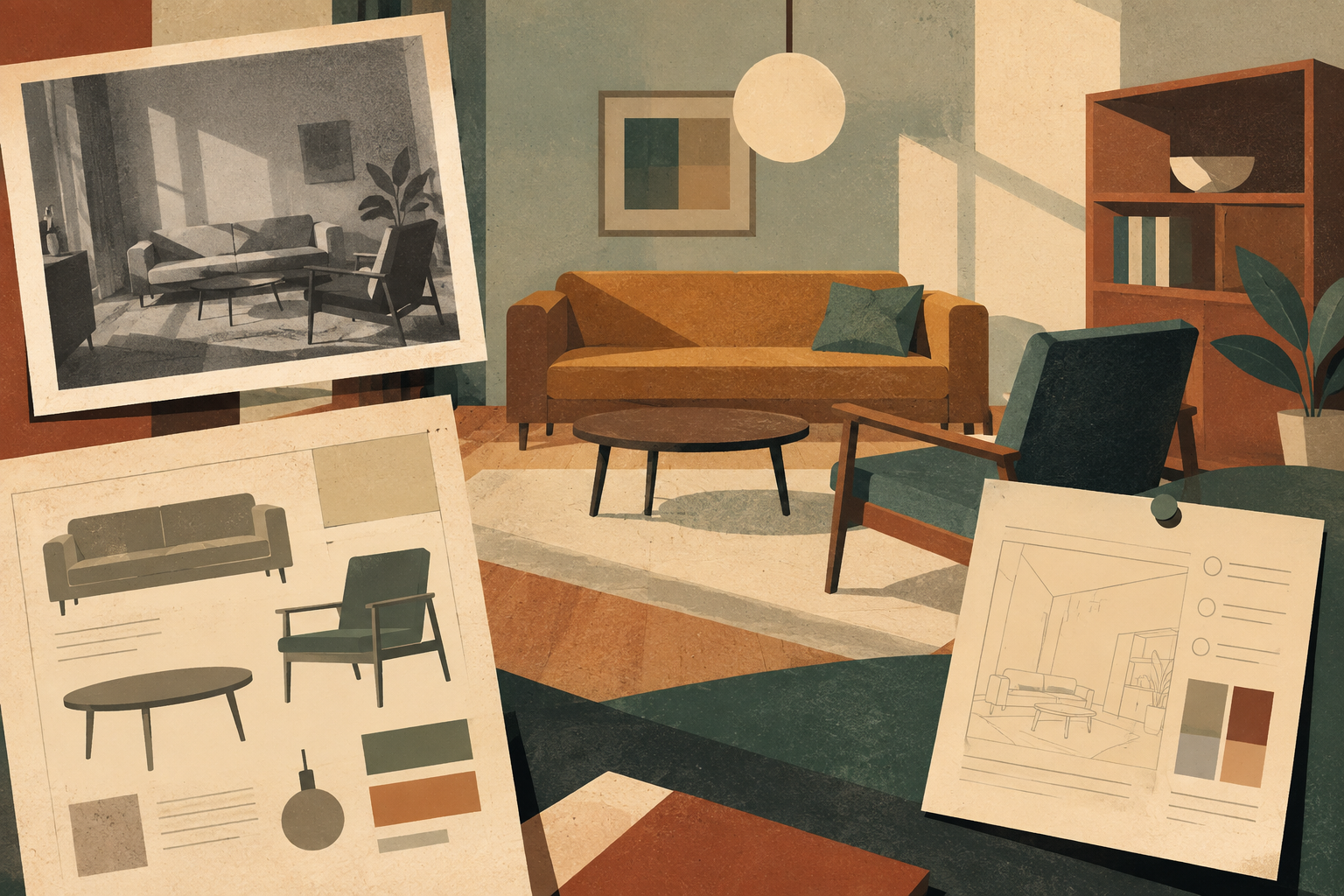
A photograph of a room seems to offer an immediate answer: here are the furniture, its arrangement and the objects someone chose to leave in view. But an image is not a complete description of a home or of the people who lived in it. A catalogue may add names, forms or production context; by itself, it does not prove that an object was in that room. Reconstructing an interior means bringing sources together without asking them to say more than they can support.
Treat the interior as a question, not a backdrop
Start by specifying what you want to know. How was the furniture arranged? Which objects appear, and which fall outside the frame? Does the image show a lived-in home, a space prepared for photography, or a scene whose purpose is unknown? These questions keep an evocative image from becoming a sweeping description of an era.
The editorial scope here is deliberately domestic: the focus is the home and the coexistence of aesthetic choices and practical needs. Yet it is not enough to assign an everyday function to everything visible. A photographed table does not establish who used it, how often, or for what purpose. Composition tells us what is shown; use requires further evidence.
What each source can contribute
Photographs let us observe spatial relationships visible in a particular view: what sits next to what, what occupies the centre and what remains at the edges. They also record choices of framing and presentation. It helps to describe an image before interpreting it: note clearly visible elements, their relative positions and any identifying information supplied with the image.
Catalogues can provide vocabulary and context for identifying furniture, objects or design languages. The bulletin of the National Museum of Decorative Arts, for example, refers to a room devoted to the history of furniture design and to chairs considered representative of that history. This can guide research into how design is arranged and communicated; it does not establish that those pieces belonged to a particular home.
Museums and corporate archives offer another route. The reference on the Alessi archive says it holds documents relating to the history of the brand and Italian design. Information about the Kartell Museum Foundation dates its creation to 1999, on the company’s fiftieth anniversary. These are examples of institutional resources that can help frame questions about objects and production. On their own, they are not evidence of domestic use.
From object to use: the inference that needs support
Identifying an object does not automatically explain its place in a room. A well-supported reconstruction needs connections: an adequately identified image, documentation linked to the object, or sources that locate the space and its users. If those connections are not present in the available evidence, the conclusion should remain open.
We must also distinguish between a represented space and a lived one. A photograph selects a viewpoint; a catalogue selects and arranges products; a corporate archive preserves documents from an institutional perspective. Each source has a purpose and its own exclusions. Comparing materials can help reveal them, but it cannot erase silences.
Academic research on the National Museum of Decorative Arts can provide context for studying the institution and its collections. A survey of textile museums and archives points to another possible family of documentary resources. These materials can guide research and analysis; the references available here are not enough to reconstruct a particular home or attribute specific practices to its inhabitants.
A reading that keeps its limits visible
A working record can separate three levels: what is visible; what a source explicitly identifies; and what the researcher interprets. Describing where a chair stands is different from identifying its model, and both differ from inferring who sat there. Keeping these categories apart makes an account easier to verify and revise when new sources emerge.
An object’s absence from an image does not prove it was absent from the home. It may be outside the frame, have been removed, or have been irrelevant to the image-maker. Likewise, a catalogue documents its own contents, not necessarily a purchase or an object’s presence in a home. Stating these limits does not weaken the history; it prevents interpretation from masquerading as fact.
Reconstruct without filling in the gaps
Photographs, catalogues, museum publications and corporate archives offer different starting points for studying interiors and their objects. Their value depends on bringing them together carefully and checking which claims they actually support. An image may describe a visible arrangement; a catalogue may help identify or contextualise; an archive may provide documents about a company or collection. None should be made to carry the whole history of a home alone.
A responsible reconstruction does not try to make an interior look complete. It shows what is known, where that knowledge comes from and where unanswered questions begin. In this way, decoration is studied not as a neutral backdrop, but as a material arrangement that sources allow us to observe only in part.
- Decade
- Contemporary
- Region
- Spain
- Level
- Enthusiast
- Entities
- Museum, Museo Nacional de Artes Decorativas
Sources and references
- Los Museos de Empresasevemuseografia.com · 2026-10-04
- Cuando la decoración también fue industria - RetroPausewww.retropause.com · 2026-10-04
- boletín del museo nacional de artes decorativaswww.cultura.gob.es · 2026-10-04
- Museos y archivos textiles en el mundo para inspiración de ...pinkermoda.com · 2026-10-04
- TEXTO Y CONTEXTO. EL MUSEO NACIONAL DE ARTES ...revistas.uned.es · 2026-10-04
- Museowww.kartell.com · 2026-10-04