The vehicle and what surrounds it
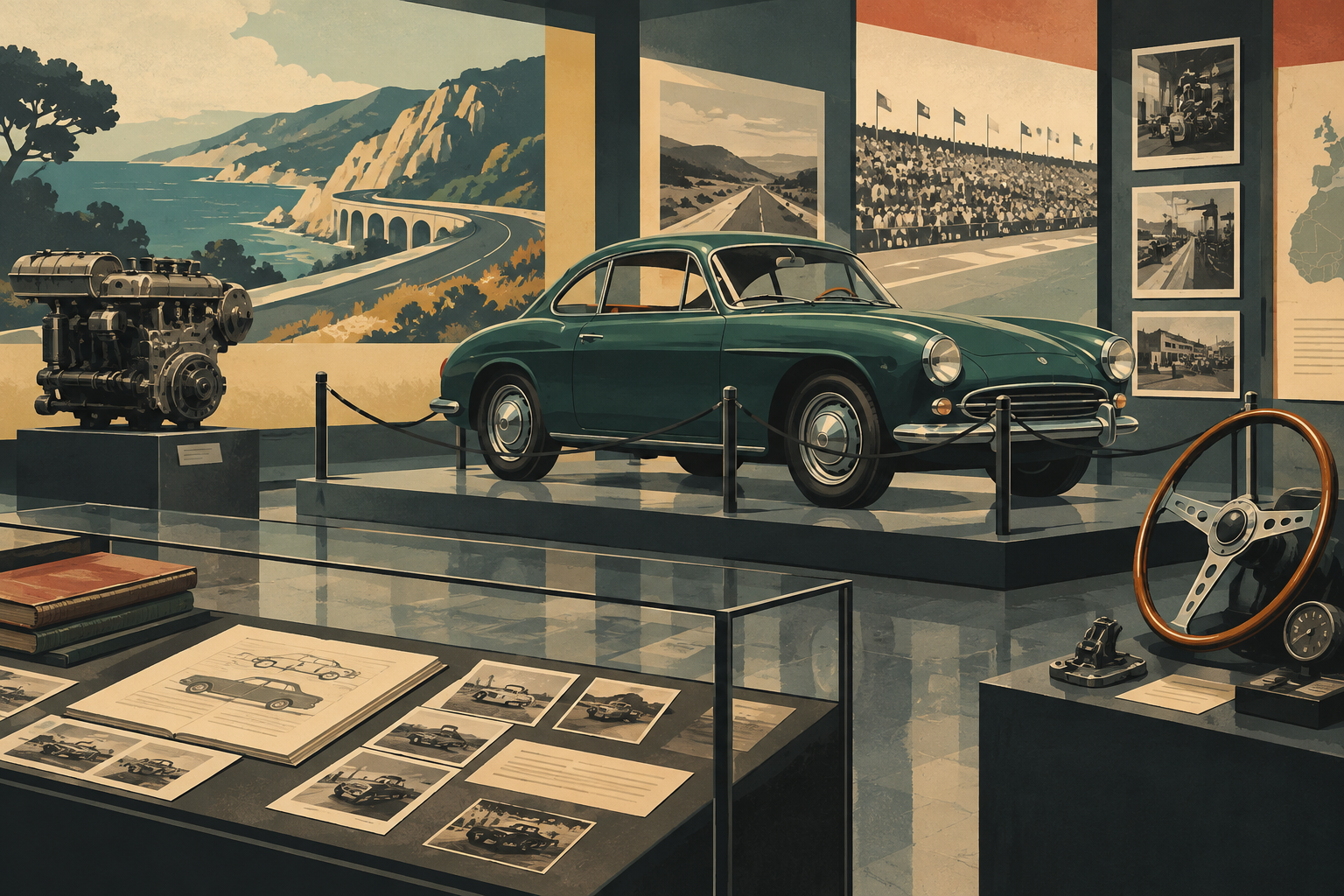
A preserved car can seem to offer a complete story: it is present, occupies space and invites us to inspect its shape. Yet the material object cannot explain by itself who used it, what route it followed or why it entered a collection. Those questions require evidence. The material supplied for this subject supports a more cautious point: motor museums may preserve vehicles alongside engines, chassis, manuals and other materials. Each kind of object can open a different line of research, but none gives permission to fill in what is undocumented.
The distinction matters because an exhibition and an archive do not do exactly the same work. The vehicle may be the visible focus; documents and records can help organize information about the collection and its context. RetroPause’s article on automotive conservation advances just this perspective: the car as archive, not as a metaphor that makes the vehicle a self-sufficient document, but as an invitation to consider the holdings that accompany it.
The collection as a whole
The Archive of the Museum of Automotive History in Salamanca is identified in Spain’s Censo-Guía de Archivos as part of the institution that holds its archival collections. This establishes the presence of a specialized archive within a particular museum, although the supplied extract does not describe its documentary series or the contents of individual files. That boundary should be respected: the institution’s custody of an archive is supported; claims about the specific information held for each object would require its inventories or records.
The Salamanca Tourist Office describes the Gómez Planche Collection, in the supplied text, as comprising more than one hundred vehicles and thousands of parts, accessories and objects. This is useful evidence of a collection’s varied nature, not a complete catalogue. It also shows why reducing a museum to its most striking cars may obscure other material of interest. It does not, however, establish a date, provenance or individual history for every object mentioned.
What documentary work contributes
The academic article “The Archive in Science and Technology Museums,” published in Tábula, presents records management as part of museum work and says it can organize cultural activities and exhibitions. Its available summary connects this work with the transformation of vehicles into heritage. This offers a framework for thinking about the relationship between preservation and public interpretation, rather than a detailed account of any particular museum’s procedures.
Editorially, this caution is useful. A displayed vehicle can prompt questions about design, use or circulation, but only answers supported by identifiable documentation should be presented as facts. Where information is missing, it is better to say so than to turn a possibility into a persuasive biography. Archives do not remove gaps: they help identify them, find relevant sources and explain why a claim has limited scope.
Institutions and their narratives
The Museum of Automotive and History says its aim is to present motoring and history, especially that of the twentieth century, through historical, cultural and economic milestones. This institutional statement confirms an intention to connect vehicles with broader frameworks. The Costa Blanca Motor Museum’s website, in turn, describes itself as a journey through the history of motoring and the automobile, including classic cars and vehicles associated with film. These are museums’ own descriptions: they help explain how the institutions present themselves, but do not replace independent research into their collections.
This points to an important distinction. A museum may propose an interpretation; the available records and objects provide material that can support or qualify it. Visitors see a selection, not necessarily the full holdings. It is therefore useful when a presentation explains what is preserved, what is on display and what documentation supports the context offered. The supplied sources do not allow us to assess how each institution handles these matters in its galleries, so a closer comparison would require consulting its catalogues and exhibitions.
A history with visible limits
Telling the history of motoring through a museum is not simply a matter of arranging vehicles by appearance or age. It also means making the relationship between objects, associated components and preserved documents intelligible. The evidence gathered here supports the existence of archives and collections connected with motor museums and offers examples of how some institutions describe their aims. It is not enough to reconstruct individual cars’ histories or establish which documents accompany each one.
That limit need not diminish a visit. It can make it more rigorous: a car is a starting point, not a witness that speaks without mediation. When an account distinguishes what the object shows, what the archive documents and what the institution interprets, visitors can better understand how knowledge is made. A preserved car gains context precisely when we do not ask it to tell, by itself, more than the sources allow us to know.
- Decade
- 2000s
- Region
- Spain
- Level
- Introduction
- Entities
- Museum
Sources and references
- archivo de la fundación gómez planche (salamanca, españa)censoarchivos.cultura.gob.es · 2026-09-29
- El automóvil como archivo: qué conservan los museos del motorwww.retropause.com · 2026-09-29
- El archivo en los museos de ciencias y tecnologías | Tábulapublicaciones.acal.es · 2026-09-29
- MAHI Museo de Automoción e Historiamuseo-mahi.com · 2026-09-29
- Museo del Motor - Costa Blancawww.museodelmotor.com · 2026-09-29